To my valued free subscribers: The Hale China Report is generally paid subscription content. Hale Report podcasts are always free, and the EconVue newsletter is often sent to everyone on my list. Since I have had a number of individual requests to see this particular China Report, I decided to send it to everyone. I do hope however that you will choose to support EconVue+ and my work by becoming a paid subscriber. I know there are many places to find news on China today. I try to present nuanced, balanced analysis that is useful to decision makers. Details, as well as the full version of Paper Tiger below. Comments are open to all, and are much appreciated! I first visited China in 1979, nearly 44 years ago. Although I have done many things that did not involve China over this span of decades, the country runs through my life like a silver thread, sometimes hidden below the surface of its fabric, but somehow always reappearing. In those halcyon days, I hardly thought that China could be considered a “strategic competitor” nor an enemy of the United States. It seemed like the beginning of a golden partnership. In some ways I suppose I am a child of the US-China relationship. The recent negative turn of events has been painful, like watching two parents who used to love each other bicker and fight to the tune of constantly escalating bitterness. In this instance it is not just the family which suffers emotionally and financially, but the entire world. The Global South resents having to chose and is becoming more vocal about it. According to Bloomberg:
The relationship Richard Nixon renewed was by and large a fruitful one, not just for the Americans who enjoyed reduced inflation and many other benefits of the China trade, but also for the many millions of Chinese and the people of other Asian nations who escaped poverty and connected with the rest of the world after the Vietnam War. There were losers to be sure, including American factory workers. The Chinese environment: air, soil and water, was spectacularly damaged by industrial activity to produce products for export. Today, American factories cannot find enough workers, and in spite of politicians calling for the reshoring of jobs from China, we really don’t need them now. In a stunning reversal, about a quarter of young Chinese cannot find jobs. This employment malaise says something about the youth of both countries who have lost their most precious possession, a vision for their future. Xi Jinping reacted yesterday in the People’s Daily by telling Chinese young people to “eat bitterness” not once but five times. His exhortations are as likely to be successful as telling a depressed patient to buck up. The children of this divorce will surely suffer, as the world becomes inexorably older.
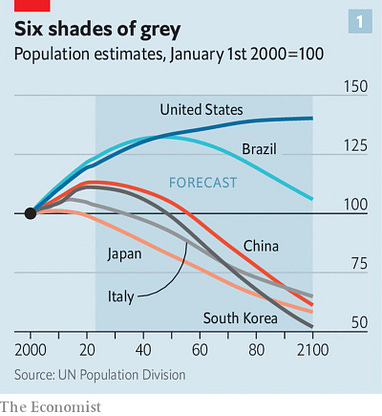
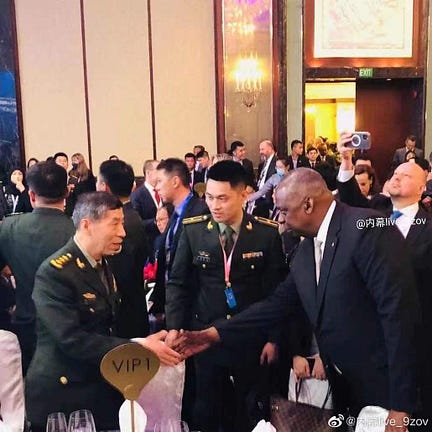
Few realize that by the end of this century America’s population could exceed China’s. The rate of population decline matters in terms of GDP growth. In general, we overestimate China’s resources and economic strength. As I have been saying for many months now, the country is not going to recover from the Zero-Covid lockdowns quickly, or perhaps ever. Closing down a resilient economy for weeks is one thing, but closing down a planned economy for years is another. It is clear that Chinese consumption has already flattened out this year, and that China has gone back to its old ways of depending upon export-driven growth. This was okay when the rest of the world was growing, which it is not right now. The US has responded with the weakest of all economic policy choices, sanctions. In the latest episode of this saga, other than a quick handshake, the two largest military powers failed to engage at the Shangri-La Dialogues in Singapore. The Chinese side refused to meet with US Defence Secretary Lloyd Austin on the understandable grounds that the US government had sanctioned his counterpart, China's Defense Minister Li Shangfu. The Chinese government is reacting more and more to these actions with silence, which is the worst and most dangerous of all possible outcomes. Better for both parties to be screaming at each other at the top of their lungs.
Now that focusing on China is no longer seen as such a great career path, the number of American students has fallen from 15,000 not long ago to only about 300. Meanwhile, 300,000 Chinese students are studying in this country. Where will our future expertise be found? China cannot be erased, nor its opening up put back in a bottle. So the method of attack has been changed to focus on technology. Two things are true here: China has been an incredible innovation partner for US companies such as Apple, contributing far more to product development than has been recognized. And secondly, without this interaction with the US in terms of both money and knowledge, China will falter. The structure of China’s economy is antithetical to innovation. The Chinese tech sector is in the process of moving to state ownership, a fact recognized by investors who have steadily pulled out of Chinese equity markets. I was asked recently if I thought that as a result of my dismal view of China’s economy, which unlike Japan’s, will get very very old before it becomes rich, if it is worthwhile to build US industrial and defense strategy around competing with China. Obviously, I do not. It is in fact a huge mistake, a great power strategic error. There are signs that the Biden Administration is realizing this. According to a scoop in the Financial Times, CIA chief Bill Burns made a secret trip to Beijing to try to ease strained relations. We did not overreact to the balloon incident. Even the non-transparent economic figures coming out of Beijing tell the tale of a nation that despite its bellicosity is struggling to revive its key industries as well as consumer confidence. US businesses, while not increasing their investments, are not pulling out either, because they can’t. Jamie Dimon and Elon Musk met with more high-level officials in China last week than the US government has in many months. On the receiving end of reaction to US policies, US Ambassador Nicholas Burns has not yet met with high-level economic policymakers in China. So American businessmen have to forge ahead on their own. I am not sanguine about China’s ability to pivot and return to its former open door policy. On the 34th anniversary of the June 4th demonstrations in Tiananmen Square, Sinocism publisher Bill Bishop, as a student in Beijing at time, wrote: One of the biggest lessons for 1989 is never underestimate what the Party will do when it feels threatened. Sounds obvious I know, but it seems like a lesson each generation needs to relearn. The CCP has the potential to be much more of a threat to its own people than it is to the US or any other foreign country. A weak China however is a threat to everyone. It could be that someday Xi Jinping will be considered historically just as Herbert Hoover is today, linked fairly or unfairly to national economic decline. So is China a paper tiger? Where did the phrase come from? According to Ben Zimmer in the Wall Street Journal:
As in any marriage, once the word divorce is uttered, things can never be the same again. But reconciliation is possible if both parties come to the understanding that separately they will not be as successful as they are together. I hope that day is coming soon.
|
Paper Tiger 纸老虎 (full version)
15:30
0