Thanks for signing up for DividendStocks.com! It's the daily newsletter built for dividend and income investors. Before we can begin sending your daily updates, there’s one quick step left. Please confirm your subscription using the link below so our emails reach your inbox. Click Here to Confirm Your Subscription to DividendStocks.com Here’s a small glimpse of what you’ll get access to: Dividend Stock Ideas — Each newsletter features dividend stocks with high yields, sustainable payouts, and strong growth potential. Ex-Dividend Stocks — Want to capture upcoming dividend payouts? Find out which stocks are going ex-dividend this week. Market News and Events — Stay in the loop on the latest developments impacting popular dividend names like AT&T, Exxon Mobil, IBM, Procter & Gamble, and Verizon. Bonus: As a thank-you for confirming, you’ll also receive a free PDF copy of Automatic Income, our popular guide to building wealth through dividend investing. Let’s get your dividend journey started! Discover Top Income-Generating Stocks Here See you in your inbox soon,
The DividendStocks.com Team P.S. Don’t miss out click here to verify your subscription and secure your daily dividend insights and your free investing guide!
Exclusive Article WD-40 Stock Sank After Earnings—Here Are 5 Reasons Bulls Aren't WorriedWritten by Thomas Hughes. Publication Date: 1/12/2026. 
Quick Look - WD-40 is trading near long-term lows, setting for a rebound that can deliver a high-double-digit total return within years.
- Q1 softness is tied to distributor order timing, not end-market weakness, and long-term forecasts were reaffirmed.
- Capital returns underpin the outlook, including the dividend and share buybacks.
WD-40’s (NASDAQ: WDFC) fiscal Q1 2026 earnings report prompted a market sell-off. That decline, however, created a buying opportunity that many total-return investors prize. Warren Buffett is sitting on $344 billion, the biggest cash position of his career. Meanwhile, CEOs behind America's most powerful tech companies are selling billions in shares even as Wall Street tells everyday investors to buy the AI dip. After 46 years tracking institutional money flows, one pattern stands out: money is leaving crowded AI trades and flooding into an ignored corner of the market. The reason is power. A single AI data center uses as much electricity as a small city, and the grid can't handle what's coming. Institutions are quietly loading up on companies upgrading America's power backbone. See the stocks flagged to lead the next leg of this market. Although the stock is well off its highs, it remains consistent with long-term trends, implying meaningful upside potential and a steady dividend. Despite Q1 results missing analyst expectations, WD-40’s long-term setup remains intact—and five fundamentals explain why the sell-off may offer a compelling entry point. 1. Revenue Growth Is Still Intact The WD-40 report failed to spark a rally because reported growth missed expectations. At $154.4 million, revenue rose less than 1%, driven mainly by foreign-exchange translation. On an FX-neutral basis, revenue fell more than 2%, but the underlying details are more encouraging. Importantly, growth exists: timing of distributor orders weighed on results while direct-market sales rose a robust 8%, led by the Americas and EIMEA regions and strength in the Specialty products segment. Management expects the indirect-market softness to normalize as the year progresses. 2. Gross Margin Expansion Signals Operating Leverage Timing-related weakness appears to be the main reason for the disappointing headline numbers, yet profitability improved. Gross margin widened by 140 basis points, positioning the company for earnings upside as revenue leverage returns. The roughly 10% increase in SG&A was tied to non-recurring items and had limited impact on cash flow. Free cash flow margin remained at about 17.5%, supporting continued capital returns, including dividends and share repurchases. 3. WD-40 Reaffirms Fiscal 2026 Guidance and Long-Term Outlook Despite a weak Q1, the company reaffirmed its full-year guidance and indicated it expects results toward the high end of the range. WD-40 forecasts revenue growth of 5%–9% for fiscal 2026, operating income growth of 5%–12%, and corresponding earnings growth. Longer-term, management contends the company has penetrated only about 25% of its target market and could expand significantly over time—potentially multiplying its current size. Viewed that way, the roughly 34x price multiple applied to current earnings in early 2026 looks less demanding; on potential longer-term earnings the stock would trade at only about 10x, indicating deep value. 4. Dividend Growth and Buybacks Support Total Returns WD-40's capital-return program, including dividends and share buybacks, is healthy and supports the stock's long-term valuation. The dividend, yielding slightly more than 2% at current levels, represents roughly 60% of forecast earnings and has been increased annually for 17 consecutive years. The most recent raise exceeded 8%, and future increases are expected to track earnings. The company repurchased more than $20 million of stock in fiscal 2025 and plans to step up buybacks in 2026. Q1 repurchases exceeded $7.5 million, trimming the share count modestly year over year. 5. Institutional Ownership Provides a Stock-Price Backstop Institutions own more than 90% of the shares, and after selling earlier in 2025 they returned to net buying in the back half of the year. That shift coincided with the market bottom, suggesting a support level that could hold into early 2026. The main risk is a pullback toward the long-term moving average near $175, but deeper lows seem unlikely. The more likely path is further consolidation around early-January levels before the stock regains traction later in the year. 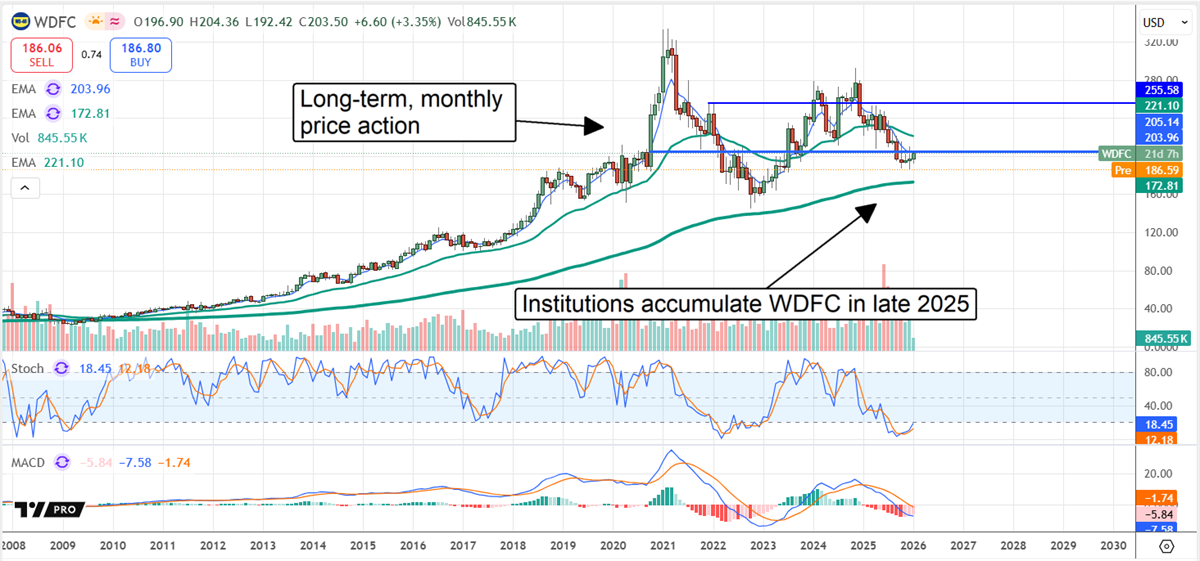
For total-return investors with a multi-year horizon, WD-40's combination of revenue resilience, margin expansion, affirmed guidance, shareholder returns and strong institutional ownership makes the recent pullback a noteworthy buying opportunity—assuming the investor is comfortable with the normal risks of market volatility.
|