Welcome! Thank you for subscribing to the Earnings360 newsletter, your daily source for quarterly earnings news and updates.
Each morning edition contains a wrap-up of today's pre-market earnings announcements and yesterday's earnings announcements after the closing bell.
Please take a moment to confirm your subscription below so we can ensure these updates reach your inbox.
Confirm Your Subscription Here
The Earnings360 Team
Special Report Rockwell Automation Stock Dips After Earnings Beat: Why Bulls See a Fast ReboundSubmitted by Thomas Hughes. Article Published: 2/7/2026. 
What You Need to Know - Rockwell Automation’s February pullback appears to be a countertrend move within a broader bullish setup tied to growth and cash flow.
- Fiscal Q1 results beat expectations on revenue and earnings, with margin expansion and strong segment performance supporting the outlook.
- Analyst targets and capital returns (dividends and buybacks) reinforce the bull case despite near-term guidance caution.
Rockwell Automation's (NYSE: ROK) February price pullback is a buying opportunity — a countertrend move within an otherwise bullish market. This market is driven by growth, outperformance and cash flow, which in turn support healthy capital returns and investor confidence. While the fiscal Q1 2026 earnings report showed a temporary headwind to cash flow, the impact appears minimal, expected, and one-off. That hit was largely due to compensation payments that were not recorded in the prior year's Q1. The long-term outlook remains intact, and prospects for automated manufacturing are bullish. Rockwell Automation is central to the application of physical AI. Its robotics and software platforms automate manufacturing workflows to improve efficiency and quality, and demand is global. Analysts forecast steady mid-single-digit revenue growth for the next five to ten years, helped by operational improvements and expanding margins. Earnings are expected to grow at a higher mid-teens CAGR well into the next decade — likely an underestimate of the company's potential. Rockwell Declines After Strong Quarter Rockwell delivered a solid Q1, topping estimates on both the top and bottom lines. Net revenue of $2.11 billion rose 12.2% year-over-year, outpacing MarketBeat's consensus by 145 basis points thanks to strength in organic business, products and software. The Intelligent Devices segment grew 18%, led by a 19% gain in Software & Control, partially offset by a slight decline in Lifecycle Services. On an organic basis, business grew 10% while FX translation added about 100 basis points. Annual recurring revenue, a sign of visible, reliable revenue streams, rose 7%. Margin news was especially strong. Volume leverage, pricing actions and a favorable mix expanded margins by 490 basis points pre-tax and 360 basis points at the segment operating level. Net income increased 65%, while adjusted EPS rose 49%, outpacing consensus by roughly 1,100 basis points. Guidance was reaffirmed rather than raised, which weighed on near-term sentiment. The company still expects solid progress — the guidance midpoint implies $11.80 in adjusted EPS, up more than 10% year-over-year and roughly in line with revenue growth. The likely outcome is that Rockwell was conservative in its guide and performance could exceed it, but the market reacted negatively to the lack of an upward revision. Analyst Response Aligns With Trend: Higher Prices Indicated The initial analyst response was consistent with the bullish picture: several firms reaffirmed or raised price targets within hours of the report. Those increases pushed the high end of targets to a fresh all-time high, with analysts citing business momentum, margin expansion and capacity for capital returns. Capital returns are a key part of the bull case, including dividends and buybacks. Following the February pullback, the dividend yields roughly 1.3% and is paid at about 50% of earnings, while buybacks continue to reduce the share count each quarter. Trailing 12-month activity reduced the share count by roughly 0.5% in Q1 and is expected to continue at a similar pace through the year. Despite the pullback, Rockwell's price action shows support from analysts and institutions. The discount drew buyers, allowing the stock to rebound from early lows and form a hammer doji — a candlestick pattern that often marks the bottom of pullbacks and signals potential for a quick rebound. The long lower shadow illustrates the depth of the bearish move and the strength of the subsequent bullish response near key support. 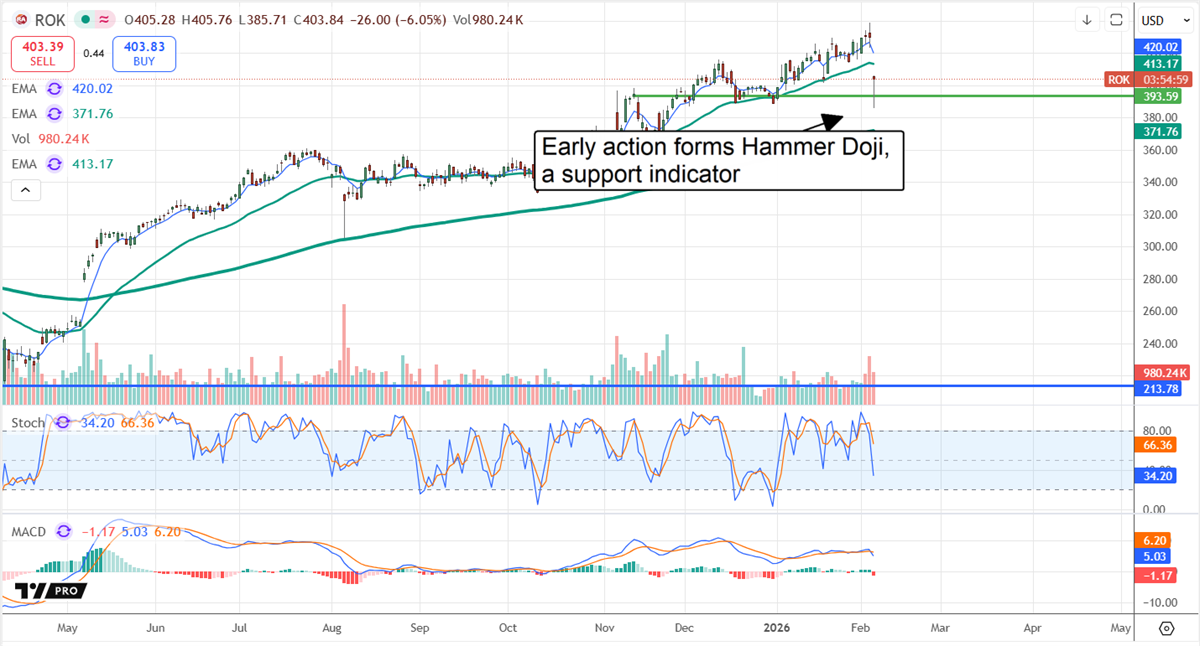
|