
Hey,
I don’t care what you think about AI.
Love it. Hate it. Ignore it.
Because Washington just changed the math behind the entire industry.
A new federal rule — with a deadline of April 30, 2026 — is about to squeeze America’s largest data centers.
And insiders already see what’s coming.
One $86 billion semiconductor giant just made a multi-billion-dollar acquisition tied directly to the solution.
Major manufacturers are quietly preparing for the transition.
And energy costs inside AI facilities are becoming impossible to ignore.
Translation?
Big Tech can’t keep running data centers the old way anymore.
They either cut power waste immediately…
or watch operating costs spiral out of control.
That’s why attention is shifting toward one under-the-radar company developing a light-based alternative many engineers believe is the next standard.
It still trades under $7.
And most investors have no idea it’s sitting at the center of this shift.
See the full story + ticker here >>>
Why Robinhood's Nearly 50% Slide Is a Buy-the-Dip Opportunity
Written by Leo Miller. Publication Date: 2/12/2026.

Key Points
- Robinhood’s Q4 earnings miss on crypto revenue accelerated a sharp post-earnings selloff.
- The stock is now down nearly 50% from its high as investors sold after the company's latest earnings.
- Despite transaction-driven volatility, Robinhood continues to see strong deposit growth, supporting its outlook.
- Special Report: [Sponsorship-Ad-2-Format3]
After explosive gains in 2025, investors have been punishing financial services stock Robinhood Markets (NASDAQ: HOOD) in 2026.
The stock has weakened as cryptocurrencies like Bitcoin (BTC) have plunged this year. Robinhood's latest earnings report, released on Feb. 10, accelerated that decline: shares fell roughly 9% the following day as markets digested the results.
Have $500? Invest in Elon's AI Masterplan (Ad)
What if you could claim a stake in what's set to be the biggest IPO ever… starting with just $500?
Everyone is talking about Elon Musk's SpaceX IPO.
Shares of HOOD have now dropped nearly 50% from their all-time high closing price in October 2025. Given that decline, is this a meaningful buy-the-dip opportunity? Let's examine the fintech firm's latest financials to find out.
Crypto Miss Weighs on Robinhood's Q4 Earnings
In Q4 2025, Robinhood reported revenue of $1.28 billion, up 27% year-over-year (YOY), but short of analyst expectations of $1.32 billion. The biggest shortfall came from crypto transaction revenue, which totaled $221 million — down 38% YOY and well below estimates of roughly $248 million.
Despite the revenue miss, the company beat EPS estimates. Adjusted earnings per share fell about 35% YOY to $0.66 but topped consensus of $0.63. Part of the year-over-year decline reflects a 47-cent tax benefit that had boosted Q4 2024 EPS.
For the full year, revenue rose 52% in 2025. Comparable adjusted operating expenses and share-based compensation (SBC) increased only 22%. At $305 million, SBC was essentially flat versus 2024 — a positive sign that profitability isn't being artificially improved by heavy stock-based pay.
Those dynamics helped the company's full-year adjusted EBITDA margin expand to 56.4%, an improvement of about 800 basis points from 2024.
Robinhood does not provide revenue guidance. At the midpoint, management expects adjusted operating expenses and SBC to rise roughly 18%, with more than half of that increase going to new and scaling businesses — a use of capital management views as constructive. On the earnings call, new CFO Shiv Verma said the company expects revenue growth to outpace expense growth.
Despite Valuation Dependence, Deposits Provide Strength
Robinhood has several structural advantages, but it is more exposed to crypto and equity market swings than many peers.
In 2025, transactions across options, equities and crypto represented 52% of total revenue (vs. 53% in 2024). Crypto alone was 20% of revenue (versus 21% a year earlier). Because transaction revenue tends to move with asset valuations, Robinhood benefits when equity and crypto markets rally — a clear sensitivity to market levels over time.
Still, options trading revenue has climbed for nine consecutive quarters, reflecting demand for products that can generate returns in both rising and falling markets.
Net deposits rose 35% in 2025, indicating asset growth driven not only by market appreciation but also by new customer inflows. Prediction markets are another growth area: trading volumes doubled in Q4, and the company identified them as a top priority for future growth.
Analysts Eye Big Upside in HOOD After Fall
Wall Street reacted conservatively to the report. MarketBeat tracked several analysts who trimmed price targets by 10% or more and two who cut targets by 20% or more. Even so, the MarketBeat consensus price target for Robinhood sits near $127, implying roughly 64% upside over the next 12 months. The average of targets issued or updated after the report is about $134, implying nearer 72% upside.
There may be a meaningful long-term opportunity in Robinhood after the stock's steep decline, but material downside in crypto or equity markets remains a major risk. Another headwind would be a lower federal funds rate — if the Federal Reserve begins cutting rates this year, Robinhood's net interest revenue could face pressure.
Going forward, the company's ability to sustain strong deposit growth and diversify revenue sources will be key. Notably, Robinhood is targeting more than 20% net deposit growth in 2026.
Insiders Piled Into These 3 Stocks in Q4—One Stands Out
Authored by Thomas Hughes. Originally Published: 2/17/2026.

Key Points
- Insider purchases accelerated in late 2025 across three names, with directors and executives adding exposure.
- One pick pairs heavy insider ownership with a tightly held float, which could amplify moves if commercialization ramps.
- The group includes a high-yield turnaround story, a steady med-tech compounder, and a speculative efficiency play.
- Special Report: [Sponsorship-Ad-2-Format3]
Insider buying was hot in Q4 2025, with money flowing into several underappreciated names. The question, as always, is whether these buys signal genuine value investors should own or whether executives are simply supporting their stock prices. In this case, insiders highlight value and opportunity in three stocks — and one stands out. Its technology is simple, effective and in demand, making it a potential disruptive force in a rapidly growing industry.
Alight: Insiders Accumulating a Tightly Held Stock
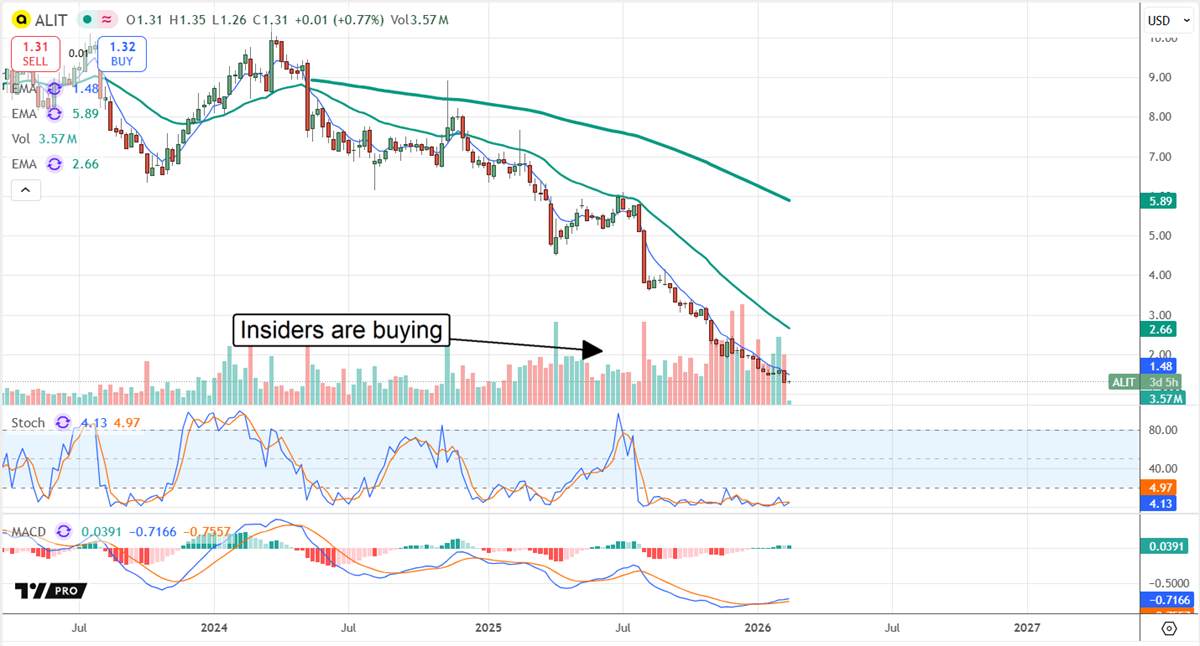
Alight (NYSE: ALIT) is a cloud-based employee engagement platform. Its services help employers and employees connect after hiring is complete, providing scheduling, time-off requests, financial services and benefits administration. Insiders, including several directors, have been buying the stock, with activity ramping through 2025 and peaking in Q4. The insider group owns about 2% of the shares — not a large stake, but meaningful given the buying activity and heavy institutional ownership. Institutions own virtually the rest of the float and have been accumulating as well, absorbing available shares.
Have $500? Invest in Elon's AI Masterplan (Ad)
What if you could claim a stake in what's set to be the biggest IPO ever… starting with just $500?
Everyone is talking about Elon Musk's SpaceX IPO.
Short interest has weighed on the share price. While institutions are buying, their purchases haven't been aggressive enough to fully offset short sales. Short interest is down from its peaks but remains elevated, near 7%, which puts pressure on the market. Headwinds include tepid, erratic growth and relatively high debt. Offsetting factors include steady profitability and a dividend that yielded about 12% annualized in early 2026. This small-cap stock carries risks, but the dividend appears sustainable — the EPS outlook forecasts roughly a 28% payout ratio in 2026 with improvement in subsequent years.
Price action is choppy but hints at growing potential for a rebound. Despite declining prices, volume has been increasing and indicators such as the MACD suggest bulls may be regaining control. Trading near $1.30, the stock sits below analysts' lowest target, implying a potential upside of roughly 200% relative to the consensus.
The Cooper Companies: Insiders Affirm a Modest Growth Outlook
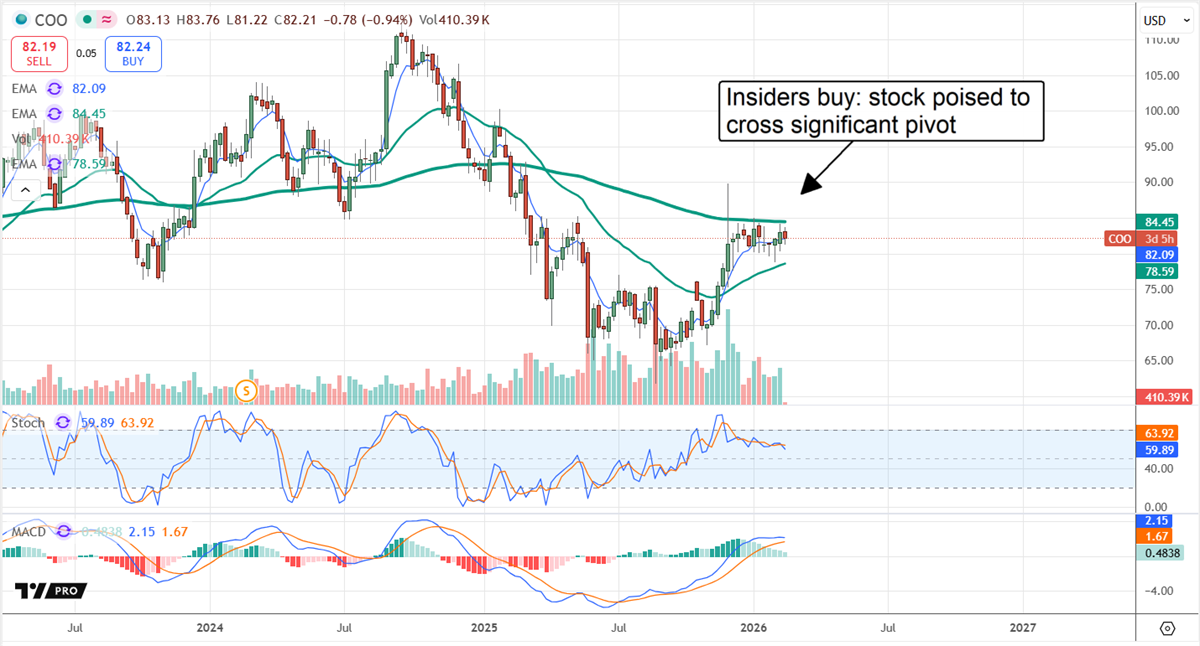
The Cooper Companies (NASDAQ: COO) doesn't pay dividends, choosing instead to reinvest in growth. The growth outlook is modest but includes steady improvements in revenue and earnings that can drive value for investors. A med-tech company, Cooper's primary focuses are vision and women's health, and insiders have been accumulating shares. Insiders, including the CEO and several directors, bought approximately $2.6 million in shares during Q4 2025, bringing their holdings to about 3% of outstanding shares.
Institutions and analysts are also constructive on the stock, indicating market accumulation. Institutions, which own about 24% of the shares, ramped up buying throughout 2025 and appear on track to set another high in Q1 2026. Analysts rate the stock as a Moderate Buy, and price-target trends suggest at least a 12% upside. That upside would put the stock near a long-term high and above key moving averages, where it may continue to advance.
AirJoule: A Technology Data Centers (and Other Industries) Will Want to Own
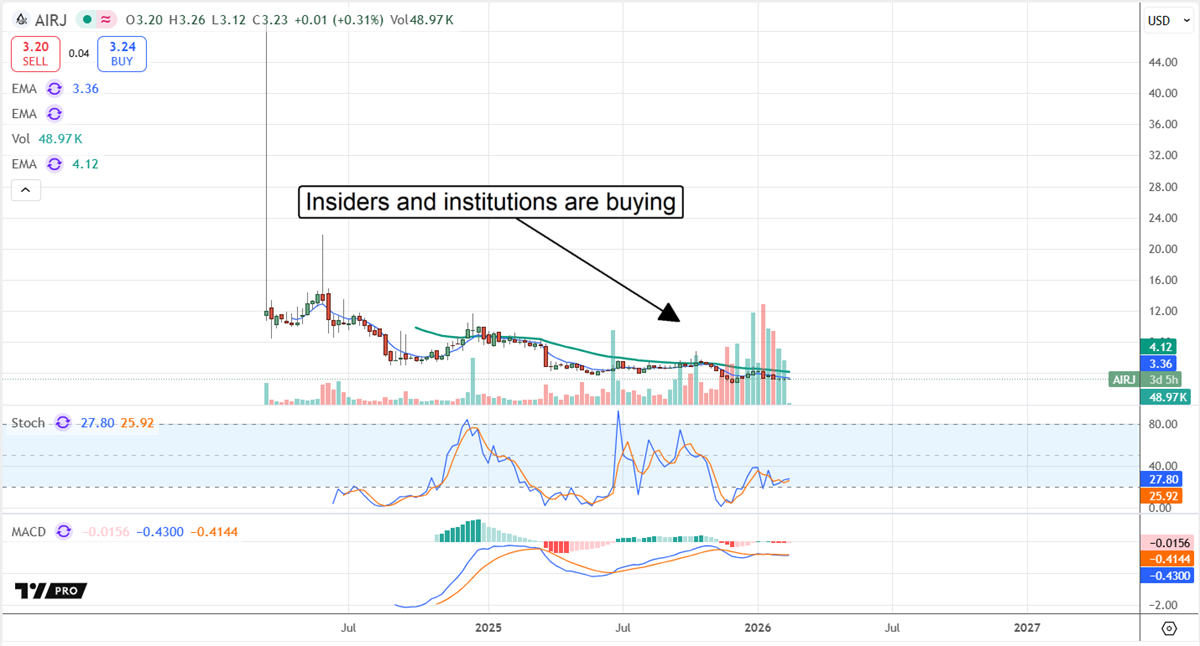
AirJoule Technologies (NASDAQ: AIRJ) is a straightforward business that makes industrial-grade dehumidifiers. Its advanced designs are 75% to 90% more efficient than traditional refrigerant-based systems, providing much-needed utility and far lower operating costs for multiple industries. While many sectors rely on humidity control, the data center industry stands out.
Data centers are proliferating, with top-tier, 1-gigawatt facilities representing multi-billion-dollar investments. Their components are highly sensitive to humidity: corrosion can cause catastrophic failures, and condensation or stray droplets can damage optical data transmission systems.
AirJoule insiders, including the CEO, CFO and several directors, bought heavily in Q4 2025. That activity is notable because insiders' holdings are significant — roughly 40% — while institutions own about 60%, making the stock tightly held. Analysts, who aggregate to a consensus Moderate Buy, see more than 100% upside at the low end of target ranges and roughly 200% at consensus. Catalysts for those gains will likely come as commercialization and sales ramp later in the year.
This email communication is a sponsored message provided by Behind the Markets, a third-party advertiser of DividendStocks.com and MarketBeat.
If you need help with your newsletter, please feel free to contact MarketBeat's U.S. based support team at contact@marketbeat.com.
If you no longer wish to receive email from DividendStocks.com, you can unsubscribe.
© 2006-2026 MarketBeat Media, LLC. All rights reserved.
345 North Reid Place #620, Sioux Falls, South Dakota 57103. United States..


