Dear Reader
I recently visited Mar-a-Lago...
And now I'm p repared to put my reputation on the line.
Since 1998, my proprietary system would've returned 13,126% in backtests.
(That's 13X the S&P and 106X the average investor, according to JP Morgan.)
However, one investment I just uncovered could be my biggest winner of all...
It involves President Trump, Elon Musk, trillions of dollars, China...
And a MAJOR upgrade to the artificial intelligence revolution.
If you buy just one stock in 2026, I urge you to make it this one.
Regards,
Louis Navellier
Senior Investment Analyst, InvestorPlace
Despite a Double Miss, D-Wave's Earnings Could Fuel a New Rally
Author: Nathan Reiff. Published: 2/27/2026.
Key Points
- Despite quarterly losses and revenue that failed to meet analyst expectations, D-Wave Quantum's Q4 earnings report showed many promising signs of growth.
- One highlight was the company's bookings momentum, which surged by 471% on a sequential basis—and January 2026 bookings have only continued to accelerate.
- D-Wave also maintains a strong cash position with about $885 million on hand, giving it ample room to fund its aggressive R&D plans in 2026.
- Special Report: [Sponsorship-Ad-6-Format3]
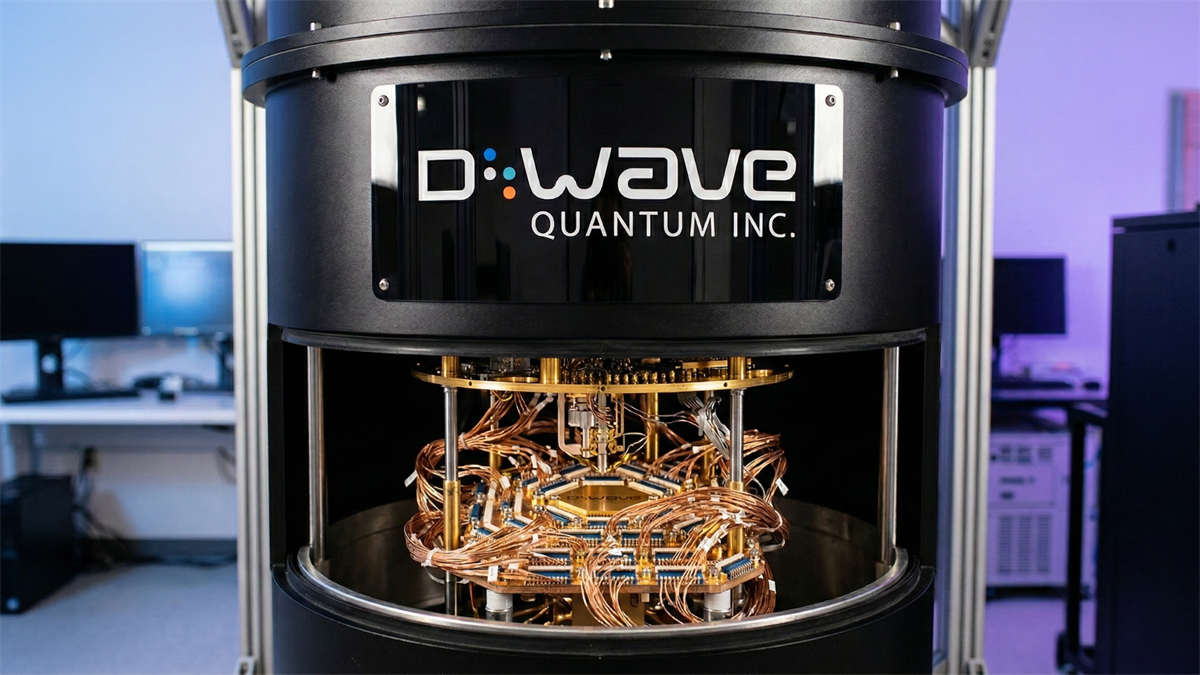
After weeks of anticipation—and amid a share price decline of nearly 29% year-to-date (YTD)—D-Wave Quantum Inc. (NYSE: QBTS) reported Q4 and full-year 2025 earnings, and the results were mixed. The headline: the company missed analyst expectations on both the top and bottom line for the fourth quarter, even though it delivered year-over-year (YOY) improvements in both categories.
Look a little closer, however, and there are reasons for optimism. D-Wave showed notable progress across several areas, including quarterly bookings, its cash position, full-year revenue and gross profit. Those gains—combined with the company's acquisition of Quantum Circuits and its repositioning as a dual-focus gate-model and annealing quantum technology company—could help cement D-Wave as one of the leading names in the space.
D-Wave's Earnings Come Up Short—But Also Impress in Important Ways
Silver $309? (Ad)
Silver: 20% + 68%
Tim Plaehn just found a Silver ETF that delivers monthly income (up to 20% in annual distributions) plus share appreciation (68% in 5 months). The precious metal has become one of the best investments for growth AND income right now.
On the downside, D-Wave's adjusted quarterly loss of $0.09 per share missed the $0.05 consensus, and reported revenue of $2.75 million was nearly $1 million below expectations, despite being roughly 22% higher than the prior-year quarter.
The revenue shortfall underscores that D-Wave remains a speculative investment—there simply isn't yet much commercial business in the quantum space while other sectors focus on products that are market-ready today.
Still, the company posted several encouraging results. Full-year revenue and gross profit were strong: 2025 revenue totaled $24.6 million, up about 179% YOY, while full-year gross profit increased roughly 265% YOY.
Those gains were driven in part by accelerating bookings. Q4 bookings reached $13.4 million, a sequential increase of about 471%. Even more notable, management said January 2026 bookings topped $30 million—already ahead of the total achieved across all of 2025.
Most of that bookings momentum came from a small number of high-profile Advantage2 system sales, and D-Wave still needs to expand its customer base to smaller clients. Nevertheless, these deals indicate meaningful traction in an area that could materially affect future revenue and, ultimately, profitability.
D-Wave's Cash Position Remains Healthy
Despite paying $550 million in cash and stock for Quantum Circuits—and taking steps that could dilute shareholders by filing $330 million in shelf registrations—D-Wave entered the new year with a robust cash position. At year-end it had nearly $885 million in cash and marketable securities, after a roughly $250 million cash outlay related to the acquisition.
Management says this cash cushion is sufficient to fund the company's planned path to profitability. Investors remain cautious, however, and the stock's year-to-date decline reflects that skepticism. D-Wave also expects aggressive R&D and go-to-market spending in the near term, which could keep bookings and revenue uneven for a while.
Even so, the sizable cash holdings should provide stability as the company navigates a likely spend-heavy phase. Whether the balance is enough to carry D-Wave through this period remains to be seen, but the cash position is a meaningful positive for now.
The Market Reacts Positively
Shares popped above $21.30 in the hours after the earnings release before settling below $20 later in the session. Overall, the stock is still down significantly YTD but remains up roughly 224% over the past 12 months after a big rally in 2025.
Analysts continue to favor D-Wave, assigning it a Moderate Buy consensus based on 14 Buys, 1 Sell and 1 Hold. The first post-earnings rating update came from Needham & Co., which kept a Buy rating but trimmed its price target by $8 to $40. QBTS has a consensus price target of $37.64, about 89% above its current price.
From Glass Maker to AI Kingmaker: Corning's Pivot
Authored by Jeffrey Neal Johnson. Originally Published: 2/24/2026.
Key Points
- Corning’s Optical Communications business is emerging as a key beneficiary of AI data center “densification” and rising fiber demand.
- Management’s Springboard framework is designed to turn incremental sales into outsized profit growth through operating leverage.
- The stock’s sharp run-up makes valuation a central risk, even as Display Technologies provides steady cash flow to fund growth.
- Special Report: [Sponsorship-Ad-6-Format3]
For the past two years, the investment narrative around artificial intelligence (AI) has focused almost exclusively on silicon. Investors rushed into semiconductor names such as NVIDIA (NASDAQ: NVDA) and AMD (NASDAQ: AMD), pushing valuations to extremes. That gold rush for processing power defined the first phase of the AI boom. Now a meaningful rotation is unfolding: fast chips are only valuable if the physical infrastructure exists to connect them.
This shift has put Corning Incorporated (NYSE: GLW) in the spotlight. Once viewed mainly as a cyclical glass supplier for TVs and smartphones, Corning has recast itself as a central enabler of the generative AI economy. The market has noticed. As of late February 2026, Corning's stock traded near an all-time high of $143.96, up roughly 54% over the prior 30 days.
Wiring the Beast: Inside the $6 Billion Meta Deal
Silver $309? (Ad)
Silver: 20% + 68%
Tim Plaehn just found a Silver ETF that delivers monthly income (up to 20% in annual distributions) plus share appreciation (68% in 5 months). The precious metal has become one of the best investments for growth AND income right now.
To appreciate Corning's surge, investors need to understand the physics behind modern computing. Generative AI data centers operate differently from the cloud servers of the previous decade.
Traditional cloud computing uses many individual servers that operate somewhat independently to store files or host websites. Generative AI models, by contrast, require thousands of Graphics Processing Units (GPUs) working together as a single supercomputer to train large language models (LLMs).
That architecture drives a phenomenon known as densification. To link GPU clusters for the required high-speed processing, AI data centers need as many as 10 times more fiber-optic connections than traditional facilities. Data can't move between chips quickly enough over copper; it must travel at the speed of light through optical glass. That technical requirement creates a substantial, secular tailwind for Corning's Optical Communications segment.
The demand is already showing up in commercial deals. In late January 2026, Corning announced a multi-year agreement with Meta Platforms. Potentially worth up to $6 billion, the deal names Corning a primary supplier of the optical cable needed for Meta's generative AI infrastructure.
The trend appears in Corning's results. In the fourth quarter of 2025, the Optical Communications segment posted a record performance:
- Segment Sales: $1.7 billion, up 24% year-over-year.
- Segment Net Income: Increased 57% year-over-year.
That direct translation of data center densification into revenue growth validates the core investment thesis: infrastructure is the next phase of the AI trade.
Using What You Have: Turning Sales into Profit
Revenue growth matters, but Corning's management is focused on converting sales into profit through a strategy called Springboard.
Springboard's idea is straightforward: produce more using factories and equipment that already exist. In manufacturing, the largest expense is often building plants and installing machinery (capital expenditures). Corning has made those investments in prior years. With factories built and fixed costs covered, the incremental cost to produce each additional unit of fiber is relatively low.
That creates strong flow-through (operational leverage): as sales rise, profits increase faster than revenue. Corning recently raised the targets for this plan, signaling confidence that the leverage will continue.
- Long-Term Goal: Add $11 billion in incremental annualized sales by the end of 2028 (up from an original $8 billion target).
- Near-Term Goal: Add $6.5 billion in incremental sales by the end of 2026.
Execution is already producing results. In Q4 2025, Corning posted an operating margin of 20.2%, hitting the company's 20% margin target a year ahead of schedule. Full-year 2025 earnings per share (EPS) rose to $2.52, a 29% increase from the prior year. Free cash flow nearly doubled from 2023 levels, reaching $1.72 billion in 2025—evidence that Springboard's operational leverage is working as intended.
The Path to $11 Billion: How Display Funds AI
With the stock up more than 50% in a month, valuation matters. Corning currently trades at a price-to-earnings ratio of roughly 78x, a large premium to its historical range when it was often considered a slower-growth industrial name. That premium reflects the market's willingness to pay for visibility into future earnings growth.
Investors are effectively paying for the expectation that future revenue will flow straight to the bottom line under Springboard. The market is pricing in near-flawless execution, but Corning has a built-in safety net: its Display Technologies segment. While Optical drives rapid growth, Display (glass for TVs and monitors) remains a steady cash generator.
Despite currency headwinds—especially a weak Japanese yen—Corning has protected profits. Through double-digit price increases in late 2024 and hedging programs running through 2030, management expects Display net income to remain in the $900 million to $950 million range. That reliable cash flow helps fund high-growth AI investments without over-leveraging the balance sheet or diluting shareholders.
Looking forward, management projects first-quarter 2026 sales between $4.2 billion and $4.3 billion. That acceleration supports the view that the AI infrastructure build-out is still in its early innings and makes the company's upgraded $11 billion incremental-sales target achievable.
Positioning for the Infrastructure Boom
Corning has successfully moved from a cyclical materials company to a critical provider of AI infrastructure. It no longer just sells glass; it supplies the connectivity required for the next generation of computing. The Springboard plan is producing measurable improvements—expanding margins and doubled cash flows.
With major tech players like Meta committing sizable business and management raising long-term sales targets through 2028, Corning offers a compelling growth narrative. While the current valuation warrants caution, the company's fundamentals and execution suggest it is well-positioned to deliver long-term value as the AI economy expands.
This email message is a paid advertisement sent on behalf of InvestorPlace, a third-party advertiser of MarketBeat. Why was I sent this message?.
If you need assistance with your account, please don't hesitate to contact our U.S. based support team at contact@marketbeat.com.
If you would no longer like to receive promotional emails from MarketBeat advertisers, you can unsubscribe or manage your mailing preferences here.
© 2006-2026 MarketBeat Media, LLC. All rights protected.
345 N Reid Place, Suite 620, Sioux Falls, South Dakota 57103-7078. U.S.A..


