
Dear Reader,
The linebacker before me had skull and crossbones rings wrapped around his knuckles...
He was a former NFL linebacker turned 40-year professional trader, and one of the most recognizable faces on CNBC.
And live on air, I told him he was dead wrong about one of his biggest holdings.
My data clearly said: Get out. Now.
It didn't matter that the stock was up big or that everyone on CNBC still loved it...
And, frankly, it didn't matter that the man could snap me in half like a twig...
I showed him what the signal was telling me... and he listened.
That man was former pro football player and 40-year professional trader, Jon Najarian...
And sure enough, days later, the pullback began. Fortunately Jon took my advice, made something like 7x his money.
We've remained friends ever since.
Most importantly, my warning came from a signal almost no one else saw coming.
My name is Marc Chaikin.
I've spent 50 years building systems used by Wall Street's most powerful firms. My indicators are in every Bloomberg and Reuters terminal.
I've made a career out of spotting when money moves, before the headlines catch up.
And today I'm seeing that pattern again.
Not in Priceline. In something bigger. And just as dangerous...or just as lucrative, depending on what you do next.
Most people won't notice it until they're already on the wrong side of it.
I'm not the only one seeing this, by the way.
Jon and I still keep in touch. And when I showed him the data he said,
"Marc, we've got to tell this story."
So that's what we're doing.
For the first time in eight years, Jon and I sat down together — 40 floors up in the World Trade Center, New York City — and filmed a complete briefing on what this signal means for the market right now.
If you watch one financial broadcast this year, please make sure it is this one.
Click here for the full story.
Be well,
Marc Chaikin
Founder, Chaikin Analytics
IBM's Steep Drop on AI Fears May Be an Overreaction
Submitted by Jeffrey Neal Johnson. First Published: 2/25/2026.
Key Points
- International Business Machines consistently generates exceptional free cash flow to comfortably support ongoing corporate transformation and reliable shareholder dividend payouts.
- Strategic acquisitions strongly enhance hybrid cloud architecture and provide a robust foundation for future enterprise technology expansion.
- Proprietary artificial intelligence innovations allow clients to safely modernize their legacy code directly on highly secure mainframe platforms.
- Special Report: [Sponsorship-Ad-6-Format3]
A sudden collision between cutting-edge artificial intelligence (AI) startups and legacy enterprise infrastructure wiped out billions in shareholder value. On Feb. 23, 2026, International Business Machines (NYSE: IBM) suffered its steepest single-day decline since 2000. Shares plunged 13.2%, erasing roughly $30 billion in market capitalization within hours.
The catalyst was a product announcement from AI startup Anthropic. The company unveiled additional features for Claude Code, including tools that claim to automate the modernization of COBOL. This decades-old programming language still underpins large portions of the global financial system. Investors feared that automated code translation would instantly evaporate the lucrative infrastructure and consulting revenues tied to maintaining those systems. The worry triggered a sector-wide contagion, dragging down major IT service providers.
Elon Musk: This Could Turn $100 into $100,000 (Ad)
What if you could shrink your entire wealth journey from decades down to just 24 hours?
Sounds impossible…
But I'll show you how Elon Musk is about to make it a reality.
That dramatic sell-off has already begun to fade. IBM stock rebounded the next day, closing up 2.68% at $229.34 on exceptionally heavy trading of more than 13.3 million shares. Major Wall Street analysts, including teams at Wedbush and Evercore ISI, quickly defended the shares, calling the move an unwarranted overreaction and a buying opportunity for investors who understand enterprise technology realities.
Why AI Cannot Replace a Mainframe
Enterprise clients cannot simply abandon their mainframes because a new AI tool can translate legacy code into modern languages. Translating syntax is very different from modernizing a deeply integrated hardware-software architecture.
The structural moat around IBM's Z series mainframe remains intact. A basic software-as-a-service tool hosted on a public server cannot replicate the hardware-level guarantees required by the world's largest institutions. Modern mainframes are purpose-built from the silicon up to deliver unmatched transactional resilience:
- Massive Scale: A single system can process 25 billion encrypted transactions per day.
- AI Performance: The platform supports roughly 450 billion AI inferences per day with one-millisecond response times.
- Extreme Reliability: The hardware operates with up to eight nines of availability.
- Future-Proof Security: The system includes quantum-safe encryption to guard against future threats.
Today, more than 90% of the world's credit card transactions are processed through these specialized systems. Regulated entities — global banks, insurers, and governments — are unlikely to move their most sensitive operational data to third-party public clouds because the data sovereignty, compliance, and security risks remain too high.
In fact, artificial intelligence can strengthen this protective moat rather than erode it. The company already offers a proprietary generative AI tool, watsonx Code Assistant for Z, which lets clients refactor and modernize legacy code directly on the platform without sacrificing enterprise-grade security.
Pristine Financials Hidden in the Noise
The market panic masked the company's actual financial performance. Before the AI-driven sell-off, fourth-quarter 2025 earnings showed broad-based growth that beat Wall Street expectations:
- Earnings Beat: Adjusted earnings per share (EPS) of $4.52 topped consensus estimates of $4.33.
- Revenue Surge: Fourth-quarter revenue reached $19.7 billion, a 12% year-over-year increase.
- Segment Strength: Growth was driven by a 14% increase in Software revenue and a 21% jump in Infrastructure revenue.
- Record Cash: Free cash flow for the full year 2025 totaled a record $14.7 billion, up $2 billion from the prior year.
The business is growing and generating substantial cash despite recent market noise. The company's generative AI book of business now exceeds $12.5 billion, including more than $10.5 billion in consulting and about $2 billion in software, demonstrating successful AI monetization within the highly regulated enterprise sector.
Management is also deploying capital to strengthen the high-margin software portfolio. Strategic acquisitions such as HashiCorp ($6.4 billion) and Confluent (NASDAQ: CFLT) ($11 billion) enhance the company's hybrid-cloud capabilities. To further its AI strategy, IBM recently announced a major collaboration with Deepgram to integrate advanced voice AI into enterprise solutions.
A 3% Dividend Yield Built on Rock-Solid Cash
The sharp drop in IBM's share price compressed the stock's valuation. The trailing price-to-earnings ratio (P/E) has fallen to about 20.5, offering a more reasonable entry point than the premium levels seen earlier in the year. Because dividend yields move inversely to price, the pullback pushed the dividend yield to roughly 2.93%.
Management has maintained a 30-year track record of consecutive annual dividend increases. That payout is well supported by the company's significant and growing free cash flow. For 2026, guidance projects over 5% constant-currency revenue growth, and management expects free cash flow to rise by another $1 billion, underscoring confidence in the ongoing transformation.
While much of the market focuses on short-term disruption narratives and headline-grabbing startup announcements, the underlying metrics tell a different story. The financials remain strong, and the core infrastructure is far more defensible than basic code translation implies. For patient investors, the recent volatility has created a meaningful opportunity to buy shares of a profitable, cash-generating, entrenched technology leader at a discount.
The Late-Stage Bull Market Is a Buying Opportunity for Tech
By Jordan Chussler. Posted: 2/24/2026.

Key Points
- Despite the NASDAQ falling 5% from its October high and tech currently lagging the S&P 500, analysts argue this is late-stage bull market maturity rather than the end of the cycle.
- Several major names—including Adobe, Intuit, and The Trade Desk—are trading at Relative Strength Index levels well below 30. Combined with significant year-to-date losses, these stocks are oversold.
- Improving valuations, including Meta’s forward P/E of 24.13 and Adobe’s 14.78, indicate that earnings potential is becoming cheaper.
- Special Report: [Sponsorship-Ad-6-Format3]
After years of leading the pack, the tech sector has been in retreat since the NASDAQ hit its all-time high last October. And while the ongoing sell-off has fueled speculation that the market is in the late stages of its bull run, discerning investors may see this as a buying opportunity for names that haven't been on sale for a while.
Tech stocks finished 2025 up nearly 34%, but after a 1.68% loss on Feb. 23, the sector is down about 2.15% year-to-date (YTD), the second-worst showing among the S&P 500's 11 sectors.
Elon Musk: This Could Turn $100 into $100,000 (Ad)
What if you could shrink your entire wealth journey from decades down to just 24 hours?
Sounds impossible…
But I'll show you how Elon Musk is about to make it a reality.
Much of this decline stems from the underperformance of several members of the Magnificent Seven, which has spurred an exodus into defensive sectors and equal-weight exchange-traded funds (ETFs). Investors are also worried about an AI bubble and a broad pullback in software stocks.
Rumblings of a potential bear market could mean further downside for tech. Even so, valuations are improving, and many analysts argue the growth-focused sector is beginning to offer value.
A Late-Stage Bull Market Doesn't Mark Its End
As Andrew Slimmon, head of the applied equity advisors team at Morgan Stanley (NYSE: MS), noted in the firm's 2026 market outlook report, a late-stage bull market doesn't necessarily mean the cycle is over.
Slimmon acknowledged the cycle is mature but not finished, observing that the average bull market lasts five to seven years and that "history favors the bull market in a fourth year," which is where the market sits in 2026.
Those years have historically produced positive returns. Slimmon added that "investors who take higher risk may be rewarded in the coming year, and while corrections are likely in a potentially volatile year for stocks, that could be healthy and support the broader trend upward."
The NASDAQ is undergoing a pullback—more than 5% below its October high—and several individual tech stocks are already in correction territory, including some Magnificent Seven names.
Both Amazon (NASDAQ: AMZN) and Meta Platforms (NASDAQ: META) are down more than 19% from their respective one-year highs. For Palantir (NASDAQ: PLTR), the drop from its one-year high is nearly 37%.
AI-powered customer relationship management provider HubSpot (NYSE: HUBS) has plunged more than 43% YTD, and International Business Machines (NYSE: IBM) fell more than 13% on Feb. 23 alone.
That doesn't automatically make any of these stocks a Buy. However, the market's flight to safety has disproportionately benefited sectors like energy, materials, and industrials, leaving numerous tech stocks oversold.
Evidence of a Buying Opportunity
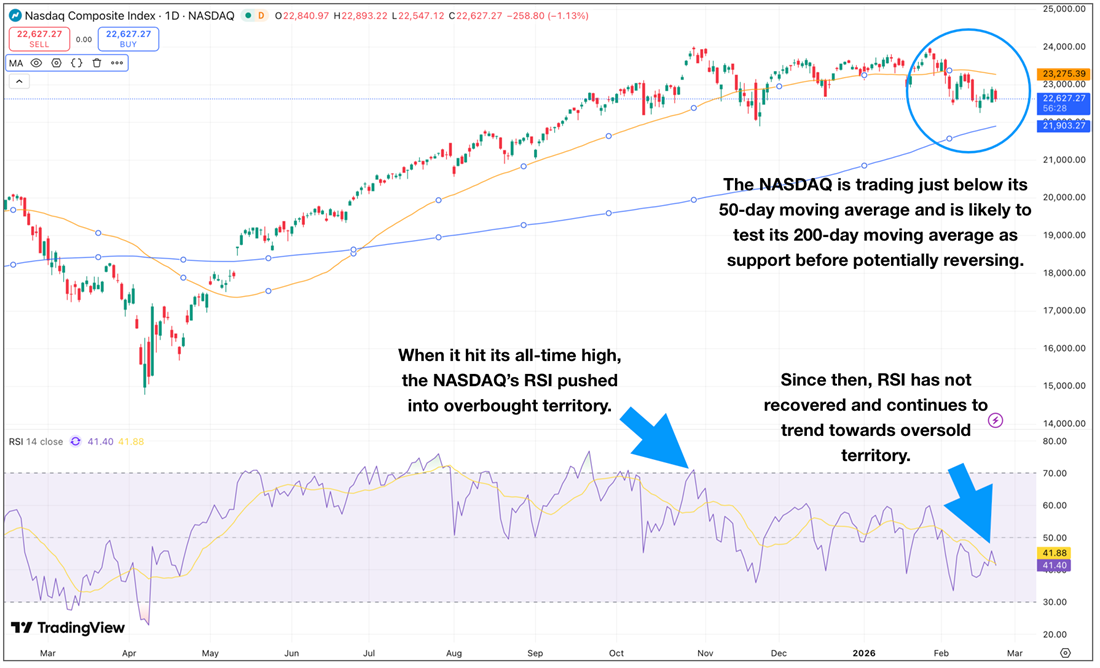
Both technical and fundamental indicators support the idea of a buying opportunity. The NASDAQ's current Relative Strength Index (RSI) of 41.4 is moving toward the 30 level commonly used to mark oversold conditions. The index is still trading below its 50-day moving average, however, which suggests more downside could occur before the NASDAQ finds support at its 200-day moving average and potentially reverses.
MarketBeat has identified dozens of oversold tech stocks, some with RSI readings well below 30 and analyst price targets that imply substantial upside:
- Adobe (NASDAQ: ADBE): RSI 33, down 26% YTD, 53% potential upside over the next 12 months
- Paychex (NASDAQ: PAYX): RSI 26, down 21% YTD, 40% potential upside over the next 12 months
- Accenture (NYSE: ACN): RSI 24, down 25% YTD, 49% potential upside over the next 12 months
- The Trade Desk (NASDAQ: TTD): RSI 28, down 34% YTD, 131% potential upside over the next 12 months
- Workday (NASDAQ: WDAY): RSI 19, down 39% YTD, 85% potential upside over the next 12 months
- Intuit (NASDAQ: INTU): RSI 18, down 46% YTD, 101% potential upside over the next 12 months
- Automatic Data Processing (NASDAQ: ADP): RSI 20, down 21% YTD, 42% potential upside over the next 12 months
These figures can change quickly, but the sector-wide message is clear: for investors who maintain a long-term bullish view on technology, the current pullback presents a compelling opportunity.
Fundamentally, many of these companies are also showing improvement. Take Meta Platforms: its trailing 12-month (TTM) price-to-earnings (P/E) ratio of 27.37 looked elevated, but a forward P/E of 24.13 implies a lower valuation relative to expected future earnings.
That's reflected in Meta's year-over-year (YOY) earnings per share (EPS) growth over recent years. After rising more than 73% YOY in 2023 and nearly 61% YOY in 2024, EPS growth fell to -1.55% last year, suggesting the potential for a regression back toward trend this year.
The same dynamic appears outside the Magnificent Seven. Adobe's forward P/E is 14.78, Paychex's is 17.72, and Accenture's is 15.77. Their five-year average annual EPS growth rates are 10.01%, 9.01%, and 9.20%, respectively.
This email content is a sponsored message from Chaikin Analytics, a third-party advertiser of InsiderTrades.com and MarketBeat.
This ad is sent on behalf of Chaikin Analytics, 201 King Of Prussia Rd., Suite 650, Radnor, PA 19087. If you would like to optout from receiving offers from Chaikin Analytics please click here.
If you need assistance with your subscription, don't hesitate to email MarketBeat's U.S. based support team at contact@marketbeat.com.
If you no longer wish to receive email from InsiderTrades.com, you can unsubscribe.
Copyright 2006-2026 MarketBeat Media, LLC. All rights reserved.
345 North Reid Place #620, Sioux Falls, S.D. 57103. U.S.A..


