

NVIDIA's AI Boom Isn't Slowing After Blowout Q4
Authored by Thomas Hughes. Date Posted: 2/26/2026.
Key Points
- NVIDIA's fourth-quarter results reveal that its growth is far from slowing, continuing to accelerate faster than expected.
- Analysts responded favorably to the news, lifting price targets and pointing to the high end of the range and another solid double-digit upside.
- Institutional trends reveal this stock was aggressively accumulated in early 2026, highlighting its value to investors.
- Special Report: [Sponsorship-Ad-6-Format3]
NVIDIA’s (NASDAQ: NVDA) Q4 earnings release for its fiscal 2026 (FY2026) shows that its AI-driven growth remains strong. Despite ongoing concerns about AI spending and disruption, NVIDIA’s revenue continues to grow at a hyper pace and management’s guidance points to more of the same.
The takeaway is that AI may or may not be a bubble; regardless, capital is still flowing into the market and the peaks may not yet have arrived. For NVIDIA investors, that means revenue should remain solid over the next few quarters to several years, supporting robust cash flow, reinvestment in next‑generation technologies, opportunistic acquisitions, and capital returns to drive shareholder value.
NVIDIA’s Wow-Quarter Reveals Acceleration in Critical Markets
Unlocked: Elon Musk's Next Big IPO (Ad)
For years, the American economy has been engineered to reward Wall Street institutional investors and Silicon Valley insiders first.
Everyday investors like you and me were left with the table scraps.
But this rigged game ends today!
NVIDIA’s Q4 showed acceleration across key markets, with revenue of $68.3 billion far above consensus expectations. Strength was broad-based: automotive and gaming growth aligned with signs of an emergent supercycle reported by industrial chipmakers.
Data Center, the company’s most important segment, grew 22% sequentially and 75% year-over-year (YOY), driven by demand for high-performance computing and AI infrastructure. It now accounts for more than 90% of revenue and is expected to remain dominant in the coming quarters. Professional Visualization grew 158% YOY, Gaming rose 48%, and Automotive increased 6%.
Margins were also strong, supporting the analysts’ stock price outlook. NVIDIA achieved improved operating leverage at multiple levels, producing $1.62 in adjusted EPS — roughly $0.10 above expectations.
That outperformance left earnings up 82% compared with a 73% increase on the top line. Looking ahead, management expects only a modest margin contraction, with Q1 FY2027 adjusted gross margin forecast to decline about 20 basis points from Q4.
Even more notable than the quarter itself was the guidance. NVIDIA forecasts $78 billion in Q1 FY2027 revenue, a sequential increase of $10 billion (14.7%) and 77% YOY, excluding China. If sales into China are approved, growth could be even stronger. Cash flow and free cash flow (FCF) were also impressive, approaching $35 billion in Q4 — just over half of revenue — and are expected to remain robust over the coming year.
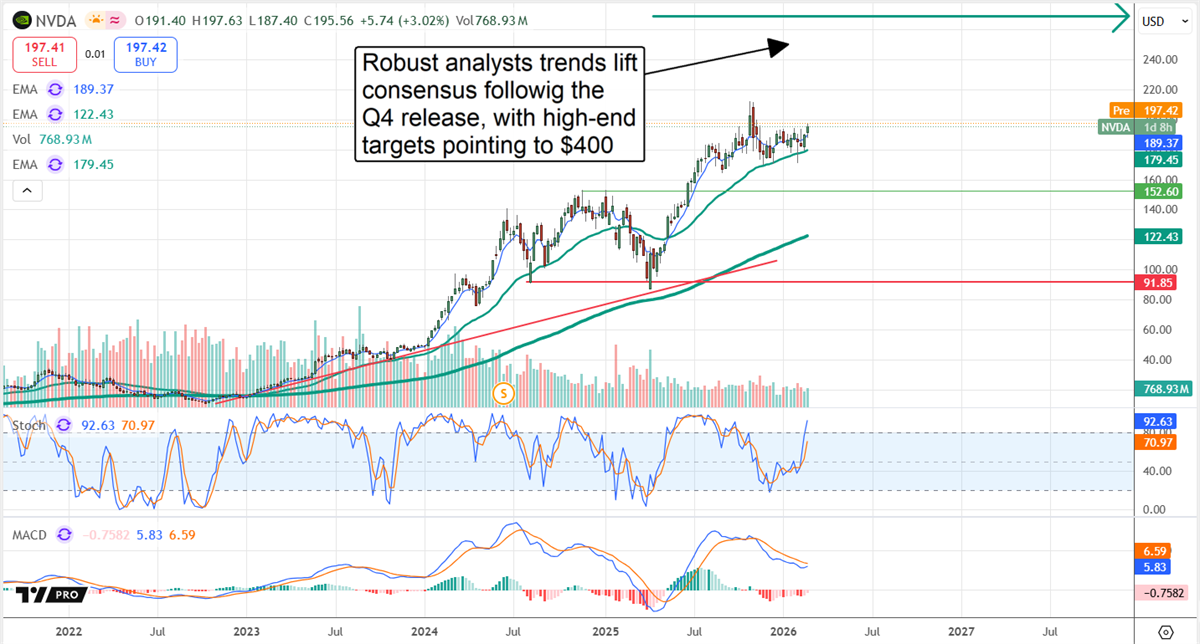
Analysts Highlight 50% Upside Potential for NVIDIA’s Stock in 2026
The analyst response to NVIDIA’s report and guidance was broadly bullish, affirming the uptrend and projecting at least 35% upside from late-February support levels.
Consensus price targets were near $268 before the release. In the wake of the report, several firms raised their targets and reaffirmed buy ratings; the refreshed consensus of new targets is near $300, with the high end around $400. No cuts were recorded among the immediate updates.
A move to the consensus target would likely produce a fresh all-time high, ending the stock’s recent consolidation. In that case, technical targets suggest $270–$280 as a reasonable near-term objective, with a potential to double in a bull scenario. Other indicators, including stochastic indicators and moving-average-convergence-divergence (MACD), are aligned with trend-following entries that could sustain upward momentum.
Analyst and institutional sentiment trends point to broad-based support. MarketBeat tracks more than 50 analysts; sentiment is pegged at Buy with a 96% buy-side bias. Institutions accumulated aggressively in early 2026, coming into the year owning more than 65% of the stock. In early Q1, buy activity exceeded sell activity by better than $4 bought for every $1 sold, providing strong support and a favorable tailwind.
NVIDIA’s Balance Sheet Is a Great Reason to Own It
Putting market dynamics aside, NVIDIA’s core business is healthy and well-positioned for the near term thanks to robust cash generation. That strength shows up on the balance sheet, where cash, assets, and equity grew despite heavy investments, capital returns, and acquisitions. Cash rose roughly 50% year over year to top $60 billion at fiscal year-end, contributing to a greater-than-50% increase in current assets (including receivables and inventory) and an almost 100% increase in total assets.
Equity, a proxy for shareholder value, nearly doubled to $157 billion. Leverage remains low: NVIDIA carries debt, but debt levels declined during the year and are offset by a sizable cash balance. The company sits in an enviable position with net cash relative to total liabilities, giving it flexibility to execute its strategy while continuing to build shareholder value.
IBM's Steep Drop on AI Fears May Be an Overreaction
Authored by Jeffrey Neal Johnson. Date Posted: 2/25/2026.
Key Points
- International Business Machines consistently generates exceptional free cash flow to comfortably support ongoing corporate transformation and reliable shareholder dividend payouts.
- Strategic acquisitions strongly enhance hybrid cloud architecture and provide a robust foundation for future enterprise technology expansion.
- Proprietary artificial intelligence innovations allow clients to safely modernize their legacy code directly on highly secure mainframe platforms.
- Special Report: [Sponsorship-Ad-6-Format3]
A sudden collision between cutting-edge artificial intelligence (AI) startups and legacy enterprise infrastructure wiped out billions in shareholder dollars. On Feb. 23, 2026, International Business Machines (NYSE: IBM) suffered its steepest single-day decline since 2000. Shares plunged 13.2%, erasing roughly $30 billion in market capitalization in a matter of hours.
The catalyst was a single product announcement from AI startup Anthropic: additional features for Claude Code that claim to automate the modernization of COBOL codebases. COBOL still underpins large portions of the global financial system, and investors feared that automated translation would instantly jeopardize the lucrative infrastructure and consulting revenues tied to maintaining those systems. The panic sparked a sector-wide sell-off, pulling down major IT service providers.
My blood is boiling… and yours should be too (Ad)
Fraud is being exposed everywhere right now. Billions gone.
But they're missing the big one...
A legal scam that affects 95% of ALL Americans.
Oxford Club's own Marc Lichtenfeld hit the streets of South Florida to expose it in broad daylight.
Watch along as he captures real people's reactions LIVE on camera.
But the dramatic sell-off began to reverse quickly. IBM shares rebounded the next day, closing up 2.68% at $229.34 on exceptionally heavy volume of more than 13.3 million shares. Major Wall Street analysts, including teams at Wedbush and Evercore ISI, moved to defend the stock, calling the sharp decline an unwarranted overreaction and a buying opportunity for investors who understand enterprise technology dynamics.
Why AI Cannot Replace a Mainframe
Enterprise clients cannot simply abandon mainframes because a new AI tool can translate legacy code. Translating code syntax is not the same as modernizing a deeply integrated hardware–software architecture.
The structural moat of the Z series mainframe remains intact. A basic software-as-a-service tool hosted on a public cloud cannot replicate the hardware-level guarantees required by the world's largest institutions. Modern mainframes are purpose-built from silicon up to deliver unmatched transactional resilience:
- Massive scale: A single system can process 25 billion encrypted transactions per day.
- AI speed: The platform delivers roughly 450 billion AI inferences per day with one-millisecond response times.
- Extreme reliability: The hardware operates with up to eight nines of availability.
- Future-proof security: The system includes quantum-safe encryption to guard against emerging cyber threats.
Currently, more than 90% of the world's credit card transactions flow through these specialized systems. Regulated entities such as global banks, insurance firms and governments are unlikely to shift their most sensitive operational data to third-party public clouds because of data sovereignty, compliance and security risks.
In fact, AI can reinforce that defensive moat rather than erode it. IBM already offers a proprietary generative AI tool, watsonx Code Assistant for Z, which enables clients to refactor and modernize legacy code directly on the platform without sacrificing enterprise-grade security.
Pristine Financials Hidden in the Noise
The market panic overshadowed the company's recent operating performance. Before the AI-driven sell-off, fourth-quarter 2025 results showed broad-based growth that beat Wall Street expectations:
- Earnings beat: Adjusted earnings per share (EPS) were $4.52, topping consensus of $4.33.
- Revenue surge: Fourth-quarter revenue totaled $19.7 billion, up 12% year over year.
- Segment strength: Growth was driven by a 14% rise in Software revenue and a 21% increase in Infrastructure revenue.
- Record cash: Free cash flow for 2025 reached $14.7 billion, up $2 billion from the prior year.
The business is growing and generating substantial cash independent of the recent market noise. IBM's internal generative AI book of business now tops $12.5 billion, including more than $10.5 billion in consulting and roughly $2 billion in software, demonstrating successful monetization of AI within regulated enterprises.
Management is also deploying capital to strengthen the high-margin software portfolio. The acquisitions of HashiCorp ($6.4 billion) and Confluent (NASDAQ: CFLT) ($11 billion) enhance hybrid-cloud capabilities. To bolster its AI offerings, the company also announced a collaboration with Deepgram to integrate advanced voice AI into enterprise solutions.
A 3% Dividend Yield Built on Rock-Solid Cash
The sharp decline in IBM's share price has compressed the stock's valuation. The trailing price-to-earnings ratio (P/E) has fallen to about 20.5, offering a more reasonable entry point than earlier in the year. Because dividend yields move inversely to price, the pullback has pushed the dividend yield to roughly 2.93%.
Management has an impressive 30-year streak of consecutive annual dividend increases. That payout is well supported by the company's growing free cash flow. For 2026, guidance projects over 5% constant-currency revenue growth and an additional $1 billion in free cash flow, signaling management's confidence in the ongoing transformation.
While the market fixates on short-term disruption narratives and flashy startup announcements, the underlying metrics paint a different picture. The financials are solid and the core infrastructure is far more defensible than simple code translation implies. For patient investors, the recent volatility may present a rare opportunity to buy a profitable, cash-generating, entrenched technology leader at a meaningful discount.
This email content is a sponsored email sent on behalf of Banyan Hill Publishing, a third-party advertiser of MarketBeat. Why did I receive this email content?.
This ad is sent on behalf of Banyan Hill Publishing. P.O. Box 8378, Delray Beach, FL 33482.
If you need assistance with your account, feel free to contact our U.S. based support team at contact@marketbeat.com.
If you would no longer like to receive promotional emails from MarketBeat advertisers, you can unsubscribe or manage your mailing preferences here.
Copyright 2006-2026 MarketBeat Media, LLC. All rights protected.
345 N Reid Pl., Sixth Floor, Sioux Falls, S.D. 57103-7078. U.S.A..


