Wishing everyone a joyful and blessed Sri Ramanavami!
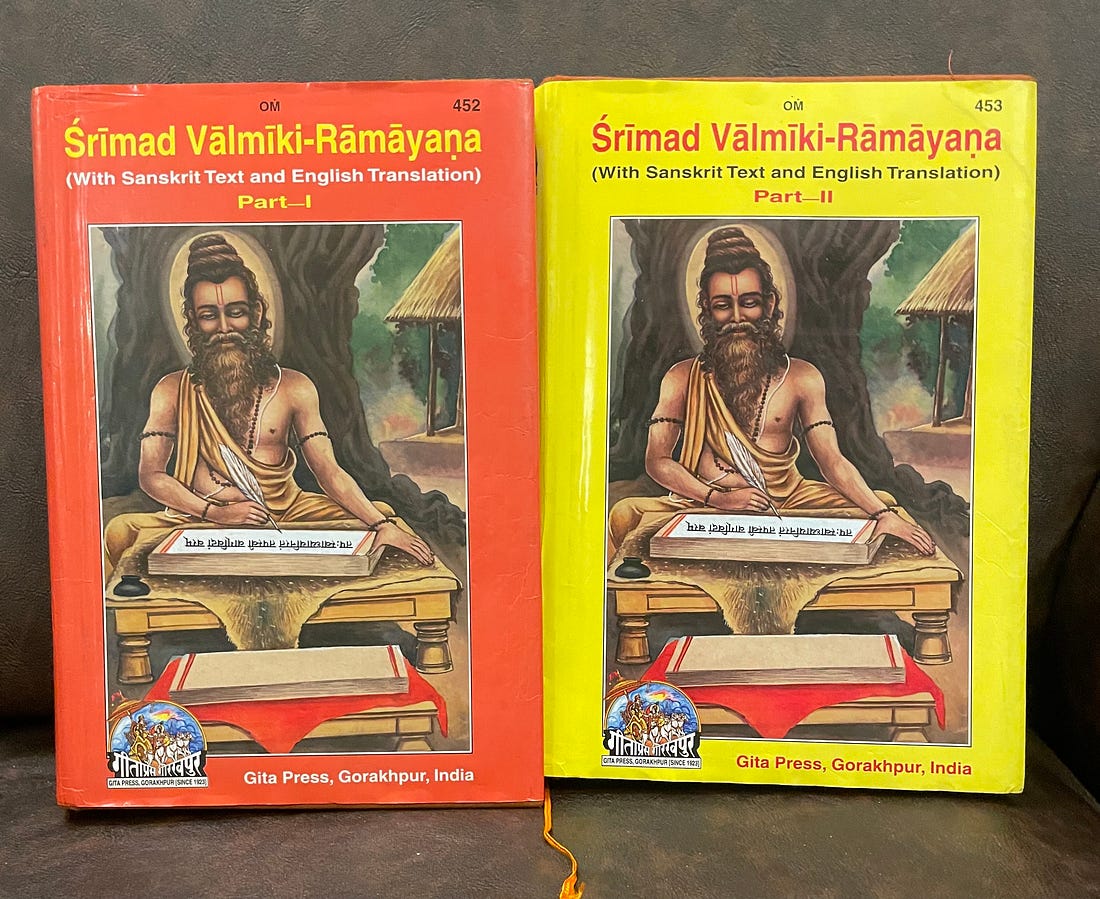
I’m happy to share 19,937 verses - 534 Sargas over 6 Kandas - from my four-year journey reading The Gita Press English translation of the Valmiki Ramayana and pairing it with original Sanskrit ghanapaati recitations on Spotify.
This effort is a labour of love dedicated to the Rama and Sita who raised me: my parents. My hope is that it makes the Ramayana easy for young people to explore, with the unique sound of Sanskrit followed by the story in English.
This podcast includes an authentic Sanskrit recitation and a genuine English translation by Gita Press, Gorakhpur, India. This is not a western translation of the Valmiki Ramayana, nor a re-telling in any form. It is translated by Hindus from within the tradition, and it is thereby recommended as the most authentic recitation and English reading available.
The Ramayana recitation by Sriram-ghanapaati HariSitaramamurti-ghanapaati comes from archive.org. The reading uses the English version of Srimad Valmiki Ramayan by Gita Press, Gorakhpur.
Here is the final sarga of Yuddhakanda: Sri Rama’s coronation, Sita blessing Hanuman with her necklace, and the epic’s glory.
 | Yuddhakanda Sarga 128, (Book 6 Canto 128) Ramayan Podcast Episode |
What have I learned from this experience? Engaging consistently with the original Ramayana provides deeper insight and builds a more personal connection with its characters and lessons.
Listening to the Ramayana is awesome! Hearing the Sanskrit recitation of the Srimad Valmiki Ramayana helps us get used to the epic’s sound, just like people did long ago by listening.
The story’s real value lies in its nuance. Amar Chitra Katha gives only a bare outline of the plot. If you stop there, you miss crucial nuance. Abridged versions can make young people ask, “What’s the big deal?” Then, Sri Rama can seem not dharmanishta but just blindly obedient; not an anguished king forced to test his wife, but a misogynist obsessed with purity.
Reading consistently reveals the complexity of the characters, who are not simply black and white. Listening to only the bare bones of the story leaves them two-dimensional and flat. To understand and appreciate dharmasankata, regular engagement with the original is necessary.
Details are essential for understanding. In Sundarakanda, Hanuman is more than an action hero; he acts thoughtfully. In Sarga 30, before approaching Sita, he carefully weighs the pros and cons. Hanuman never acts without thorough consideration. He truly embodies Bala, Buddhi, and Vidya; these qualities are best appreciated by engaging deeply with Valmiki’s Ramayana.
Listening to the full text will help us connect with whatever resonates deeply with us. And it could mean different things to different people. The fierce warrior that Sri Rama is - he goes after evil to eliminate it. We forget this in modern tellings. For example, in Sarga 9 of the Aranyakanda, Sita tells Rama not to kill the ogres in Dandaka forest without enmity, and to eschew violence. But Sri Rama reiterates that it is his duty to protect the innocent, and he has given his word to the sages since he has the capability to protect them and their happiness from the ogres of cruel activities. In these times when we are obsessed with non-violence (ahimsa), this conversation gives an important perspective.
There are many little details revealing a lesser-known side of Rama: his profound grief after Sita’s disappearance, leading him to faint, wail, and become depressed. In Sarga 58 of the Aranyakanda, he repeatedly claims he will die and shows no interest in ruling the world; his life has no worth without Sita, whom he considers more precious than his own life. He is physically and mentally weakened until Lakshmana comforts and encourages him. Then, Rama expresses his rage and threatens to burn down the three worlds if he does not find Sita. In Sundarakanda, Rama is described as emaciated with grief while waiting for news from Hanuman. Even in battle (Yuddhakanda Sarga 83), Rama faints in grief upon hearing that Sita has been killed, “like a tree whose roots have been severed.”
The Ramayana helps us appreciate ideal conduct and relationships. Even a little monkey in the epic has given its best because of the divine inspiration it receives from the proximity of Sri Rama, Devi Sita, and the mighty Hanuman. We understand how life must have been in a time that valued responsibilities over rights.
Only the original Valmiki Ramayana helps us understand its lasting appeal: it influenced many ancient countries, especially Southeast Asia, and continues to shape cultures today.
Every effort, no matter how small, contributes to building something lasting, just as every grain of sand carried by small squirrels helped build the Ramasetu. It’s an important lesson for modern Hindus trying to pass on our faith and culture to our children, as we struggle to bridge an ancient culture to modern times.
To listen to Sundarakanda, start here:
| Sundara Kanda Sarga 1, "Hanuman's Flight over Ocean", Book 5 Canto 1 Ramayan Podcast Episode |
Link to the whole podcast, starting with Balakanda:
| The Authentic Valmiki Ramayana Ramayan Podcast Podcast |
The podcast is being heard by 3700 young people, many of them college students, on their daily commute. It’s become the second-most-popular Ramayan podcast, known for “its focus on the original scriptures and authentic narration and theological accuracy.”
The Authentic Valmiki Ramayana is available on all popular podcast platforms.
Give it a listen, and share it with friends!
-By Rekha Achyutuni, Founder of Hindu Parenting.
Hindu Parenting is a community for Hindu parents worldwide. We carry articles, podcasts, reviews, classes for teens and various other resources to help you in your parenting journey.
Subscribe to get the latest articles and podcasts in your e-mail inbox. See more at hinduparenting.org
Leave a note, DM or send email to contact@hinduparenting.org if you’d like to share your viewpoints, experiences and wisdom as Hindu parents, or if you wish to join our community!
You can also follow us on X (Twitter) or Instagram. Our handle is “hinduparenting”