Why being boxed into ‘scientifically proven’ categories comforts usIn the past week itself, two important developments have taken place that reinforce the core anxiety of our cultural imagination of gender: does proclaiming one’s gender make it so?
The first development took place at a national level. The Transgender Persons (Protection of Rights) Amendment Bill, 2026, was cleared by Parliament during its ongoing budget session, which wrongly conflated intersex variations and differences in sexual development (DSD) with transgender identities. In doing so, it also dropped the crucial self-identification clause that has already been established by a series of seminal Supreme Court verdicts since 2014. The second development occurred on Thursday, when the International Olympic Committee (IOC) president Kristy Coventry announced a new Policy on the Protection of the Female (Women’s) Category in Olympic Sport and Guiding Considerations for International Federations and Sports Governing Bodies. The policy mandates gene testing for women and girls participating across all sporting categories in the 2028 Summer Olympics in Los Angeles. This announcement comes after months of deliberations by medical experts appointed by the IOC, and reinstates gender-testing in the Olympics after 2000. Last year, World Athletics and World Boxing approved the use of the same test—the SRY Gene test—on all women participants. Both instruments have a common central imagination—that gender is based on sex characteristics—but approach it from different angles.
The Transgender Persons Bill purports to benefit transgender persons by wrongly defining them as persons with intersex variations or DSD. This follows from a flawed thinking of gender being a direct result of the chromosomes—XX and XY—found in female and male bodies. Ironically, the very existence of intersex variations and DSD sets aside this binary logic, where male and female sex characteristics map neatly on to man and woman. The bill collapses chromosomes and sex characteristics with gender identity, gender identity with gender expression, and gender expression with criminal social behaviour. It creates a law with a filtering system where transgender people have to be medically certified, which leaves out swathes of people who don’t fit within this so-called scientific imagination. In a welfare state, where the economically disadvantaged are entitled to benefits, reverting to a binary logic will enable the State to sift through claimants. This was explicitly explained by Dr Parmar Jasvantsinh Salamsinh, one of the Members of Parliament who belongs to the Bharatiya Janata Party, during the discussion in the Upper House. The IOC policy purports to protect sportswomen whose participation and victory in elite sports is seemingly threatened by women with intersex variations and DSD. Though the IOC’s guidelines were made after several rounds of consultation with experts, including those from medical and scientific fields, there is enough testimony that casts doubt over the efficacy of the SRY gene test.
The scientist who discovered this gene in 1990 warned against using it as a singular test to determine an individual’s sex. What’s more, there is no published research showing that the presence of the SRY gene itself is linked to athletic performance. No doubt, those who try and game a system should be filtered out, but let’s not hide behind science to penalise naturally-occurring differences, as that has real-world implications on those being tested and medically certified. In the absence of conclusive scientific evidence, peer-reviewed research, and even community consultation, what explains the unwillingness of lawmakers and governing bodies to let go of the binary logic, and admit that the plurality of gender, or even of sex characteristics, is not a threat? Might it be that it emerges from a colonial, Judeo-Christian outlook that only accords value to the word of god, not man (certainly not woman, and definitely not transperson)? Only god can say, let there be light, and there was light. If a mortal proclaims something into being, it challenges the way power works in our society: class, caste, race, gender, sexuality and other hierarchies function because power is not equally distributed. To imagine self determination—where one’s word is enough to call one’s identity into being—is to imagine a world where everyone, even those at the bottom of the hierarchy, has power. READ | Touching Grass: A Book of ComicsRachita Taneja compiles the political cartoons she has made over the past 12 years and offers it up with commentary on our response to everything going on in the world.
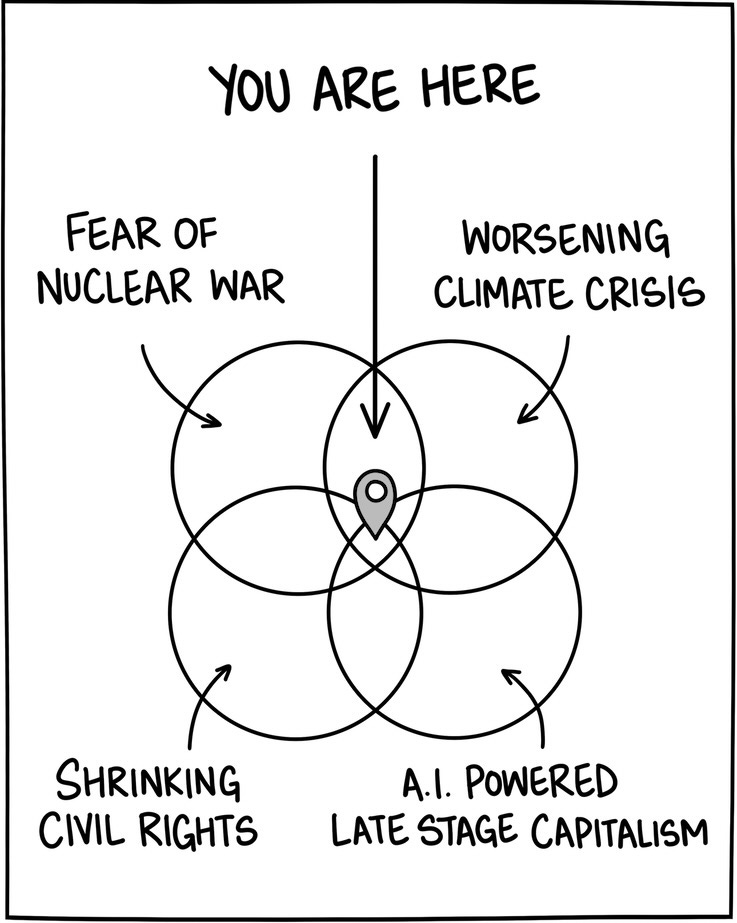
Her disarming introduction explains how she took to drawing political commentary, named it Sanitary Panels, and why, 12 years on, misinformation, artificial intelligence, political crackdown on dissent, social media deluge, wars, climate change and doom-scrolling have led her to the point of reassessing one’s role in the world. Touching Grass, a term that refers to grounding oneself and getting in touch with reality, is an apt response, and perhaps the only sane one, her new book seems to suggest.
LISTEN | Sweet Dreams (Are Made of This) by Arooj AftabGrammy winner Arooj Aftab’s Urdu rendition of the 1983 Eurythmics synth pop UK and US chart topper, Sweet Dreams (Are Made of This), which dropped on Thursday. Recorded in collaboration with British-Indian DJ Anish Kumar, the song titled Sunehray Khwabon (Ka Khel Hai), is part of the soundtrack of Bait, an Amazon Prime Video series created and co-written by Riz Ahmed — a British actor of Pakistani heritage. Expect some sitar, and a lot of synth that Annie Lennox and Dave Stewart propelled to musical greatness, defining the sound of a generation, and an almost-exact translation of lyrics. As a child of the 80s, however, I’m still partial to the original music video, where Lennox’s gender-bending androgynous look, which the BBC said, broke the mould of female pop stars of the time.  Dhamini Ratnam is culture editor at Hindustan Times. Ways of Seeing is her weekly newsletter that takes you through only the most important cultural happenings you need to know of. You can write to her at dhamini.ratnam@htlive.com or comment on this newsletter below. Edited by Dhrubo Jyoti. Produced by Tushar Deep Singh.Thanks for reading Ways of Seeing! Subscribe for free to receive new posts and support my work.
|
Why being boxed into ‘scientifically proven’ categories comforts us
19:30
0