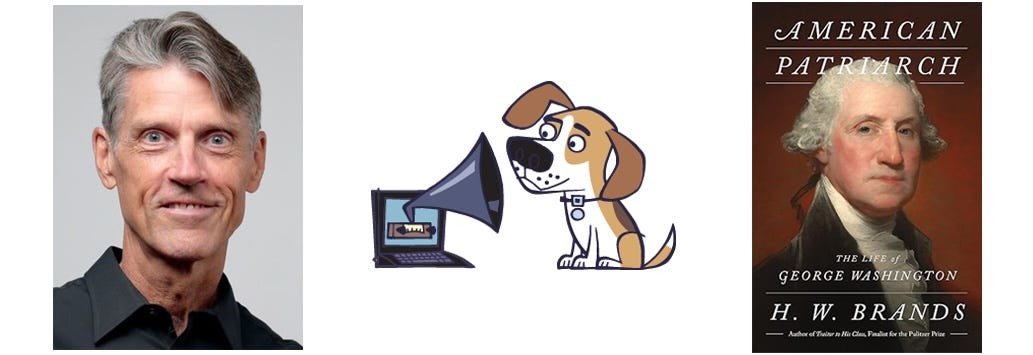
Bill is a historian. He currently teaches at the University of Texas, where he holds the Jack S. Blanton Sr. Chair in History. He’s the author of more than 30 books, including The First American and Traitor to His Class. His new book is American Patriarch: The Life of George Washington. As part of our occasional series on great Americans, it was time for the OG American. I learned a lot reading the book and talking to Bill.
An auto-transcript is available above (just click “Transcript” while logged into Substack). For two clips of the episode — on Washington’s humane display of aristocracy, and how he’s the antidote to today’s politics — head to our YouTube page.
Other topics: Bill growing up in a Catholic neighborhood in Portland, Oregon; teaching at a Jesuit high school in his early 20s; the different styles of historians; Washington born into the Virginia gentry; losing his dad at a young age; smallpox as a teen likely making him infertile but protecting him during war; his skill at land surveying; joining Ben Franklin in the Ohio Company of land speculation; British arrogance toward colonists; GW accidentally sparking the French and Indian War; his grudge against the Crown; losing most of his battles but winning both wars; his Dunkirk and his D-Day; a meh tactician but a grand strategist; his wise retreats; absconding to Mount Vernon; Hamilton and LaFayette as surrogate sons; attacking the Brits on Christmas; holding the army together at Valley Forge; the deep loyalty of his men; keeping his ego in check; Shays’ Rebellion; GW the key to securing the Constitution; declaring neutrality in European wars; his farewell address; and warning against partisanship.
Browse the Dishcast archive for an episode you might enjoy. Coming up: Ben Rhodes on Iran and speech-writing, John Gray on Trump’s new world, Bob Wright on the evolutionary force of AI, Tiffany Jenkins on privacy in a liberal democracy, Daniel McCarthy on conservatism, Stephen Grosz on the struggles of love, David Thomson on cinema history, and Robby George on all our disagreements. Please send any guest recs, dissents, and other comments to dish@andrewsullivan.com.
From a fan of last week’s episode:
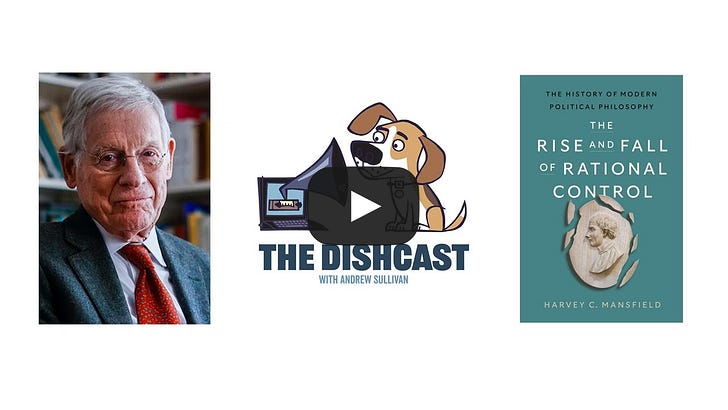
I enjoyed your conversation with Harvey Mansfield and was touched by your obvious affection for him.
I have a question, but it’s a bit personal: What were your thoughts, as a gay man, when he was your tutor?
I ask in part because I met Mansfield once, almost 20 years ago, when he came as a guest speaker to a freshman seminar I taught on youth culture in the 1960s. One of my students, rather courageously, challenged him for using a cliched, derogatory term for gays. She mentioned that her brother was gay, and conveyed, with some emotion, that Mansfield’s comment did not sit well with her. He just sort of absorbed the criticism — he didn’t elaborate, or defend it — and we moved on.
My sense is that he wasn’t averse to gays on an individual level — your terrific relationship with him seems to show that — but he’s of a generation that was often casually dismissive of gays, and by 2008, he still hadn’t moved on. Did that ever bug you?
Well, yes. Harvey is a gentleman and would never think less of someone for being gay. And after I had graduated, he agreed to debate me at Harvard on the question of gay marriage, which we did in Michael Sandel’s legendary class, “Justice” (for which I was also a teaching fellow.) Here’s a 1993 article from the Harvard Crimson covering that debate. Money quote:
“It is often said that controversial issues cannot be debated at American universities,” Sandel said. “Today we proved otherwise.”
Those were the days I wasn’t de-platformed and we could debate rigorously and in good faith. A distant memory now. I last got a college invite seven years ago. Even someone who is credited with pioneering the arguments for marriage equality is anathema. Because I will not submit to the queers.
Another listener writes:
I had no idea you were a Mansfield protégé. His translation of Tocqueville is probably the best there is.
It’s gorgeous. But the best translation he has done is Machiavelli’s The Prince. It’s like when they renovate a masterpiece correctly. You see clean through the gloss to the real thing.
This next listener responds to our pod with Jerusalem Demsas on how the Dems have gone astray:

The Democrats lost me for good on immigration. Here’s just one example of how hostile and dishonest so many were, and still are, regarding that issue (the biggest one of the century, aside from AI): a close friendship of 22 years ended shortly after the 2018 midterms. Sherrod Brown had hung on in Ohio, against a very flawed candidate, but the election results by county were startling. In several Rust Belt counties that were once very Dem-leaning and more economically liberal, Brown didn’t just lose; he was wiped out in all but a few counties, where he ran up big margins.
My friend and I had both just finished helping on separate Dem congressional campaigns. I remarked that Dems had little chance of appealing to alienated voters in de-industrializing and rural counties if those voters perceived the Dem message as: your citizenship and pride in place means nothing; this country should have virtually open borders; and labor arbitrage benefiting upper-middle-class professionals and investors at your expense is a valid approach to trade.
He disagreed entirely and was insulting about it. He told me flatly that I “sound[ed] like some nutter on Facebook.” This is the general counsel of a nonpolitical nonprofit, and I had written a bar recommendation for him and spoke at his wedding. I have experienced some version of this exchange, again and again: Dems pretending to pity me — in a nasty, condescending, dismissive manner — for seeing and acknowledging reality. Those same Dems tell me that I’m the one imagining things and/or wildly exaggerating. Nobody actually support open borders, they said — but how bigoted and right-wing of me for even using that distillation to describe how other voters might see the issue. And illegal immigration is a made-up non-problem, only being pushed as a vile, racist, culture war attack by GOP operatives.
But also: there is nothing wrong with having open borders, they say, and virtually everyone else in the world is more deserving of a place here than I am.
Yes. I published the following graph in Notes this week:
It’s a graph of immigration to the UK in two-and-a-half centuries. It’s why the two main parties who made this happen — Labour and the Tories — are now often in third or fourth place. And almost all the responses I got on Notes were variations on: “So what’s wrong with that?” “Serves the British right for empire.” “You’re obviously a racist for even thinking of this.” And this is how most Democrats are. They still don’t have a clue. And they will not allow their 2028 candidate to support strong immigration control. Which means president Vance or Rubio. If we’re lucky.
Another listener writes, “I have a great idea for a podcast guest”:
He’s a new voice, young, and very sharp: Adam Szetela. His first book, That Book is Dangerous!, is about the monoculture and woke panic in the publishing industry — in other words, it’s right up your alley! I learned of Adam because we both belong to a group called the Heterodox Academy, which promotes viewpoint diversity in higher ed. He’s very bright and easy to talk to.
A reader writes, “Last week’s column resonated with me deeply”:
Learned helplessness is a good way to describe the last 10 years for me. When Trump ran for president, I assumed no reasonable person would vote for him. His win was shocking, but I was also shocked by the animosity I received from Trump supporters when I said I didn’t vote for him even while agreeing with them on many other things.
Around the same time, I was mostly surrounded by liberals, and if I complained about wokeness, they would nod along — but then claim it was just a few crazy fringe people on the far left. In 2020, I was very critical of the “racial reckoning” and expected moderate liberals to have my back. Once again, I was shocked to find that they fully embraced BLM.
I got into many arguments where I pointed out that the data showed no anti-black racism in police shootings and that killings of unarmed black men were statistically rare. People made ridiculous retorts like “What about George Floyd?,” “Police are three times more likely to kill black men,” and “Well, people’s perception is that police are killing a lot of black men.”
Eventually I refused to talk about politics anymore, and this has persisted to the present day. I have stopped following the news and have not voted since voting for Biden in 2020. While Trump is doing a lot of things that are objectively terrible, I mostly don’t find out about them and have no emotional reaction when I do.

It’s not that I’m depressed overall; I’m busy in day-to-day life with work, dating (well, trying to), lifting weights, and martial arts training. However, I have stopped caring about my country or following the news. Imagine you live in a Third World country with a corrupt dictator, but you are safely secluded within your own corner and can go about your day-to-day life while ignoring the outside world. That’s basically who I am at this point, living in the US. I may be ignoring my civic duty, but that has to be a collective effort.
I still read your column every week and admire you for fighting the good fight. Few people have stood up to both Trump and wokism, but you have — and there is a great honor in that.
Here’s a dissent:
Wow, that column was depressing. Not that I disagree with its basic premise. We’re in a very dark place, and the Mad King responsible for the darkness is only getting worse by … the hour?
But allow me to dissent from something: your “bothsidesism”. ...



%26stroke%3Dnone%26strokeWidth%3D3.6)