Thanks to a new law Trump just signed… Every day until April 2027 the entire GDP of Switzerland will migrate onto Trump's New Money Grid, that's $909 billion. Every single day. That's every bank account, every fund, every mortgage, every stock trade in America. Translation: our entire financial system is migrating onto a new blockchain-based Money Grid. And every dollar that moves burns one scarce asset. That's why BlackRock, JPMorgan, Goldman Sachs and Fidelity are hoarding shares like it's Black Friday. Get in on the trade BlackRock, JPMorgan, and Fidelity are already making. The Nasdaq just got SEC approval to move stocks onto blockchain rails. BlackRock CEO Larry Fink dedicated his entire 2026 annual letter to it. The World Economic Forum says 2026 is "a defining moment" for this new financial infrastructure. Everyone who's actually building this thing is saying the same thing… This is not a drill. This is the biggest overhaul of America's money system since we stopped using gold coins. And at the center of it all? A scarce asset that gets burned every single time a transaction happens. Block Chain expert Andy Howard is calling it "Digital Oil." And right now, before this goes mainstream, you can still get in at prices the institutions would love to lock in forever. Get the name. The ticker. And exactly how to buy here. Your future looks bright, Andy Howard
The Edge™ Senior Blockchain Analyst PS I'm predicting this could potentially be one of, if not THEE most explosive wealth opportunities I've come across. That's why you can't drag your feet here, because once retail investors catch wind of this, it will be too late… Click here before it's too late to get in on the trade.
Today's Bonus Story
ASML’s Chip Dominance Runs Into New Silicon BoundariesReported by Jeffrey Neal Johnson. Publication Date: 6/24/2026. 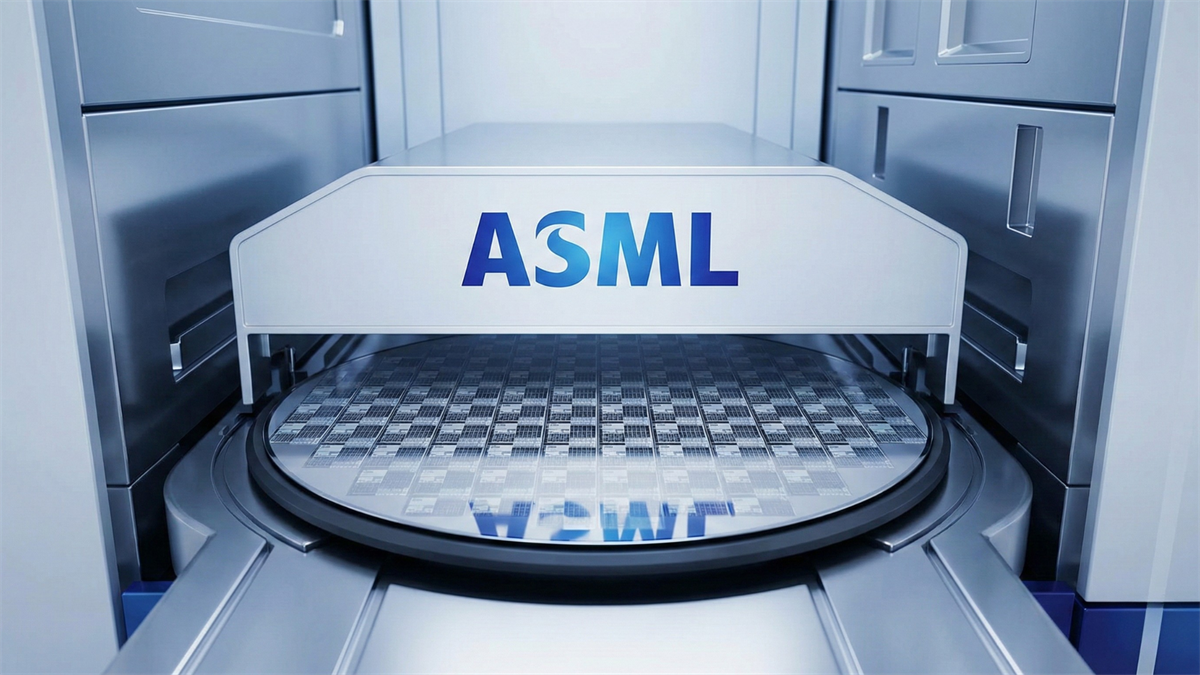
Key Points
- Massive investments in global fabrication infrastructure are paving the way for sustained expansion across the entire chip sector.
- The unprecedented and continuous demand for artificial intelligence hardware provides a highly secure structural foundation for advanced lithography platforms.
- Subsidized manufacturing facilities being constructed throughout Western nations are set to successfully absorb and redistribute future capital equipment allocations.
- Special Report: SpaceX doesn’t need your money
On June 23, 2026, the equity market delivered a sharp reminder that technology leadership is inseparable from global trade policy. Shares of the Dutch lithography giant ASML Holding N.V. (NASDAQ: ASML) declined 7.82%, pulling back from the all-time high of $1,929.68 reached on June 18, 2026. The immediate catalyst was the official announcement that the Dutch government would join the Pax Silica alliance, a U.S.-led coalition designed to coordinate artificial intelligence (AI) hardware and supply chain security. Funding for Domestic Rivals Reshapes the BoardThis alignment raises expectations of deeper, multilateral export restrictions. It also reinforces a growing policy-driven discount on premium technology valuations. Compounding the pressure, the U.S. Commerce Department recently awarded a $150 million investment to xLight, an American startup developing alternative extreme ultraviolet source technology. The funding signals a strategic U.S. effort to cultivate domestic lithography alternatives, adding a small but meaningful competitive variable to ASML's long-term outlook.
For capital allocators, navigating this landscape requires distinguishing between temporary policy disruptions and structural demand trends. While trade restrictions introduce real operational friction, the broader semiconductor capital equipment sector remains supported by unprecedented physical expansion of global manufacturing capacity. Squeezing China While Securing Western SoilThe main driver of current investor anxiety is the proposed Multilateral Alignment of Technology Controls on Hardware (MATCH) Act. This U.S. bill establishes a strict 150-day deadline for allied nations to align their export policies with Washington's standards. Unlike previous rounds of restrictions that focused on advanced extreme ultraviolet systems, the legislation targets older, mature-node deep ultraviolet immersion equipment. Crucially, the legislation would prohibit Western companies from providing software upgrades, replacement parts, and maintenance services for equipment already installed in China. That measure strikes at the heart of ASML's highly profitable service and maintenance business. Dutch Trade Minister Sjoerd Sjoerdsma actively lobbied in Washington against these service-level bans, arguing that unilateral restrictions disrupt the integration of allied supply chains. Nevertheless, the Netherlands' decision to join the Pax Silica initiative suggests that economic security priorities will override corporate export preferences, creating a long-term drag on recurring services. This decoupling is already visible in the company's financial trends. In the final quarter of 2025, Chinese clients accounted for 36% of ASML's system sales. By the first quarter of 2026, that figure had fallen to 19%. The sequential drop suggests Chinese customers were front-loading orders in anticipation of tighter limits. As that temporary demand cushion fades, the market must adjust to a lower baseline of legacy system revenues. How Subsidized Fabs Anchor Advanced LithographyDespite these regulatory headwinds, the fundamentals of the advanced lithography business remain healthy. In the first quarter of 2026, net sales reached 8.8 billion euros (approximately $9.4 billion), beating consensus estimates and producing a gross margin of 53%. Reflecting robust demand from Western customers, management raised its fiscal 2026 consolidated sales guidance to a range of €36 billion to €40 billion (approximately $38.5 billion to $42.8 billion). This optimistic outlook reflects the massive capital expenditure budgets Western manufacturers have committed to. As the artificial intelligence hardware buildout continues, companies like Intel Corporation (NASDAQ: INTC) and Taiwan Semiconductor Manufacturing Company (NYSE: TSM) are constructing leading-edge fabrication facilities in both the U.S. and Europe. These multi-billion-dollar projects, heavily subsidized by regional government programs, require substantial deployments of advanced lithography tools. While legacy Chinese deep ultraviolet demand is shrinking, the transition to high-performance artificial intelligence processors requires next-generation extreme ultraviolet and High-NA extreme ultraviolet platforms. Because ASML maintains sole-supplier status in extreme ultraviolet systems, its high-end backlog remains well protected. The reality of the technology supply chain is that global demand for advanced computation has not diminished; it is simply being reshaped geographically. Western projects, backed by substantial subsidies, will absorb the capital expenditures originally planned for Asian markets and eventually backfill some of the demand now blocked there. Nikon Wages a Legacy Pricing WarWhile the high-end extreme ultraviolet market remains a monopoly, the mature-node deep ultraviolet market is facing new competitive challenges. In late May 2026, Nikon Corporation (OTCMKTS: NINOY) announced that its new chief executive, Yasuhiro Ohmura, would pursue an aggressive commercial strategy to capture mature-node market share by offering steep price discounts on its argon-fluoride immersion deep ultraviolet systems. By using in-house component manufacturing, Nikon is positioned to undercut ASML's average deep ultraviolet tool price of $82.5 million. At the same time, Chinese domestic lithography competitors are attempting to fill the import gap. Reports indicate that Shanghai Micro Electronics Equipment is mass-producing a domestic immersion scanner capable of 10 nm. Although these domestic Chinese tools are several generations behind Western cutting-edge capabilities, they represent a viable alternative for Chinese fabs operating legacy nodes. These dual competitive threats mean that even if the regulatory landscape softens, the mature-node business segment faces potential margin compression. Investors cannot assume that legacy deep ultraviolet sales will continue to generate historical profitability. However, the secular strength of the high-margin advanced segment remains the primary driver of long-term equity value, distinguishing ASML from competitors focused solely on older technologies. Playing the Silicon Long GameFor the broader semiconductor sector, the recent correction in equipment stocks points to a localized discount rather than a systemic risk. Institutional behavior suggests a lack of panic; short interest in the leading Dutch hardware supplier is just 1.03 million shares, or 0.26% of the public float. That indicates professional short-sellers are not making significant directional bets against ASML's long-term dominance. The physical economy requires more silicon, and that silicon cannot be patterned without specialized lithography. The current regulatory friction is reshaping the global trade map, but the semiconductor sector's long-term upward trajectory remains intact. Cautious investors may prefer to wait for a technical base to form and for regulatory clarity on the MATCH Act's servicing ban before establishing or expanding long-term positions in the lithography space.
. |