
Thanks to a new law Trump just signed…
Every day until April 2027 the entire GDP of Switzerland will migrate onto Trump's New Money Grid, that's $909 billion. Every single day.
That's every bank account, every fund, every mortgage, every stock trade in America.
Translation: our entire financial system is migrating onto a new blockchain-based Money Grid.
And every dollar that moves burns one scarce asset.
That's why BlackRock, JPMorgan, Goldman Sachs and Fidelity are hoarding shares like it's Black Friday.
Get in on the trade BlackRock, JPMorgan, and Fidelity are already making.
The Nasdaq just got SEC approval to move stocks onto blockchain rails.
BlackRock CEO Larry Fink dedicated his entire 2026 annual letter to it.
The World Economic Forum says 2026 is "a defining moment" for this new financial infrastructure.
Everyone who's actually building this thing is saying the same thing…
This is not a drill. This is the biggest overhaul of America's money system since we stopped using gold coins.
And at the center of it all?
A scarce asset that gets burned every single time a transaction happens.
Block Chain expert Andy Howard is calling it "Digital Oil."
And right now, before this goes mainstream, you can still get in at prices the institutions would love to lock in forever.
Get the name. The ticker. And exactly how to buy here.
Your future looks bright,
Andy Howard
The Edge™ Senior Blockchain Analyst
PS I'm predicting this could potentially be one of, if not THEE most explosive wealth opportunities I've come across. That's why you can't drag your feet here, because once retail investors catch wind of this, it will be too late…
Click here before it's too late to get in on the trade.
FuelCell Energy Just Got a Wake-Up Call From Wall Street
Authored by Jeffrey Neal Johnson. Posted: 6/10/2026.
Key Points
- Canaccord Genuity upgraded FuelCell Energy from Hold to Buy with a $30 price target, sending shares up more than 12%.
- FuelCell Energy's sales pipeline grew 267% sequentially to 4 gigawatts, with 89% of that demand coming from AI data center clients.
- The company plans to spend $200 million to $275 million expanding its Torrington, Connecticut, facility to support standardized 12.5-megawatt power block production.
- Special Report: SpaceX is offering you shares. Don't take them.
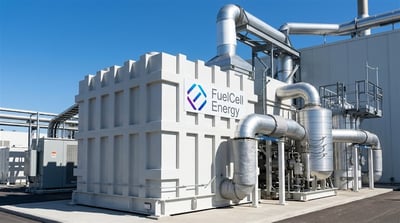
An aggressive analyst upgrade sent shares of FuelCell Energy (NASDAQ: FCEL) climbing more than 12%, signaling a powerful shift in how the market values this clean energy innovator. This appears to be more than just another volatile move; it looks like a fundamental repricing.
The catalyst was a clear signal from Canaccord Genuity that FuelCell Energy is evolving from a speculative green energy play into an essential, utility-grade infrastructure provider for the AI super-cycle. The rally reflects a growing realization that, as AI data centers push the national power grid to its breaking point, localized and reliable energy solutions are no longer a luxury; they are a necessity.
BUY THIS: Claim a backdoor stake in SpaceX (Ad)
Marc Chaikin, the Wall Street veteran who spotted Nvidia before a 45,000% run, says there's a simple trade available in your brokerage account today that offers backdoor pre-IPO exposure to SpaceX.
With the IPO date approaching, Chaikin believes this position could benefit from as high as a $122 billion windfall on IPO day - and he warns against buying in on day one due to potential price instability.
See exactly how to make this trade before SpaceX goes publicFor investors who have been watching from the sidelines, this price action serves as a critical alert. The market is beginning to connect the dots between the explosive growth in AI and the foundational need for the exact power solutions FuelCell Energy provides.
The Upgrade Is the Spark, The Pipeline Is the Fuel
The immediate catalyst for the breakout was a decisive upgrade from Canaccord Genuity, which moved its rating on FuelCell Energy from Hold to Buy and set an ambitious $30 price target. That valuation is based on forward-looking analysis of a massive, unfolding opportunity. The firm's conviction is rooted in intelligence suggesting a transformative data center deal is on the horizon, positioning FuelCell Energy to follow the highly successful commercial roadmap laid out by its peer, Bloom Energy (NYSE: BE).
While a glance at the fiscal Q2 2026 earnings report shows a revenue dip and an operating loss, investors are now looking past these lagging indicators. The truly significant number in the report was the 267% sequential growth in FuelCell Energy's sales pipeline, which has now ballooned to 4 gigawatts (GW).
This isn't speculative; it's a direct reflection of inbound demand. Crucially, management confirmed that 89% of this pipeline consists of potential AI data center clients, validating the thesis that hyperscalers are actively seeking out FuelCell Energy's solutions. The past quarter's financials represent the cost of positioning for this tidal wave of demand, while the pipeline represents future revenue.
Building the Power Plant of the Future, Today
To meet this surge of interest, FuelCell Energy is making a smart strategic pivot. The business is moving from customized projects to standardized, 12.5-megawatt (MW) utility-grade power blocks designed for rapid deployment. To ensure it can deliver, FuelCell Energy announced a capital expenditure plan of $200 million to $275 million to expand its Torrington, Connecticut, manufacturing facility.
Investors should not see this as a risky expenditure, but as a necessary investment to capture a once-in-a-generation market opportunity. Building out capacity ahead of contract signings is a sign of management's conviction in the quality of the pipeline.
They are building the factory because they have the orders lined up at the door. The comparison to Bloom Energy is not a stretch; it's a playbook. Bloom Energy has already proven the model, and FuelCell Energy is now positioned at an earlier, potentially higher-upside stage of the same growth trajectory. It's about securing manufacturing capacity to become a key supplier in the AI arms race.
From Bearish Bets to Bullish Conviction
While the upgrade certainly forced some bearish investors to reconsider their positions, it would be a mistake to dismiss the 12% rally as a technical event. The surge represents a genuine and durable shift in market sentiment. For years, the narrative around FuelCell Energy has been defined by its potential in a theoretical green future. Now, that future has arrived in the form of the AI revolution, which has an immediate and insatiable appetite for power.
The market is waking up to the fact that FuelCell Energy's technology, which provides continuous baseload power directly at the point of use, is a strong solution to the challenges data centers face. This rally wasn't just about covering shorts; it was about long-term investors recognizing that the entire thesis for owning FuelCell Energy has fundamentally changed for the better. The business is now aligned with one of the most powerful secular growth trends of the next decade.
A New Era of Growth Is Powering Up
The recent 12% surge in FuelCell Energy's stock price is more than just a fleeting rally; it's a signal that the market is beginning to correctly price the business as a critical infrastructure provider for the AI era. The Canaccord upgrade and the enormous growth in the data center pipeline provide tangible evidence that the long-promised potential of fuel cell technology is finally meeting massive real-world demand.
While past financial results reflect the cost of innovation, the forward-looking metrics point toward a significant inflection in revenue and growth. Investors looking for a pure-play on the AI power bottleneck may see the current momentum as the beginning of a much larger, fundamentally driven move.
3 Retail Winners Using Cash Flow to Stay Ahead
Authored by Thomas Hughes. Posted: 6/20/2026.

Key Points
- TJX Companies, Williams-Sonoma, and Tractor Supply combine aggressive share buybacks with dividend growth to deliver capital-efficient returns to shareholders.
- Williams-Sonoma leads peers in buyback intensity, reducing its share count by nearly 4% over the trailing 12 months while maintaining an operating margin above 16%.
- Tractor Supply has raised its dividend for 16 consecutive years, yielding approximately 3.2%, with further increases expected as cash flow remains healthy.
- Special Report: SpaceX is offering you shares. Don't take them.
Retail “apex predators” like TJX Companies (NYSE: TJX), Williams-Sonoma (NYSE: WSM), and Tractor Supply Company (NASDAQ: TSCO) harness consumer trends to gain market share, generate cash flow, and deliver value for investors.
While dividends are central to their investment appeal, these companies also aggressively buy back shares, boosting profitability and dividend support while signaling confidence in cash flow. Capital efficiency is a unifying trait among the three, with growth, financial health, and shareholder returns balanced to support long-term sustainability.
Buybacks Drive Value Gains for Stock Owners
BUY THIS: Claim a backdoor stake in SpaceX (Ad)
Marc Chaikin, the Wall Street veteran who spotted Nvidia before a 45,000% run, says there's a simple trade available in your brokerage account today that offers backdoor pre-IPO exposure to SpaceX.
With the IPO date approaching, Chaikin believes this position could benefit from as high as a $122 billion windfall on IPO day - and he warns against buying in on day one due to potential price instability.
See exactly how to make this trade before SpaceX goes publicThe impact of buybacks on shareholder value cannot be understated. At worst, buybacks offset the effects of dilution; at best, as with the stocks on this list, they reduce the share count. Reducing the share count increases the value of each remaining share because it represents a larger portion of the underlying business, and it is a tax-efficient way to return capital. It also offsets the impact of dividend payments by reducing the number of shares outstanding, helping support sustainable dividend increases that can amplify shareholder returns.
Institutional activity underscores the importance of these companies to income and total-return investors. TJX carries the lowest institutional ownership, but even that remains robust at 90%, while Tractor Supply and Williams-Sonoma are virtually 100% institutionally owned.
Tractor Supply Company: Life Is Good, Gaining Share
Tractor Supply Company is a big-box retailer focused on less-urbanized areas. Its product mix spans several categories, with an emphasis on home, yard, and farm goods, daily essentials, hardware and supplies, and pets.
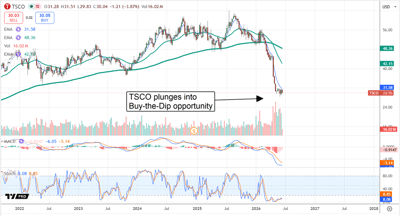
The story in 2026 is that growth has slowed but remains intact, with revenue advancing at a sustainable, modest single-digit pace. Margin compression was evident in fiscal Q1, tied to an expanding store base and slowing sales. The key takeaway is that cash flow remained healthy, enough to cover the dividend and support share buybacks.
Tractor Supply Company’s buybacks reduced its share count by more than 1% on a trailing 12-month basis. Meanwhile, the dividend yielded approximately 3.2%. Buybacks are likely to continue, as the company remains committed to capital returns, and additional distribution increases are expected. The company has increased its dividend for 16 consecutive years and is on track to be included in numerous dividend-tracking indices. This year’s catalysts include expanded offerings in hardware and electrical, store count growth, and an inflection in revenue and earnings growth, which is expected to show up in the upcoming Q2 release.
Williams-Sonoma: Margin Strength Shines in All Parts of the Consumer Cycle
Williams-Sonoma is a smaller, niche retailer focused on an upscale, chic lifestyle. A key takeaway from its performance is that its target market is resilient, what Bank of America analysts call a demographic sweet spot, reducing the need for markdowns and marketing to drive business.
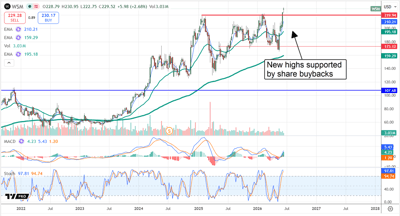
The takeaway is that Williams-Sonoma operates a high-margin business, sustaining above-target margins over the past few years and generating robust cash flow despite business contraction. The story in 2026 is that revenue growth resumed in Q1, with an operating margin of more than 16% and strength across categories.
Williams-Sonoma’s buyback is more aggressive. The company reduced its share count by an average of nearly 4% over the trailing 12 months (TTM) as of Q1 2026 and is expected to maintain a robust pace as the year progresses. Last year’s $1 billion buyback authorization is supported not only by earnings and cash flow, but also by a healthy balance sheet with approximately $1 billion in cash. The dividend is also meaningful, yielding approximately 1.2% as of mid-June, growing at a double-digit compound annual rate, and representing only 28% of the current-year earnings forecast.
TJX Companies: Top of the Retail Food Chain
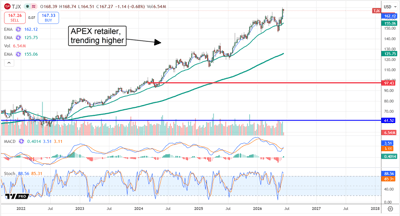
TJX Companies is at the top of the retail food chain in 2026, growing at an industry-leading pace and taking share from mainstream retailers across categories.
Industry trends and macroeconomic conditions have left its off-price model perfectly positioned to secure deals from top-tier merchants and pass them along to resilient yet price-conscious consumers. The company also continues to show strength across brands and categories, and it expects those strengths to continue.
TJX Companies is also a top-tier capital return machine. Its high-margin business outperformed in early 2026, with profit growth outpacing revenue at both the gross and operating levels. That strength led management to increase its target range for buybacks, which now amounts to approximately 1.6% of the share count. The dividend is worth approximately 1.2%, in addition to the share count reduction, and the distribution is expected to increase at the end of the fiscal year. TJX dividend growth is a driving force for its market, with the CAGR running at a double-digit pace.
This message is a paid advertisement for Awesomely, LLC, a third-party advertiser of DividendStocks.com and MarketBeat.
If you no longer wish to receive these emails, unsubscribe here.
If you need help with your newsletter, please contact MarketBeat's U.S. based support team at contact@marketbeat.com.
If you no longer wish to receive email from DividendStocks.com, you can unsubscribe.
Copyright 2006-2026 MarketBeat Media, LLC. All rights protected.
345 N Reid Pl. #620, Sioux Falls, S.D. 57103. United States..


