
Thanks to a new law Trump just signed…
Every day until April 2027 the entire GDP of Switzerland will migrate onto Trump's New Money Grid, that's $909 billion. Every single day.
That's every bank account, every fund, every mortgage, every stock trade in America.
Translation: our entire financial system is migrating onto a new blockchain-based Money Grid.
And every dollar that moves burns one scarce asset.
That's why BlackRock, JPMorgan, Goldman Sachs and Fidelity are hoarding shares like it's Black Friday.
Get in on the trade BlackRock, JPMorgan, and Fidelity are already making.
The Nasdaq just got SEC approval to move stocks onto blockchain rails.
BlackRock CEO Larry Fink dedicated his entire 2026 annual letter to it.
The World Economic Forum says 2026 is "a defining moment" for this new financial infrastructure.
Everyone who's actually building this thing is saying the same thing…
This is not a drill. This is the biggest overhaul of America's money system since we stopped using gold coins.
And at the center of it all?
A scarce asset that gets burned every single time a transaction happens.
Block Chain expert Andy Howard is calling it "Digital Oil."
And right now, before this goes mainstream, you can still get in at prices the institutions would love to lock in forever.
Get the name. The ticker. And exactly how to buy here.
Your future looks bright,
Andy Howard
The Edge™ Senior Blockchain Analyst
PS I'm predicting this could potentially be one of, if not THEE most explosive wealth opportunities I've come across. That's why you can't drag your feet here, because once retail investors catch wind of this, it will be too late…
Click here before it's too late to get in on the trade.
Microsoft's Boring Stock Story May Be Its Biggest Strength
Written by Chris Markoch. First Published: 6/22/2026.

Key Points
- Microsoft continues to generate enormous cash flow despite record AI infrastructure spending.
- A growing dividend, share buybacks, and a strong balance sheet support the long-term investment case.
- Trading below its historical valuation, Microsoft may offer AI exposure at a more reasonable price than many pure-play competitors.
- Special Report: The company SpaceX cannot operate without
Microsoft Corporation (NASDAQ: MSFT) is down approximately 20% over the last 12 months. Much of the news surrounding the company has been negative.
There have been layoffs, significant ongoing capital expenditures to support its artificial intelligence ambitions, cost pressures in its gaming division, and the ongoing transformation of Microsoft’s relationship with OpenAI.
Missed Nvidia’s 44,000%? This is the next big opportunity (Ad)
In February 2016, Louis Navellier recommended Nvidia at $2.51 split-adjusted - before a 44,000% gain. He also called Apple before a 36,000% rise and Microsoft before a 60,800% climb.
Now Navellier says he's seeing the same data pattern in a little-known company tied to a government AI project called Golden Dawn - a system he believes could trigger a $100 trillion reset of AI markets. He's revealing the name and ticker for free.
Get the full details and the ticker in Navellier's free presentationThat’s created significant noise around the company and distracts from the fact that the business is doing just fine.
Significantly, investors are only paying about 22x earnings to own MSFT. That has some investors crying foul because of the company’s self-reported $80.1 billion in capital expenditures in the nine months ending March 31, 2026.
But there’s more nuance to that story than may first appear. And that’s where the boring but beautiful story begins.
Microsoft's AI Spending Is Backed by Strong Cash Flow
It's fair to point out that Microsoft's free cash flow (FCF) is down. Operating cash flow over that nine-month stretch mentioned above was $127.5 billion, which means CapEx alone consumed roughly 63 cents of every dollar of operating cash generated. That's compared to about 51 cents in the prior-year period.
But there’s an equally compelling counterargument that needs to be considered in an honest discussion. Microsoft is funding the buildout primarily through the cash machine it already runs, not by straining the balance sheet.
In fact, long-term debt is actually shrinking. The $80 billion CapEx isn't leverage-fueled speculation; it's a company deploying its own cash to build infrastructure it expects to monetize. That should take investors to the company’s nine-month net income, which hit $98 billion.
The takeaway is that Microsoft’s cash-generation engine isn't under stress. Perhaps more importantly, the company’s AI business surpassed an annual revenue run rate of $37 billion in the last quarter. That was up 123% year over year (YOY).
Azure grew 40%, and contracted future revenue was up 99% YOY to $627 billion. That backlog is the story behind infrastructure spending. Management is guiding for roughly $190 billion in capital expenditures for calendar year 2026 while simultaneously reporting demand that continues to outpace capacity.
Microsoft's Dividend Growth Story Is Easy to Overlook
But something else has been happening behind the scenes over the last 20 years. In fact, it’s been the last 23 years. That’s the number of consecutive years that Microsoft has increased its dividend payment.
Many investors will yawn at a yield of just 0.95%. However, the more important number is the average annual growth rate of over 10% in the last three years. That's resulted in an annual payout per share of $3.64. Both numbers are well supported by a payout ratio of around 18% based on next year’s earnings estimates.
It may not mean much to say that Microsoft will be a Dividend Aristocrat in two years. But the company’s path to that title hasn’t come at the expense of growth. In the last 10 years, MSFT has delivered a total return of over 780%, and with a dividend yield under 1%, virtually all of those gains have come from stock price appreciation.
What makes the dividend story particularly compelling right now is the timing. Microsoft's next annual dividend increase is likely to be announced alongside its fiscal Q4 earnings report, due in late July. Investors who buy before that announcement lock in a lower cost basis on a growing income stream. That's a straightforward value proposition that tends to get overlooked by investors who are fixated on CapEx.
MSFT's Valuation Looks Increasingly Attractive
MSFT’s 20% decline in 2026 has quietly created one of the more attractive entry points Microsoft has offered in years. At roughly 22x forward earnings, MSFT is trading approximately 24% below its 10-year average price-to-earnings (P/E) ratio of around 31x.
Investors can choose to look at MSFT as a stock in distress. However, a more accurate framing may be to view it as a company being repriced because the market is impatient with infrastructure spending that hasn't yet fully shown up in free cash flow.
Microsoft’s business, however, hasn't missed a beat. Over each of the three most recent quarters, Microsoft posted 18% revenue growth. Operating margins expanded year over year in each of those same periods. Net income for the trailing 12 months recently crossed $125 billion.
Are those the numbers of a company in trouble? It doesn’t seem so. They look more like the numbers of a company transitioning from a software giant into a cloud and AI infrastructure platform. That transition is measurably ahead of schedule.
For investors who want exposure to AI without paying the speculative premiums attached to pure-play names, Microsoft is an unusual combination. It's a business growing at 18% annually, returning capital through buybacks and a growing dividend, with a balance sheet that carries more cash than long-term debt and a contracted backlog approaching two-thirds of a trillion dollars.
The noise around the stock may be real—but it’s also masking the opportunity.
Rackspace’s AI Land Grab: Plugging Into the Next Compute Boom
Authored by Jeffrey Neal Johnson. Date Posted: 6/19/2026.
Key Points
- The strategic partnership between Rackspace Technology and Advanced Micro Devices unlocks specialized cloud capabilities for highly regulated industries.
- Advanced Micro Devices is successfully expanding its enterprise hardware footprint by securing major infrastructure agreements beyond traditional public clouds.
- Rackspace Technology is actively transitioning its business model toward highly lucrative machine learning hardware deployments that generate recurring revenue.
- Special Report: The company SpaceX cannot operate without
The broader market remains intensely focused on public hyperscalers hoarding silicon to build massive, general-purpose artificial intelligence models. But look one layer deeper into the physical economy, and a distinct structural shift is unfolding. Tier-2 data centers are quietly carving out highly lucrative, specialized niches to capture enterprise workloads that major public clouds cannot accommodate.
Plugging Advanced Silicon Into the Rackspace Grid
Rackspace Technology (NASDAQ: RXT) recently secured a binding agreement to deploy 30 megawatts of artificial intelligence compute power engineered exclusively by Advanced Micro Devices (NASDAQ: AMD). This infrastructure rollout fundamentally alters the trajectory for both AMD and Rackspace.
Missed Nvidia’s 44,000%? This is the next big opportunity (Ad)
In February 2016, Louis Navellier recommended Nvidia at $2.51 split-adjusted - before a 44,000% gain. He also called Apple before a 36,000% rise and Microsoft before a 60,800% climb.
Now Navellier says he's seeing the same data pattern in a little-known company tied to a government AI project called Golden Dawn - a system he believes could trigger a $100 trillion reset of AI markets. He's revealing the name and ticker for free.
Get the full details and the ticker in Navellier's free presentationBy securing AMD's Instinct processors to build a fully governed, compliant AI stack, Rackspace directly addresses the data-sovereignty bottlenecks that prevent the healthcare and financial sectors from scaling internal machine learning models. The strategic silicon-level partnership immediately validates AMD's mid-tier cloud penetration, while giving Rackspace a high-margin, verifiable revenue pipeline that market participants are already aggressively repricing.
Moving off the Drawing Board and Onto the Grid
Rackspace Technology's share price has exhibited parabolic price action this year, surging more than 600% year to date. It jumped 21% intraday immediately following the announcement of the compute agreement. Wall Street is currently digesting the shift from a non-binding memorandum of understanding to a definitive, monetizable contract.
The agreement outlines a phased global data center deployment spanning late 2026 through 2028. This staggered timeline is a vital part of the overarching thesis. Rackspace avoids the immediate, crushing capital expenditure burden of outfitting 30 megawatts of server racks all at once.
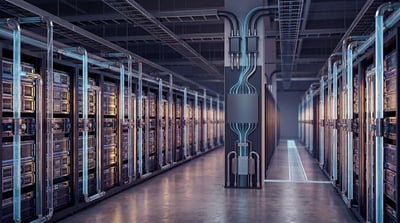
To put 30 megawatts into perspective, that level of energy consumption is equivalent to a small city's power draw, requiring highly advanced liquid-cooling infrastructure and specialized power routing.
By staggering the rollout, Rackspace secures a structured path to deploy a highly sought-after hardware-as-a-service architecture, enabling it to match infrastructure spending with incoming enterprise client demand.
While elevated short interest has undoubtedly amplified the rapid expansion in Rackspace's valuation by forcing buying, the underlying catalyst represents a tangible narrative shift. Participants are no longer pricing Rackspace as a legacy managed-hosting provider facing terminal margin compression. Instead, they are repricing it as a high-density, infrastructure-agnostic AI play.
Fortifying the AI Grid for Data Sovereignty
Investors have to look at the end user to understand why 30 megawatts of dedicated compute is such a major competitive advantage. Highly regulated industries face staggering compliance hurdles. Hospitals managing sensitive clinical data and financial institutions running proprietary risk algorithms face strict regulatory constraints on where data resides and how it is processed.
Pushing governed workloads into a generic, public hyperscaler environment often triggers severe data sovereignty and compliance risks. Isolating algorithmic trading data from public internet scraping is nearly impossible on shared public clouds. Rackspace Technology solves this structural deficit by offering a private, governed AI stack.
By utilizing a hardware-as-a-service model, enterprise clients can sidestep the massive upfront capital expenditures required to purchase data center hardware. Clients simply rent the exact compute power needed within a secure, dedicated Rackspace environment.
This allows clinical healthcare providers to anonymize patient records and regional banks to run heavy inference workloads entirely in-house. Rackspace provides the fortified digital real estate, while Advanced Micro Devices supplies the horsepower required to analyze millions of data points per second.
Supplying the Horsepower Behind the AI Revolution
The hardware architecture driving this deployment goes far beyond generic compute power. The agreement specifically leverages Advanced Micro Devices' Instinct accelerators, namely the MI355X and MI350P processors, which are paired directly with AMD EPYC server processors.
This establishes AMD as the foundational silicon partner for Rackspace Technology's newly launched Enterprise AI Cloud. For AMD, securing a footprint of this magnitude proves its hardware can successfully penetrate and compete in mid-tier enterprise cloud environments. AMD is demonstrating that it does not have to rely solely on Tier-1 hyperscalers to drive sustained enterprise volume. Because AMD architecture is highly competitive on a price-to-performance basis, Tier-2 data centers can adopt the technology while maintaining attractive margins.
The underlying fundamentals support this aggressive expansion. AMD recently posted 37.8% year-over-year revenue growth, beating earnings consensus by 8 cents per share. Operating cash flow sits at a robust $4.89 per share, providing the liquidity needed for AMD to continue out-innovating competitors in the accelerator space. Landing 30-megawatt contracts with specialized data centers signals to the market that enterprise architects actively trust and demand the AMD ecosystem.
Funding the Pivot and Keeping the Lights On
While the growth narrative is compelling, it remains necessary to evaluate the fundamental realities of the balance sheet. Rackspace Technology is navigating a precarious transition phase. Rackspace currently reports negative net margins of 5.41% alongside a recent earnings miss. Liquidity remains exceptionally tight, highlighted by a quick ratio of just 0.68, indicating that Rackspace holds only 68 cents in liquid assets for every dollar of short-term liabilities.
Transitioning from legacy cloud hosting to high-density AI infrastructure is highly capital-intensive. To support this pivot and alleviate immediate balance-sheet distress, Rackspace implemented strategic workforce reductions to slash operating expenses. This aggressive cost-cutting strategy acts as a bridge. Rackspace must drastically reduce cash burn today so it can survive long enough to realize the high-margin, recurring revenue generated by the upcoming Advanced Micro Devices deployment.
The extreme divergence between the current trading price and the consensus analyst target of $2.70 suggests institutional skepticism remains. Insider activity reflects this cautious transition, with Rackspace's executive officers executing strategic equity sales in the lead-up to the announcement. The rapid stock surge requires flawless execution from Rackspace management over the coming quarters to justify its newly assigned valuation premium.
Evaluating the High-Voltage Return on Enterprise AI
The 30-megawatt pact between Rackspace and AMD is a textbook example of how the internet's physical infrastructure is adapting to regulated enterprise demand. Advanced Micro Devices continues to validate its hardware prowess outside of the hyperscaler bubble, while Rackspace Technology attempts a massive, high-reward turnaround driven by specialized, governed cloud environments.
Investors tracking the semiconductor sector may view AMD as a core allocation for sustained enterprise integration, especially given the $6 billion share repurchase program, which provides structural support. For those monitoring the data center land grab, Rackspace offers a high-beta vehicle tied directly to the hardware-as-a-service rollout.
Cautious investors may prefer to wait for the current short-covering volatility to subside before establishing a position, watching closely to see if Rackspace can translate operational cuts into sustainable margin expansion ahead of the 2026 deployments.
This email is a sponsored email sent on behalf of Awesomely, LLC, a third-party advertiser of DividendStocks.com and MarketBeat.
If you no longer wish to receive these emails, unsubscribe here.
If you have questions about your newsletter, don't hesitate to contact our South Dakota based support team at contact@marketbeat.com.
If you no longer wish to receive email from DividendStocks.com, you can unsubscribe.
© 2006-2026 MarketBeat Media, LLC. All rights protected.
345 N Reid Pl., Suite 620, Sioux Falls, South Dakota 57103-7078. United States of America..


