Thanks to a new law Trump just signed… Every day until April 2027 the entire GDP of Switzerland will migrate onto Trump's New Money Grid, that's $909 billion. Every single day. That's every bank account, every fund, every mortgage, every stock trade in America. Translation: our entire financial system is migrating onto a new blockchain-based Money Grid. And every dollar that moves burns one scarce asset. That's why BlackRock, JPMorgan, Goldman Sachs and Fidelity are hoarding shares like it's Black Friday. Get in on the trade BlackRock, JPMorgan, and Fidelity are already making. The Nasdaq just got SEC approval to move stocks onto blockchain rails. BlackRock CEO Larry Fink dedicated his entire 2026 annual letter to it. The World Economic Forum says 2026 is "a defining moment" for this new financial infrastructure. Everyone who's actually building this thing is saying the same thing… This is not a drill. This is the biggest overhaul of America's money system since we stopped using gold coins. And at the center of it all? A scarce asset that gets burned every single time a transaction happens. Block Chain expert Andy Howard is calling it "Digital Oil." And right now, before this goes mainstream, you can still get in at prices the institutions would love to lock in forever. Get the name. The ticker. And exactly how to buy here. Your future looks bright, Andy Howard
The Edge™ Senior Blockchain Analyst PS I'm predicting this could potentially be one of, if not THEE most explosive wealth opportunities I've come across. That's why you can't drag your feet here, because once retail investors catch wind of this, it will be too late… Click here before it's too late to get in on the trade.
This Week's Featured Content
Delta Air Lines Lives Up to Its Claims: Shares Can Keep ClimbingAuthor: Thomas Hughes. Article Published: 7/12/2026. 
Key Points
- Delta Air Lines reported strong Q2 2026 results with revenue up 30.3% and raised guidance, prompting 27 analysts to maintain a consensus Moderate Buy rating with an 89% Buy-side bias.
- Analysts have set price targets between $110 and $116, representing a fresh all-time high, while institutional investors own 70% of shares and continue accumulating.
- Despite a price pullback and risks from rising costs and a C-suite transition, Delta's cash flow, debt reduction, and dividend growth support an intact uptrend.
- Special Report: Prepare NOW for Election Chaos
Delta Air Lines (NYSE: DAL) lived up to its motto, with the Q2 2026 earnings results showing strength and suggesting the shares can keep climbing. Drivers include outperformance in international demand, overall demand, premiumization, and structural cost advantages, which together provide ample cash flow. The most important detail in the release was the guidance, which indicates these trends should continue. Just as importantly, guidance was raised, prompting a strong response from analysts.
While no upgrades or price target revisions were tracked in the first hours after the release, several commentaries quickly hit the wires. Analyst commentary continues to reinforce the strong trends, including numerous initiations, upgrades, and price target increases ahead of Delta’s earnings release on July 10. As it stands, MarketBeat tracks 27 analysts rating DAL as a consensus Moderate Buy. Coverage has increased versus the prior month, quarter, and year, with sentiment firming and an 89% buy-side bias in the data. The consensus price target implies fair value near the early-July highs, but the trend matters more. Recent revisions place this market in a high-end range between $100 and $116, which would mark a fresh all-time high if reached. Delta’s July Pullback: A Touch-and-Go Event, Buy the DipDelta’s price pullback reflects a market that was already expecting strength, and the Q2 results and guidance delivered exactly that. Revenue growth accelerated sequentially and year over year, rising a robust 18.7% and coming in ahead of expectations. Delta’s strength showed across the metrics, underpinned by only a 1% increase in capacity. Total revenue per average seat mile (TRASM) grew by 12.4%, with particular strength in the main cabin and premium segments, which rose by 17%. Domestic revenue grew by 12% and international revenue by 8%, while cargo increased by 39% and maintenance services by 32%. Loyalty, a forward-looking indicator, grew by 19%, and corporate traffic grew by double digits. While margins contracted in the quarter, and slightly more than expected, the decline was minimal. More importantly, top-line strength flowed through to the bottom line, leaving adjusted earnings per share of $1.56 above forecasts by 400 bps. Looking ahead, the company expects strength to continue and reaffirmed its guidance. The critical points are that free cash flow and capital returns should continue, and that the guidance may be conservative. Travel trends remain robust across leisure and business segments, potentially helped by falling energy prices. Delta’s Cash Flow Recovery Story Takes FlightDelta’s stock price recovery is underpinned by growth but, more importantly, by the cash flow it generates. Drivers of the share price include persistent debt reduction, improving investment-grade balance sheet quality, and returning capital to shareholders. Q3 capital returns included dividends but no share buybacks, with the dividend annualizing to about 1%. The payout ratios show no red flags for investors, as the company is positioned to continue executing its strategy while increasing its dividend annually. Balance sheet highlights include more cash, less debt, and improving equity, with equity up 4.6% year to date. Institutional activity reflects the potential in a DAL investment. Institutions own a substantial 70% of the stock and have been accumulating at nearly a $2-to-$1 pace over the trailing 12 months. That creates a solid support base and market tailwind that is likely to remain in place given the guidance. In this scenario, DAL’s share price could continue pulling back in Q3, but downside appears limited, and higher prices are likely by year-end. Key support levels are near $85 and $80; lower lows are not expected. Delta’s risks center on cost controls and execution. Costs, including labor, continue to rise while a major C-suite transition is underway. Two retirements and one executive’s departure for new opportunities have led to several promotions and consolidated roles. The risk is that role changes could create disruptive hiccups, especially during the upcoming seasonal shift. If Delta fails to match capacity with demand, it risks losing pricing power, which would be detrimental to both top- and bottom-line results. Over the longer term, Delta is expected to sustain modest growth over the next five years. 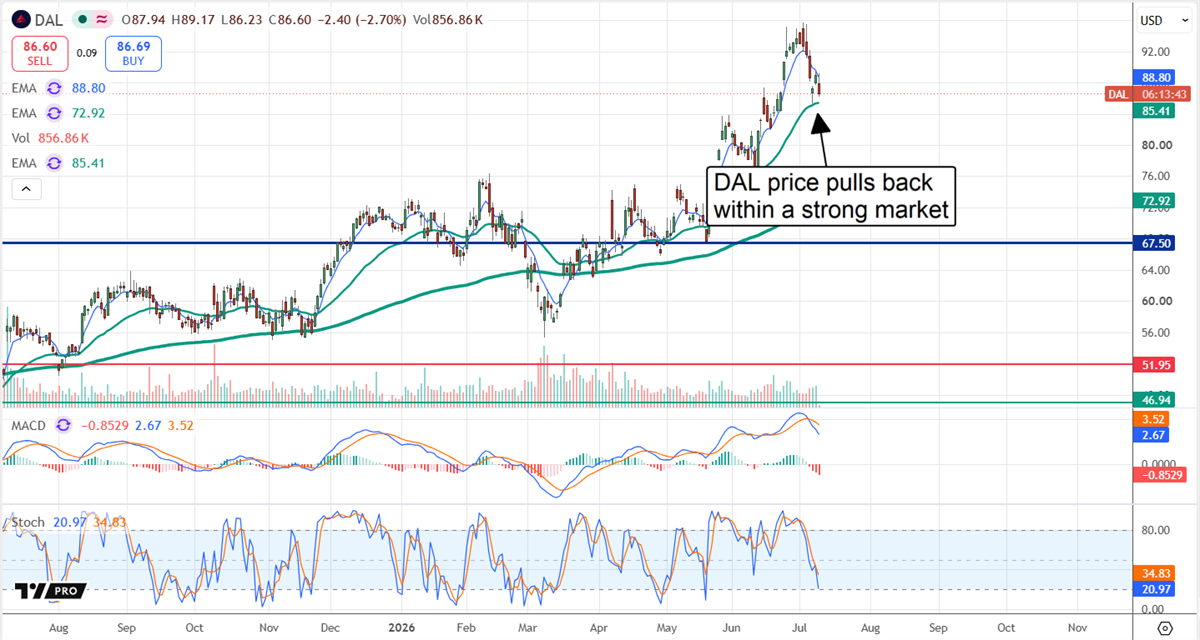
The stock price action remains favorable despite the early Q3 pullback. Delta is rising on a wave of strength, cash flow, and dividends that has yet to fully play out, leaving the underlying uptrend intact. The likely outcome is that support will emerge at or near the early July lows, leading to a trend-following signal and a price rebound later this year. Signals of strength include MACD convergence on the weekly chart, suggesting the latest highs will at least be retested, as well as support at the 30-day exponential moving average.
. |