
Thanks to a new law Trump just signed…
Every day until April 2027 the entire GDP of Switzerland will migrate onto Trump's New Money Grid, that's $909 billion. Every single day.
That's every bank account, every fund, every mortgage, every stock trade in America.
Translation: our entire financial system is migrating onto a new blockchain-based Money Grid.
And every dollar that moves burns one scarce asset.
That's why BlackRock, JPMorgan, Goldman Sachs and Fidelity are hoarding shares like it's Black Friday.
Get in on the trade BlackRock, JPMorgan, and Fidelity are already making.
The Nasdaq just got SEC approval to move stocks onto blockchain rails.
BlackRock CEO Larry Fink dedicated his entire 2026 annual letter to it.
The World Economic Forum says 2026 is "a defining moment" for this new financial infrastructure.
Everyone who's actually building this thing is saying the same thing…
This is not a drill. This is the biggest overhaul of America's money system since we stopped using gold coins.
And at the center of it all?
A scarce asset that gets burned every single time a transaction happens.
Block Chain expert Andy Howard is calling it "Digital Oil."
And right now, before this goes mainstream, you can still get in at prices the institutions would love to lock in forever.
Get the name. The ticker. And exactly how to buy here.
Your future looks bright,
Andy Howard
The Edge™ Senior Blockchain Analyst
PS I'm predicting this could potentially be one of, if not THEE most explosive wealth opportunities I've come across. That's why you can't drag your feet here, because once retail investors catch wind of this, it will be too late…
Click here before it's too late to get in on the trade.
Apple’s Intel Deal Arrives at the Right Time for Its Stock
By Sam Quirke. Article Published: 6/23/2026.
Key Points
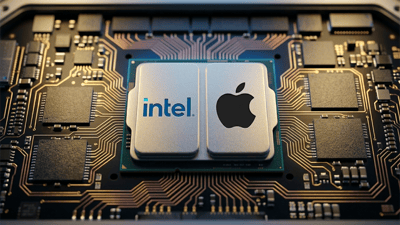
- Apple has agreed to partner with Intel to design and manufacture some of its chips on US soil, in a deal that solves several headaches at once.
- With memory chip prices surging to the point that Apple's CEO, Tim Cook, has said price hikes are now unavoidable, diversifying away from Asia has rarely made more sense.
- Add in a US political environment that's all-in on domestic manufacturing, and this is shaping up to be one of the more clever moves Apple has made in years.
- Special Report: The company SpaceX cannot operate without
Shares of tech giant Apple Inc. (NASDAQ: AAPL) are trading just under $300 this week as they continue to rebound from earlier-month lows and move back toward the all-time high reached a few weeks ago.
The bull case for the stock has been quietly strengthening despite the wobble that followed the recent Siri AI announcement. The latest piece of news adds another credible reason to think the next leg higher could already be underway.
Live demo of Elon Musk’s AI agent (Ad)
Jeff Brown picked Nvidia in 2016 - it's up 25,155%. He recommended Bitcoin at $240 - it's up 31,219%. Now he's zeroing in on Elon Musk's new AI agent, which Musk himself believes could return 70 times investors' money.
Brown, who correctly predicted the SpaceX IPO and held Tesla when experts turned bearish, says an announcement is expected by end of month that could make this AI agent available to every American. He's offering a free live demo and ground-floor access details right now.
Watch the free live demo and learn how to get in todayIt was reported late last week that Apple has agreed to partner with Intel (NASDAQ: INTC) to design and manufacture some of its chips in the United States. At first glance, that may seem to come out of nowhere, given Apple's move away from Intel chips to its own in-house Apple Silicon several years ago.
However, when you consider the timing and the broader pressures the company has been navigating, it's hard to see this as anything other than a highly strategic move. Let's jump in and see why below.
Why the Timing Is So Compelling
The big picture here is that Apple has been quietly grappling with several significant supply chain headaches, and this deal helps ease them. The main one is memory chip pricing. As we covered recently, surging costs have begun to bite into Apple's margins to the point that Tim Cook has publicly acknowledged that the "situation has become unsustainable" and that "price increases are unavoidable." That's the kind of statement that doesn't get made lightly, particularly by a CEO famous for measured language.
Layered on top of that is Apple's longstanding overdependence on Taiwan Semiconductor Manufacturing Company (NYSE: TSM) for its most advanced chips. TSMC's production lines are in extraordinary demand from AI chipmakers like NVIDIA (NASDAQ: NVDA) and Advanced Micro Devices (NASDAQ: AMD), which have steadily driven up costs and intensified the risk of bottlenecks for everyone who relies on the foundry.
The Right Deal at the Right Time
Apple has been working for years to build a more diversified manufacturing footprint, with expansion into Vietnam, India and the US, but a deal of this scale with Intel takes that effort to a whole new level.
The team at Wedbush put it well, noting that "this is the right time to do this deal with Apple looking to diversify its manufacturing footprint" while demand for advanced chips continues to climb. Coming just ahead of what's expected to be a multi-year AI-driven device cycle, the deal effectively locks in domestic capacity right as Apple's AI ambitions begin to take shape.
A Political Tailwind That's Hard to Ignore
The other reason this deal looks so well-timed is the wider political backdrop. The US administration has made it a stated priority to bring semiconductor manufacturing back to American soil, and Intel has emerged as the central beneficiary of that policy. Apple's agreement to partner with Intel on domestic production, therefore, brings the company directly into alignment with that political direction.
For a multinational of Apple's scale, that's a strategic move on multiple levels. As we've seen with other big tech names in recent months, being on the wrong side of US trade and manufacturing policy can quickly turn into a sustained headwind.
By proactively committing to domestic chip production, Apple has essentially insulated itself from a chunk of that risk in one move while also strengthening its standing as one of the largest investors in US manufacturing.
How This Supports Higher Prices
There's a third reason this deal is being received so well: it lays the groundwork for Apple to potentially raise prices on its core products with significantly less risk. With Tim Cook already flagging that price hikes are coming, likely in September alongside the new iPhone lineup, the Intel partnership gives Apple a credible story to tell consumers and shareholders about why those higher prices are sustainable.
Wedbush analyst Dan Ives said Apple is in a strong position to raise prices without sacrificing hardware performance or increasing customer churn, citing the company’s growing focus on higher-end consumers. That bullish view is also reflected in Apple’s Moderate Buy consensus rating, which suggests Wall Street remains constructive despite the stock’s recent wobble. For investors, that’s close to the dream scenario, and one that few companies could deliver at Apple’s scale.
The Bigger Picture for the Stock
With Apple now firmly in motion on its AI strategy, the Intel partnership cementing a more resilient supply chain, and the broader political winds at its back, the company is heading into the second half of the year with arguably its strongest setup in a long time.
And while the price action at the start of June briefly suggested otherwise, the underlying picture is becoming more optimistic by the day.
D.R. Horton Is Defying the Housing Gloom
By Peter Frank. Article Published: 7/4/2026.
Key Points
- D.R. Horton beat earnings expectations in its second fiscal quarter, posting $7.6 billion in revenue and raising its full-year revenue guidance above analyst estimates.
- Net sales orders rose 11% to 24,992 homes, and the company returned more than $1 billion to shareholders through buybacks and dividends during the quarter.
- Analysts maintain a consensus Hold rating on DHI with an average price target of $168.54, implying roughly 7% upside amid persistent affordability and margin headwinds.
- Special Report: The company SpaceX cannot operate without
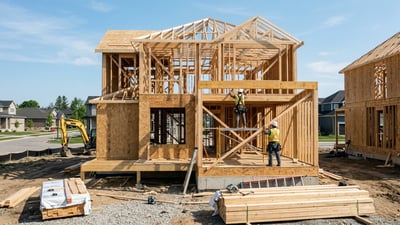
As the most prolific homebuilder in the United States, D.R. Horton (NYSE: DHI) is battling a broad decline in new home sales and cautious buyers.
Yet investors might not realize that from its financial performance. For the latest quarter, the company beat expectations, raised its revenue outlook, increased new home orders by double digits, and returned more than $1 billion to shareholders.
$285B wiped out. Yours could be next. (Ad)
One private company wiped $31 billion from IBM with a blog post - and $285 billion from the broader software sector in under a week. Microsoft alone has surrendered $700 billion since this disruption began.
Now that company is preparing to go public, possibly in October, at a near-$1 trillion valuation. If you hold software, consulting, or services stocks in your retirement account, you may be directly exposed.
See the 5 stocks to sell and the one backdoor play to consider before the IPOThat’s not to suggest the company is immune to industry headwinds. Analysts rate the stock a Hold, with limited 12-month upside.
But for patient investors, the disconnect between homebuyer hesitation and the company’s results is worth considering before deciding to act.
Building Its Business Around Affordable Homes
D.R. Horton has been building homes for Americans since 1978, and over those decades it has become the largest homebuilder in the United States by volume, with operations spanning 125 markets across 35 states.
Its strategic focus on entry-level and first-time buyer homes gives it some insulation against luxury-home volatility. When mortgage rates rise and discretionary buyers step back, affordably priced starter homes tend to hold their ground the longest.
Like other homebuilders in the construction sector, sales took off in late 2020 as interest rates sat at record lows and work-from-home trends drew many buyers into the market. But that hasn’t been the recent story. Monthly new home sales are down roughly 30% from that earlier peak and are currently at their lowest levels since 2023.
Strong Quarterly Results Defy a Weak Housing Market
The current trend is what makes D.R. Horton’s second fiscal quarter ended March 31 so interesting. It was the clearest recent evidence of what the company’s positioning can produce under pressure.
The company reported that for the three months, it generated $7.6 billion of consolidated revenue, above analysts’ expectations, and $647.9 million of net income, or $2.24 per diluted share. Its pretax profit margin was 11.5%.
Although revenue beat expectations, it declined slightly from year-earlier levels as home prices and incentives reflected higher mortgage rates. “Affordability constraints and cautious consumer sentiment continue to impact new home demand,” the company said.
Underlying demand, though, was clearly positive. Net sales orders rose 11% to 24,992 homes, with an order value of $9.2 billion. Backlog grew to 16,882 homes worth $6.4 billion at quarter-end. Since orders and backlog are leading indicators of future sales, both moved in the right direction.
Orders and Inventory Point to Future Strength
The details inside the numbers were also telling. Homes closed during the quarter rose 1% to 19,486 even as revenue in the overall homebuilding segment, hit by buyer incentives, declined 2% to $7.1 billion.
The company also generated nearly $800 million in revenue during the quarter from rental operations, financial services, and the sale of ready-to-build lots for homebuilders.
Inventory also improved. Unsold completed homes fell by 35% from a year ago. The cancellation rate held flat at 16%, consistent with prior periods and far below levels that would suggest buyer panic.
Given these figures, the company updated its full-year revenue guidance to a range of $33.5 billion to $34.5 billion, with homes sold expected to total between 86,000 and 87,500. That outlook came in above analyst expectations even after the range was narrowed. By comparison, in fiscal 2025, the company sold 84,863 homes, a 5% decline.
Shareholder Returns Reflect Financial Confidence
These days, the stock reflects recognition of the company’s performance without confident exuberance about its near-term prospects. DHI recently traded near $159, up 12% over the past three months. Its trailing price-to-earnings ratio of 14.7 is slightly above that of others in the sector.
During the second quarter alone, D.R. Horton repurchased 6 million shares for $950.6 million and paid $130 million in dividends, exiting the period with total liquidity of $6 billion and debt to total capital of just 21.7%.
Subsequent to quarter-end, the board also declared another quarterly dividend of 45 cents per share, producing a yield of roughly 1.1%. The company reaffirmed plans for $2.5 billion in share repurchases and roughly $500 million in dividend payments for fiscal 2026.
Analysts Expect Only Limited Near-Term Upside
Analyst sentiment is measured rather than overly enthusiastic. Of the 16 analysts following the stock, the consensus rating is a Hold, with four recommendations to Buy, 10 suggesting Hold, and two listing it as a Sell.
With an average price target of $168.54, the 12-month target implies an approximate 6% rise. Much of the sector already enjoyed a short rally following congressional passage of an affordable housing bill, a reminder of how sensitive it can be to news.
Housing Headwinds Still Pose Meaningful Risks
The bear case is easy to see, and it helps explain why the stock is priced the way it is. Affordability remains the central issue pressuring new home demand.
Sales incentives are expected to remain elevated through fiscal 2026, which could compress margins and limit earnings. As seen in the second quarter, home sales revenue declined even as closings edged higher.
The competitive landscape adds to the concern. Among homebuilders, Lennar (NYSE: LEN) targets similar buyers, while PulteGroup (NYSE: PHM), NVR (NYSE: NVR), and Toll Brothers (NYSE: TOL) target substantially different segments.
Further, the existing home market could loosen and draw away buyers if mortgage rates decline.
A Quality Builder in an Uncertain Market
For investors, the question is whether to treat D.R. Horton as part of the speculative homebuilding sector or as a high-quality operator. With its ability to generate cash, maintain a clean balance sheet, and return capital to shareholders, the company has proven it can weather cycles.
But the macro environment is hard to forecast. A further economic slowdown and higher unemployment could seriously pinch buyers’ budgets and reduce home sales. The future path of interest rates remains a key factor.
Either way, D.R. Horton has earned the right to be taken seriously even in a market that has not yet decided what to make of it.
This email message is a sponsored email provided by Awesomely, LLC, a third-party advertiser of MarketBeat. Why did I receive this email content?.
If you no longer wish to receive these emails, unsubscribe here.
If you have questions or concerns about your newsletter, please feel free to email our U.S. based support team at contact@marketbeat.com.
If you would no longer like to receive promotional emails from MarketBeat advertisers, you can unsubscribe or manage your mailing preferences here.
© 2006-2026 MarketBeat Media, LLC. All rights reserved.
345 N Reid Place #620, Sioux Falls, S.D. 57103. USA..

