
| Unsubscribe |
I wish this wasn’t the case…
But it’s happening, exactly as I predicted.
I first warned my readers of this threat months ago. Many disregarded it.
Now it’s accelerating and unless you prepare now you could be blindsided by an event two Nobel Prize winners have warned of… an event that you cannot ignore.
The clock is ticking. Just take a look:
In a single month, March of this year, U.S. employers announced 60,620 job cuts. That's a 25% jump from February. And one force was named as the reason why.
Then the floodgates really opened.
Meta announced it's laying off roughly 8,000 employees – 10% of its workforce – and quietly killing another 6,000 unfilled roles.
The same week, Microsoft offered "voluntary separation" to 7% of its U.S. workers — more than 8,500 people.
Translation: quit on your terms, or we'll fire you on ours.
And they're not alone. Not by a long shot.
Amazon cut 16,000 corporate jobs… Block cut 40% of its workforce…. Salesforce eliminated 44% of its support team... Oracle is reportedly axing up to 30,000 roles.
IBM, Snap, Pinterest, Klarna… the list grows by the week.
Almost 80,000 tech jobs evaporated in the first three months of 2026 alone.
Although most people think this is about AI… it’s not. The story goes far deeper and is far more consequential. It’s something that I’ve been warning off for months now.
And I’m not the only one.
Two Nobel Prize winners have warned of this Final Displacement.
Because they know, as I do, this event could trigger a once-in-a-generation wealth shift.
A transfer of wealth that’s already begun with Goldman Sachs estimating 12,400 Americans are being financially destroyed every day… while others grow richer than ever before.
Which side you’re on could depend on what you do next.
Because for those who understand what’s unfolding, this could be one of the greatest wealth-building phenomena of their lives.
But for those who bury their head in the sand… this force threatens to wipe out years of investment returns and could even destroy their financial future.
Here’s the full story for you.

26 years ago, I started telling friends, family, and anyone who would listen about an unprecedented societal shift that was barreling down on us.
I’d discovered that a new technology was about to unleash massive, almost unimaginable, changes. I likened the impact to the railroad boom, the Industrial Revolution, and the rise of personal computing.
At the time, I was working as an investment analyst for an elite research group, but my colleagues and bosses refused to listen to me.
No matter what I said, they simply would not acknowledge the sands shifting beneath their feet.
The legendary Dr. Kurt Richebächer – one of the world’s leading Austrian economists – even called me and my ideas “radical.”
But I was certain this new technology would trigger a transformation that was simply unfathomable to most people… and those on the frontier could reap financial returns unlike any the world had ever seen before.
So, I decided to put my entire career – not to mention every cent I had – on the line to spread the story myself.
I left my job as a research analyst… went home to my third-floor apartment in one of Baltimore’s worst neighborhoods… and with a borrowed laptop, I wrote my first financial prophecy.
And in an investment paper that’s now been read by more than one hundred thousand people…
I explained how the endless miles of new fiber optic cables being laid was creating a new railroad across America.
And that this new “railroad” was going to upend the telecommunications industry and pave the way for a new internet economy.
I also warned it would decimate some of America's most dominant companies like AT&T.
At the time, this was an outlandish idea, with analysts calling AT&T “dominant”, “unstoppable”, and “the giant that no other company can topple.”
But those who were willing to open their minds to my so-called “radical” ideas were not only able to sell these companies before they collapsed…
They also had the chance to get in early on the firms that would go on to command this new internet economy:
Amazon, Adobe, Qualcomm, SunMicrosystems, Uniphase, Texas Instruments… These are household names now, but when I first recommended them in the late 90s, they were complete unknowns.
Since then, I’ve issued a number of other financial prophecies, many of which have come to pass precisely as I predicted.
But today, I’m stepping forward with a new exposé that I believe could surpass anything I’ve ever done…
It’s an investigation into what I call The Final Displacement… and I don’t think we will ever again see a story that rivals the magnitude of this during my lifetime.
I’m not talking about AI… quantum computing… augmented reality… the blockchain… or anything else you might be thinking of.
No. This is far bigger than them all. In fact…
It’s the cornerstone that all our recent technological innovations have been built upon and the future will be built upon too.
Yet you’ve likely never heard of it before.
Outside of the labs in the world’s most prestigious universities and tech companies, almost nobody has.
But those who have… those who can see the writing on the wall… they’re investing billions of dollars, as they know this will transform everything.
Marc Andreessen… Ben Horowitz… Elon Musk… Jeff Bezos… Mark Zuckerberg…Jensen Huang… Bill Gates… the list goes on and on.
They know, as I do, that in a few years from now, we will not recognize the world we live in.
How we work, live, communicate, transact… it will all be completely upended by what’s coming next.
Today, I’m going to share it all with you… and I promise you’ve never heard anything like this before.
You see, despite the magnitude of this story, nobody is openly and freely discussing this turning point. And that deeply concerns me, because I believe its emergence will draw an indelible demarcation line in society.
On one side, you’ll have those who understand it, invest in it, and who are greatly enriched by it.
On the other side… you’ll have those who underestimate it, turn a blind eye and are unfortunately impoverished by the sweeping changes it ushers in.
I know what side I’ll be on.
And I know what side I want you to be on.
So go here to watch my full investigation into this story.
Including the names of the companies to buy and sell if you want to capitalize on the impending multi-trillion-dollar displacement.
Good investing,
Porter Stansberry
Netflix May Be Cheap Enough to Tempt Buyers After Earnings Drop
Written by Chris Markoch. Publication Date: 7/18/2026.

Key Points
- Netflix reported slightly better-than-expected earnings per share, but revenue came in just below Wall Street’s estimate.
- The company narrowed its full-year revenue forecast and guided for third-quarter growth below analyst expectations.
- Netflix will move its What We Watched report to an annual cadence, adding to investor scrutiny around engagement.
- Special Report: Forget SpaceX. Buy the company Musk can't replace.
Netflix Inc. (NASDAQ: NFLX) has been one of the weakest large-cap media and technology stocks over the past year, with shares still sharply lower in 2026 heading into its Q2 earnings report. Investors who hoped the report would reverse that trend may have to wait. NFLX sold off after the company delivered a mixed report.
Netflix delivered a slight beat on adjusted earnings per share (EPS), with earnings of 80 cents per share coming in a penny above the estimate of 79 cents. However, revenue of $12.56 billion came in slightly below the $12.58 billion consensus estimate.
A 17-year investing experiment investigated in Dublin (Ad)
Porter Stansberry flew the Porter and Co. team 3,300 miles to Dublin to investigate a 17-year investing experiment called Project Prophet - and documented everything on film.
Rooted in the laws of physics, this quantitative approach challenges conventional wealth-building wisdom. With 17 years of verified data behind it, Porter calls it unlike anything he has seen in nearly 30 years in the business.
Watch the full investigation and decide for yourselfRevenue was up 13% year over year, while the company’s operating margin came in at 33%. Both figures were in line with the company’s previous forecasts.
The report is being described as one in which the company set a low bar and still tripped over it. The bigger story may be that investors are deciding how to value the business Netflix is today.
Netflix Faces a New Reality Beyond Its FAANG Era
Before the Magnificent Seven, there were the FAANG stocks: Meta Platforms Inc. (NASDAQ: META), Apple Inc. (NASDAQ: AAPL), Amazon.com Inc. (NASDAQ: AMZN), Alphabet Inc. (NASDAQ: GOOGL), and Netflix. These stocks were the darlings of the mobile and cloud-computing buildout.
At that time, Netflix was delivering organic growth on an epic scale. In fact, Netflix took away password sharing and aggressively introduced an ad-supported tier, and consumers paid for the privilege of accessing its content.
But the one thing Netflix can’t seem to outrun is its competition. The company says that it “only” has about 5% of its total addressable market.
On the surface, that sounds like a company trying to explain why it still deserves to be part of the cool club. But it could also be a reminder that consumers have many options. Moreover, content production remains a major expense at a time when the company is becoming more opaque about who is watching and for how long.
Netflix Will Only Report Engagement Numbers Once a Year
A notable takeaway from the report is that Netflix will now report engagement numbers, through its What We Watched report, only in the first quarter starting in 2027. Management cited a goal of separating the report’s publication from earnings to keep the focus on its primary financial metrics, revenue and operating profit.
After becoming a streaming service in 2007, Netflix reported its engagement numbers every quarter. Since the company wasn’t profitable in its early days, engagement served as a proxy for future revenue and a breadcrumb on its path to profitability.
Today, Netflix is generating much of its revenue from its ad business. Therefore, from management’s perspective, engagement numbers don’t carry as much weight as they used to.
That’s probably accurate. But once analysts become accustomed to receiving a specific data point, its absence opens the door to interpretation. That’s not fair, and it’s not the primary reason NFLX is down. At the same time, if Netflix knew it was going to deliver strong engagement numbers, it would probably pre-release that information.
The Chart Confirms the Story Wall Street Is Telling
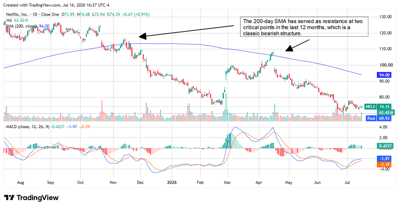
NFLX has been in a clear downtrend since October 2025, carving out lower highs and lower lows into a July bottom near $70. The 200-day moving average, now at $94 and sloping downward, has capped every rally since December, including bounces in February and April that both failed near that line. That’s a classic bearish structure: price below a declining long-term average.
Heading into earnings, shares had stabilized in the low-$70s, closing at $74.35. The MACD had crossed above its signal line and moved above zero for the first time since March, creating a tentative bullish signal. The after-hours drop to roughly $69 undercuts that setup and pushes shares back toward the $70 support level, which has held twice this year. Holding that zone would suggest the base remains intact; a decisive break below it on volume would open the door to the mid-$60s, territory NFLX hasn’t seen since 2023.
Is NFLX Becoming So Bad It’s Good?
In an earnings season when many companies are expected to post record results, those that miss will be sharply punished. That’s a lot of what’s going on with NFLX. Investors are selling first and will ask questions in the coming days.
One thing they’ll be pondering is the company’s cash position. Second-quarter free cash flow (FCF) came in at $1.5 billion, down from $2.3 billion in Q2 2025, with the decline reflecting higher cash tax payments. Netflix is still guiding for full-year FCF of approximately $12.5 billion, a target that includes the after-tax benefit of the Warner Bros. Discovery termination fee.
Netflix isn’t in trouble, and it’s not hard to argue that the company is still the best in breed in streaming. The forward price-to-earnings (P/E) ratio was around 20x before the post-earnings selling, and the company has a solid balance sheet. Those figures put the opportunity in plain view.
But what is that opportunity? The Netflix consensus price target of $104.78 still implies meaningful upside from recent levels, even after the post-earnings sell-off. However, several analysts had lowered their price targets before the earnings report. That trend is likely to continue in the days ahead.
3 Non-Tech Stocks Still Winning Big on AI
Written by Nathan Reiff. Publication Date: 7/13/2026.
Key Points
- Investors seeking AI exposure without direct tech-sector risk can consider Powell Industries, AAON, and EMCOR Group, all benefiting from data center demand.
- Powell Industries and AAON have posted strong backlog growth and revenue gains, but their share prices have already risen sharply, raising valuation concerns.
- EMCOR Group shows steady revenue and earnings growth with a more modest year-to-date gain, and analysts see further upside potential ahead.
- Special Report: Forget SpaceX. Buy the company Musk can't replace.
The AI-driven tech boom continues, but investors concerned about potential overexposure may find it challenging to avoid some of the biggest names in technology. Even those seeking out overlooked tech investment targets may want greater diversification across other sectors. After all, energy, industrials, and other market segments are also performing well.
It is possible to build exposure to AI trends without leaning too heavily toward technology stocks. Companies providing data center services and equipment, including construction work, have been thriving despite not being part of the tech sector. The firms below all have the potential to continue benefiting as AI demand remains strong without adding significant direct exposure to technology stocks.
Massive Demand Increase for Powell, but Valuation May Be a Concern
A 17-year investing experiment investigated in Dublin (Ad)
Porter Stansberry flew the Porter and Co. team 3,300 miles to Dublin to investigate a 17-year investing experiment called Project Prophet - and documented everything on film.
Rooted in the laws of physics, this quantitative approach challenges conventional wealth-building wisdom. With 17 years of verified data behind it, Porter calls it unlike anything he has seen in nearly 30 years in the business.
Watch the full investigation and decide for yourselfPowell Industries Inc. (NASDAQ: POWL) designs and builds customized power control and distribution products, along with a range of automation, metering, and data acquisition systems. While the firm has traditionally served customers in the energy, mining, and utilities sectors, it has increasingly focused on data center clients.
Business appears to be accelerating, based on two significant projects the firm won in the second quarter of 2026, each worth more than $75 million, as well as a post-quarter data center award exceeding $400 million.
This should help drive revenue growth in the future. The firm's $297 million in second-quarter revenue was solid but up only about 6% year over year (YOY), leaving ample room for improvement.
Gross margin fell modestly on a YOY basis, but backlog reached a massive $1.8 billion, up 33% YOY. The $490 million in new orders received during the quarter indicates just how strong demand is for Powell's products. The company is also expanding capacity in a sustainable, self-funded manner that has not yet required shareholder dilution.
The issue for investors may be whether POWL's recent rally has room to continue. The stock has already returned about 120% year to date (YTD), and with a price-to-earnings (P/E) ratio of 45, it is not exactly cheap. Analysts still favor the stock overall, however, with four Buy and three Hold ratings.
A Fast-Growing HVAC Firm Works to Build Capacity and Improve Margins
Cooling is a major engineering challenge for data centers, which must maintain appropriate temperatures to prevent hardware malfunctions. Industrial HVAC firms like AAON Inc. (NASDAQ: AAON) have consequently become a pivotal part of the data center industry.
AAON's recent financials demonstrate how important the company has become to data center builders and operators. In the first quarter of 2026, the firm reported record quarterly net sales of nearly $497 million, up 54% YOY, as well as a $2.1 billion backlog. That figure is more than double the backlog from one year earlier, underscoring the momentum in data center demand for HVAC products and services.
As a result, AAON updated its full-year outlook for 2026 and now anticipates sales growth of about 40% to 45%. Gross margin was somewhat less stable early in the year, falling 170 basis points YOY to 25.1%. However, management expects it to improve to between 27% and 28% by the end of 2026 as AAON builds its internal capacity. In the meantime, capital expenditures (CapEx) will remain high after totaling about $53 million in the first quarter alone.
Like Powell, AAON has risen rapidly this year, climbing about 48% YTD. Analysts still rate it a Buy, with four Buy ratings and two Holds, despite minimal upside potential.
Steady Growth From EMCOR, With Room Left to Run
While the two companies above specialize in products or services vital to data center operations, EMCOR Group Inc. (NYSE: EME) is a broader electrical and mechanical contractor involved in data center construction. Its services range from HVAC and electrical installation to fire protection, automation, and more.
The company has managed to meet rising demand for its services. It experienced almost 20% YOY revenue growth to $4.63 billion in the first quarter of the year. At the same time, it maintained operating income of $404 million and improved diluted earnings per share (EPS) by about 30% YOY.
Although its mechanical construction margins have become somewhat compressed, with operating margin falling to 10.9% from 11.9% a year earlier, the decline likely reflects ongoing variability and pass-through work rather than an inability to scale.
EMCOR heads into the second half of the year with strong performance obligations and an optimistic management team, which expects full-year revenue to reach an impressive $18.5 billion to $19.3 billion, with EPS ranging from $28.25 to $29.75.
Shares of EME are up 27% YTD, a more modest gain than those of the other companies on this list, and analysts see another 12% in upside potential. Nine Buy ratings and two Holds suggest that Wall Street remains optimistic about EMCOR's ability to navigate a high-demand environment going forward.
This email is a paid sponsorship for Porter & Company, a third-party advertiser of MarketBeat. Why did I receive this message?.
If you have questions or concerns about your account, feel free to email our South Dakota based support team at contact@marketbeat.com.
If you would no longer like to receive promotional emails from MarketBeat advertisers, you can unsubscribe or manage your mailing preferences here.
Copyright 2006-2026 MarketBeat Media, LLC.
345 North Reid Place, Suite 620, Sioux Falls, South Dakota 57103-7078. United States..


