
|

Why PriceSmart’s Discount May Not Last Much Longer
Submitted by Thomas Hughes. Published: 4/10/2026.

Key Points
- PriceSmart is positioned to grow, drive cash flow, and pay dividends in 2026, outperforming estimates for fiscal Q2.
- Marketshare gains, new stores, and comp-store growth underpin an outlook for double-digit earnings growth over the coming years.
- PriceSmart’s valuation remains below that of its larger membership-club peers, though emerging-market exposure and currency volatility remain key risks.
- Special Report: Have $500? Invest in Elon’s AI Masterplan
PriceSmart (NASDAQ: PSMT) carries elevated risk as an emerging-market stock, but it is well positioned and trading at a discount relative to peers Walmart’s (NASDAQ: WMT) Sam’s Club and Costco (NASDAQ: COST).
Those two leading membership-club retailers trade at much higher valuations, suggesting PriceSmart has upside. PriceSmart trades at roughly 29x earnings versus Costco’s about 50x, implying meaningful upside supported by its growth potential.
PriceSmart self-funds its growth and leads in percentage gains. Fiscal Q2 2026 results show revenue growth of 9.7%, compared with Costco's 9.1% and Walmart's 5.6% in the same period.
Elon Musk already made me a “wealthy man” (Ad)
I Met Elon Musk "Face-to-Face"
During a private gathering of Wall Street elites, I was one of two people selected to speak with Elon personally.
As a result, my research now leads me to believe Elon will announce the SpaceX IPO on this date:
April 20, 2026. Circle it on your calendar.
I'm sharing an "access code" that lets anyone grab a pre-IPO stake before it happens. This is your invitation to the biggest wealth-building event of the decade.
Click Here to See how to Get Your "SpaceX Access Code"Looking ahead, PriceSmart expects to sustain its double-digit pace, driven by market-share gains, comparable-store growth and new club openings. As of fiscal Q2 2026, the company’s store count increased 3.7% year over year and is expected to rise nearly 9% by the end of FY2027.
PriceSmart Outperformance Triggers Continuation Signal
PriceSmart delivered a solid fiscal Q2, with revenue rising 9.7% to $1.5 billion, outperforming the consensus estimate by 135 basis points.
The gain was driven by a 9.9% increase in merchandise sales, underpinned by a 7.8% rise in net sales and a 2.1% currency tailwind. Comparable-store sales increased 7.6% (5.5% adjusted for currency translation), and membership fees grew 17%, suggesting comp-store gains may continue in upcoming quarters.
Margin trends were positive as well. Improving revenue leverage, stronger-than-expected traffic and operational execution produced accelerated earnings growth. EBITDA, a measure of core profitability, rose 14.5%, and GAAP EPS was $1.62—more than a nickel ahead of consensus. Margins are expected to remain healthy in the next quarter, supporting a robust market response.
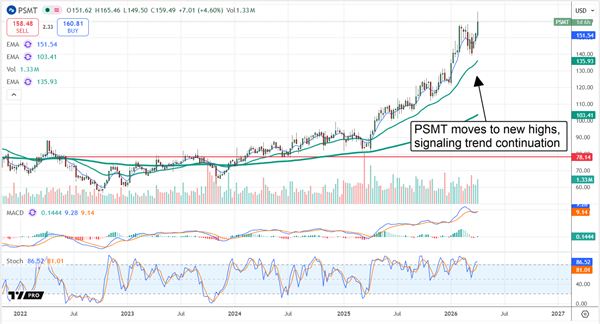
PriceSmart’s stock price jumped more than 2% after the release, pushing the shares to a new all-time high.
The move confirms an uptrend and a bullish Flag pattern, signaling trend continuation. Targets for the move are based on the Flag’s pole—approximately $22—placing the stock near $175 by midyear. Higher highs are likely over the longer term given continued growth, strong cash flow and the ability to return capital.
PriceSmart’s Dividend and Distribution Growth Make It a Buy-and-Hold Investment
PriceSmart isn’t a high-yield stock, but it is a reliable dividend payer with a history of aggressive increases.
In early 2026 the yield was under 1%, but the low payout ratio and strong distribution compound annual growth rate (CAGR) mitigate the low current yield.
The payout ratio is low—about 20%—leaving room for distribution increases without requiring double-digit earnings growth.
Distribution CAGR is in the low teens and is likely sustainable given the payout ratio and earnings trajectory.
Institutional ownership supports the stock's dividend power and growth outlook but can act as a headwind for price action. Institutions own more than 80% of the shares; they were net buyers over the trailing 12 months (at times aggressively) but were net sellers in Q1 2026.
That selling could make it harder for the stock to hold gains, but the fiscal Q2 results may draw institutions back into accumulation, as similar results have done for other retail companies.
There were no obvious red flags in the quarter’s balance sheet—only signs the company can continue executing its strategy. Despite a modest decline in cash at the end of fiscal Q2, PriceSmart remains well-capitalized; gains in current and total assets help offset the cash decline.
Increases in liabilities were manageable, equity rose and leverage remains low. Long-term debt is less than 0.25x equity, leaving the company nimble and able to raise capital if needed.
The main risks this year are rising costs, margin pressure and foreign-exchange volatility. So far, rising costs and margin pressure have been managed, but FX volatility remains a likely wild card for the foreseeable future.
5 Space Stocks Already Climbing Ahead of the SpaceX IPO
Submitted by Bridget Bennett. Published: 4/14/2026.

Key Points
- Rocket Lab and AST SpaceMobile are the two most-watched beneficiaries of a SpaceX IPO, with accelerating revenue growth and expanding launch backlogs that could attract fresh institutional capital once the space sector gets its benchmark public listing.
- Intuitive Machines stands closest to profitability among the five names, with 2026 revenue guidance of up to $1 billion and a backlog approaching $943 million anchored by NASA and defense contracts.
- Planet Labs and Redwire remain earlier-stage plays with longer runways to profitability, but both could benefit from the wave of institutional investment a SpaceX listing is expected to unlock across the broader space sector.
- Special Report: Have $500? Invest in Elon’s AI Masterplan
The most anticipated IPO in market history is no longer just speculation. SpaceX filed a confidential draft registration with the SEC on April 1, targeting a $1.75 trillion valuation and a roughly $75 billion raise that would dwarf Saudi Aramco's 2019 record. A June Nasdaq listing is the current timeline, and MarketBeat analyst Thomas Hughes sees the event as more than a single-stock story—it could be the catalyst that finally unlocks institutional-scale capital across the commercial space sector.
Hughes notes that SpaceX commands the vast majority of the global launch market, and nearly every company building satellite constellations, lunar infrastructure, or orbital manufacturing depends on its rockets. A successful public listing at this valuation would legitimize commercial space as an investable asset class, and companies already positioned in the sector stand to benefit from the capital that follows.
Elon Musk already made me a “wealthy man” (Ad)
I Met Elon Musk "Face-to-Face"
During a private gathering of Wall Street elites, I was one of two people selected to speak with Elon personally.
As a result, my research now leads me to believe Elon will announce the SpaceX IPO on this date:
April 20, 2026. Circle it on your calendar.
I'm sharing an "access code" that lets anyone grab a pre-IPO stake before it happens. This is your invitation to the biggest wealth-building event of the decade.
Click Here to See how to Get Your "SpaceX Access Code"Here are five space stocks Hughes is watching ahead of that potential inflection point.
Rocket Lab: The Second Mover With Accelerating Momentum
Rocket Lab (NASDAQ: RKLB) is the closest thing SpaceX has to a domestic launch competitor. It remains a distant second by scale, but the gap is narrowing. Revenue reached $601.8 million in 2025, up nearly 38% year over year, and the company is accelerating launch cadence while developing the Neutron heavy-lift vehicle that would enable larger constellation deployments and potentially human spaceflight.
Shares surged toward $100 in January before pulling back with the correction in speculative growth names. They currently trade around $70; Hughes views the retreat as the market establishing support at a higher level rather than a sign of a fundamental problem. Rocket Lab is still unprofitable, but revenue growth and an expanding backlog suggest profitability could arrive within a year or two. Fifteen analysts carry a consensus Buy rating with an average price target of $71.
Valuation is the primary risk: at roughly 60 times trailing sales, the market is pricing in years of execution. Hughes argues that the company's launch pace and the broader space investment thesis justify the premium, particularly if a SpaceX IPO accelerates institutional appetite for the sector.
AST SpaceMobile: Satellite 5G With a Massive Addressable Market
AST SpaceMobile (NASDAQ: ASTS) is attempting what no other company has delivered: a space-based cellular broadband network that connects directly with standard, unmodified smartphones. The idea is global, uninterrupted 5G coverage, and the company is leaning heavily on SpaceX launches to deploy its BlueBird satellite constellation.
Revenue jumped from $4.4 million in 2024 to $70.9 million in 2025 as AST moved from testing into early commercialization.
Losses widened to $342 million, but Hughes frames the current phase as derisking: the technology works, and satellites are launching. Major telecom providers, including TELUS (NYSE: TU), Orange (OTCMKTS: ORANY), and Vodafone (NASDAQ: VOD), have signed on. What remains is execution and time.
The stock hit an intraday high near $130 in January, fell to the mid-$30s during the correction, and has since recovered to the high $90s. Hughes expects periodic pullbacks as the market recalibrates, but sees the trend rising as each launch and partnership announcement removes another layer of risk. The biggest near-term threat is delays in the constellation buildout.
Intuitive Machines: Closest to Profitability With a Lunar Edge
Intuitive Machines (NASDAQ: LUNR) builds robots, landers, and infrastructure components focused primarily on the moon. Of the five names on this list, it may have the most compelling near-term financial story. Management guided for $900 million to $1 billion in revenue for 2026, a large step up from $210 million in 2025, driven by acquisitions, NASA's Commercial Lunar Payload Services contracts, and defense awards.
The company also guided to positive adjusted EBITDA in 2026, which would make it one of the first non-SpaceX space companies to reach that milestone.
A backlog approaching $943 million provides visibility, though revenue can be lumpy given the project-based nature of government contracts.
Intuitive Machines is more than a moon play because of its broader service business. NASA contracts and defense engineering work generate steadier revenue streams than lunar landings alone, and the $4.8 billion Near Space Network contract awarded in 2024 runs through 2034. The stock currently trades around $24, near its 52-week high, after spending much of the past year in a sideways range. Hughes views the breakout as the market pricing in a profitability inflection.
Planet Labs: Earth Imaging in a Space Economy
Planet Labs (NYSE: PL) operates a constellation of Earth-imaging satellites and is evolving from a hardware company into a data-intelligence platform. Fiscal 2026 revenue reached $307.7 million, up 26% year over year, with Q4 revenue of $86.8 million that beat estimates by a wide margin.
The connection to SpaceX is straightforward: Planet uses SpaceX's Falcon 9 rockets to launch its satellites. Every launch supports SpaceX's business, and growth in satellite-based Earth observation adds to the demand pipeline across the launch industry.
Institutional investors own roughly 40% of the float and, according to Hughes, have been net buyers at better than a two-to-one pace.
Profitability remains the challenge. Losses widened to $247 million in fiscal 2026, and the path to breakeven remains several years out. Hughes frames Planet Labs as a longer-term play in which a SpaceX IPO could accelerate the timeline by drawing more capital into space infrastructure. The chart action has been strong, with shares reaching new 52-week intraday highs near $38, but the stock trades at a premium that leaves little room for execution missteps.
Redwire: Orbital Manufacturing at the Earliest Stage
Redwire (NYSE: RDW) occupies a different corner of the space economy. The company builds space infrastructure, including deployable solar arrays, sensors, avionics, and in-space manufacturing facilities, along with a growing defense technology segment that includes autonomous systems and optical sensors.
Revenue grew 10% to $335 million in 2025, but losses widened to $272 million and the profit margin sits at about negative 67.5%. Of the five stocks, Hughes identifies Redwire as the weakest near-term play, with the longest runway to profitability. The chart reflects that assessment—the stock has struggled for more than a year and currently trades around $9.
The bull case rests on positioning: as more companies move into space to build satellites, infrastructure, and eventually manufacturing capacity, they will need the components and superstructures Redwire provides. A SpaceX IPO that accelerates the broader buildout could pull Redwire's demand curve forward. Analysts assign a consensus Strong Buy rating with an average price target of $13.89, suggesting meaningful upside if the thesis plays out, but investors should expect volatility and exercise patience.
The SpaceX Catalyst and What to Watch
The common thread across these names is that a SpaceX IPO at a $1.75 trillion valuation would create a pricing benchmark for the entire commercial aerospace sector. It would validate commercial space as an institutional-grade asset class and could unlock capital flows that have been waiting for exactly this kind of signal.
Hughes cautions that the SpaceX IPO itself is likely to be volatile. He expects the offering to be oversubscribed, with the potential for a sharp initial spike followed by a pullback as short sellers engage. For investors considering the five stocks on this list, the play is less about timing the IPO day and more about positioning ahead of the broader capital rotation into space.
The names closest to profitability—Intuitive Machines and Rocket Lab—carry the least execution risk. AST SpaceMobile offers high upside but depends on continued satellite deployment. Planet Labs and Redwire sit further out on the risk curve, with longer timelines to prove their financial models. Across the group, the setup is the same: a sector that has been growing on speculation may be on the cusp of receiving institutional validation that turns speculation into sustained investment.
This email message is a paid advertisement from SmartAsset, a third-party advertiser of MarketBeat. Why did I get this message?.
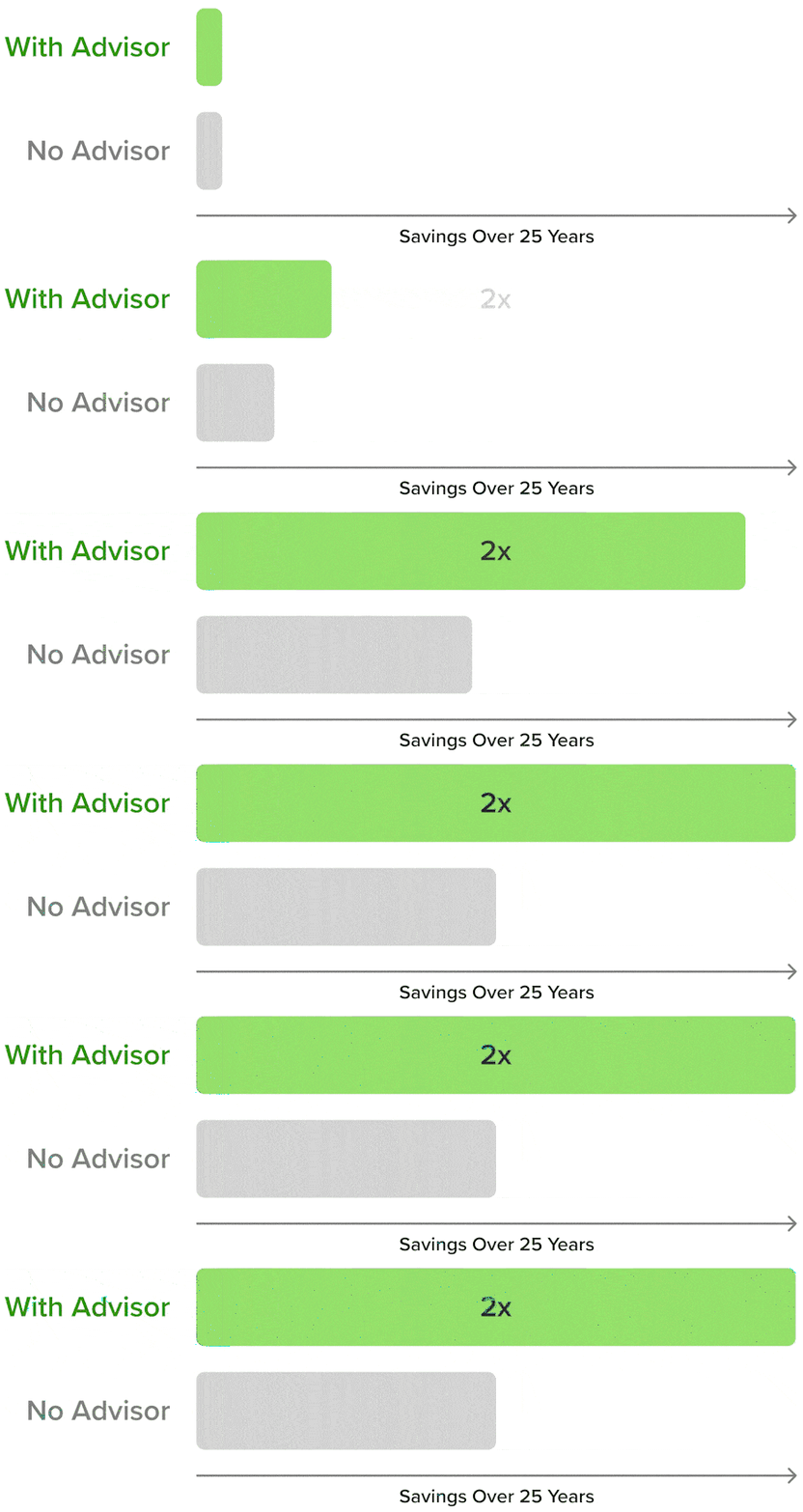
Disclaimer: This example demonstrates the potential final lifetime portfolio value, accounting for estimated investment returns, tax savings and inflation over different life stages for an individual starting with $500,000 at age 45, through age 77. Under a set of core assumptions, this consumer profile is projected to have a final lifetime portfolio value of approximately $3.24 million if retaining the services of a financial advisor – not accounting for additional savings or portfolio withdrawals – versus a final estimated lifetime portfolio value of $1.56 million without the services of a financial advisor. This example is based on the valuation framework presented in SmartAsset's whitepaper [link]"The Value of a Financial Advisor: What's It Really Worth?" (Nov. 2024)[/link]. The value of professional financial advice is only an illustrative estimate and varies with each unique client's individual circumstances and portfolio composition. Carefully consider your investment objectives, risk factors, and perform your own due diligence before choosing a financial advisor.
This is a hypothetical example and is not representative of any specific security. Actual results when working with a financial advisor will vary. This scenario is for illustrative purposes only and does not represent an actual client. Results may vary.
This is not an offer to buy or sell any security or interest. All investing involves risk, including loss of principal. Working with an adviser may come with potential downsides such as payment of fees (which will reduce returns). Past performance is not a guarantee of future results. There are no guarantees that working with an adviser will yield positive returns. The existence of a fiduciary duty does not prevent the rise of potential conflicts of interest.
SmartAsset.com is not intended to provide legal advice, tax advice, accounting advice or financial advice (Other than referring users to third party advisers registered or chartered as fiduciaries ("Adviser(s)") with a regulatory body in the United States). The article and opinions in this publication are for general information only and are not intended to provide specific advice or recommendations for any individual. We suggest that you consult your accountant, tax, or legal advisor with regard to your individual situation.
SmartAsset Advisors, LLC ("SmartAsset"), a wholly owned subsidiary of Financial Insight Technology, is registered with the U.S. Securities and Exchange Commission as an investment adviser. SmartAsset's services are limited to referring users to third party advisers registered or chartered as fiduciaries ("Adviser(s)") with a regulatory body in the United States that have elected to participate in our matching platform based on information gathered from users through our online questionnaire. SmartAsset receives compensation from Advisers for our services. SmartAsset does not review the ongoing performance of any Adviser, participate in the management of any user's account by an Adviser or provide advice regarding specific investments.
We do not manage client funds or hold custody of assets, we help users connect with relevant financial advisors.
Sources:
1. [link]"The Value of a Financial Advisor: What's It Really Worth?" SmartAsset (Nov. 2024)[/link]
If you have questions about your newsletter, feel free to email MarketBeat's South Dakota based support team at contact@marketbeat.com.
If you would no longer like to receive promotional emails from MarketBeat advertisers, you can unsubscribe or manage your mailing preferences here.
© 2006-2026 MarketBeat Media, LLC.
345 N Reid Place, Suite 620, Sioux Falls, SD 57103. U.S.A..


