
Stephen Schwartz’s Genesis and Exodus musicals tore a page from the Christian playbookBONUS ISSUE: "Children of Eden" streams all weekend—but its loose theology is a little wicked
Join David Benkof, The Broadway Maven for two FREE and different classes on the classic musical Fiddler on the Roof. These hour-long classes are offered at Noon and 7 pm ET, so feel free to attend both! Why are the themes of Fiddler so universal? How has the musical infiltrated pop culture? Ever wonder why Bock & Harnick chose specific lyrics? These questions and more are answered in this FREE online class including covering how this show fits into the legacy of all musical theater. Perfect for theater lovers, students, and curious minds alike.
Shalom, Broadway lovers!
NOTE: Stephen Schwartz’s Biblical epic Children of Eden is streaming online this weekend only. With so many fans of the composer’s other work (especially Wicked) preparing to watch, this Bonus Issue will revisit that musical and another Biblical Schwartz show, The Prince of Egypt. As you’ll see, preparing this essay has been a different kind of Sunday School lesson. ESSAY: Traditionally, Christian theology has been forbidden fruit for American Jews. But Stephen Schwartz, a Jewish composer, may be the most consistent creator of Christian music in Broadway history. From writing lyrics for Bernstein’s Mass to adapting the Gospel of Matthew in Godspell, he has repeatedly returned to explicitly Christian material. Yet some of his most ambitious shows draw not on the New Testament but on the Hebrew Bible. The Prince of Egypt and Children of Eden take as their subjects the foundational narratives of Exodus and Genesis, stories central to Jewish tradition. And yet, for all their scriptural sourcing, these works do not simply dramatize the Torah. Instead, Schwartz reshapes these narratives around individual guilt, redemptive suffering, and personal moral transformation—concepts far more central to Christian theology than to Jewish covenantal thought. The result is something like a Christian midrash on the Torah: a retelling that preserves the outline of the original while quietly rewriting its theological grammar. Much of the very language of The Prince of Egypt is not native to the Torah, though it would fit right into the New Testament. For example, “Thus saith the Lord” (from “The Plagues”) is a faithful rendering of the Hebrew, but it is also the archaic diction of the King James Bible—a translation tradition far more at home in Christian liturgy than in modern Jewish practice. More importantly, The Prince of Egypt centers the concept of “deliverance,” which the narrative in Shemot (Exodus) does not. Early in the show, it’s the word that Miriam incorrectly presents as the translation of “Moses,” which tips off anyone who knows Biblical Hebrew that the show is taking serious liberties with the Torah’s priorities. When the slaves sing “Deliver us to the Promised Land” in the opening song, it sounds biblical, but that isn’t how the Torah thinks. In Exodus, Israel is not “delivered” in one sweeping motion, since different verbs refer to escape and arrival. The musical collapses the sequence into a single word—“deliver”—which the Hebrew Bible does not do, but which aligns neatly with Christian habits of thought, where deliverance often implies a unified journey toward fulfillment. And note the unmistakable resonance with perhaps the most famous Christian prayer, the Lord’s Prayer, with its “deliver us from evil” line. Now, the term does appear (very rarely) in Jewish translations of the Tanakh, but many never use it at all. There’s just no Hebrew word with a one-to-one correspondence with “deliver.” The most consequential shift in The Prince of Egypt is its transformation of Moses from prophetic emissary into a Christ-like figure of moral suffering and redemptive purpose. When Moses laments “a ransom never to be paid” and offers himself—“Let me be the ransom for my people”—he adopts a theological language foreign to the Torah but central to Christianity, where suffering is understood as a debt requiring redemption. In Exodus, the plagues are acts of divine judgment, not moral liabilities incurred by Moses. Yet in “For the Rest of My Life,” he agonizes over them as if they were his own crimes, relocating the story’s moral center from God’s sovereignty to Moses’s conscience. This shift is reinforced by the musical’s broader emphasis on individual guilt, heroism, and reconciliation—hallmarks of Christian theology rather than Jewish covenantal thought. Even God’s role recedes: “I saw a miracle and now it’s up to me,” Moses declares. By the stage play’s finale, divine judgment gives way to fraternal reconciliation, as Moses’s arc culminates not in law or covenant (as in the animated film) but in forgiveness, completing his transformation into a quasi-sacrificial savior. With Moses firmly established as a Christ figure, the story begins to generate familiar Christian oppositions—including ones with a long and troubling history. The Prince of Egypt unproblematically recycles classic Christian critiques of the Old Testament (and, by extension, Jews). Two examples: Ramses is cruel, zealous, jealous, and demanding, like tendentious Protestant portrayals of the God of the Torah—as opposed to the loving, accepting, life-affirming Christ-like figure of Moses. The meticulously legalistic, spiritually rigid priest Hotep represents another famous contrast Christians have made: between Christ and the Pharisees, a group of Jewish religious authorities presented as opposed to authentic moral insight. With Moses repurposed as a Christ figure of moral suffering and redemptive purpose, the story needed an opposing force to represent Christ’s Jewish adversaries and found one in an unexpected place: an openly polytheistic priest. The same pattern appears even more clearly in Children of Eden. The title itself gestures toward scripture while quietly reshaping it. “Children of Eden” is not a traditional biblical phrase; when it appears in the Hebrew Bible, it refers not to humanity but to a specific, non-Israelite people. Schwartz had other, more authentic options available. “Children of Adam”—b’nai Adam—simply means human beings, while “Children of Noah”—b’nai Noach—refers in Jewish tradition to those outside the covenant of Israel. By choosing “Children of Eden,” he centers a concept that carries far greater theological weight in Christianity than in Judaism, where the focus falls instead on covenant, law, and the Exodus. That shift continues within the show itself. God is no longer Elohim or YHWH but “Father,” echoing the division of roles in the Trinity and recasting Genesis as a family drama. The expulsion from Eden becomes not an account of human limitation, but a story of disobedience and rupture, imbued with the psychological and moral weight of what Christians call the Fall. Across the Cain, Abel, and Noah narratives, Schwartz consistently foregrounds individual guilt, emotional conflict, and the possibility of moral growth, transforming Genesis into a unified story of sin and redemption. Schwartz has repeatedly returned to explicitly Christian material—Bernstein’s Mass, Godspell, even The Hunchback of Notre Dame. Against that backdrop, the theological shape of his Old Testament musicals begins to look less incidental and more a reversion to form. To be sure, musical theater demands introspection and psychological conflict; Schwartz may simply be translating ancient narrative into modern dramatic form. But he achieves emotional resonance by quietly reshaping Jewish scripture into Christian narrative patterns. While that’s certainly his prerogative, it’s a weakness of the shows that they present Genesis and Exodus as authentically rooted in the Hebrew Scriptures or even Judaism itself despite their non-Jewish value systems. In the end, these are not Jewish stories retold, but Jewish stories re-theologized.
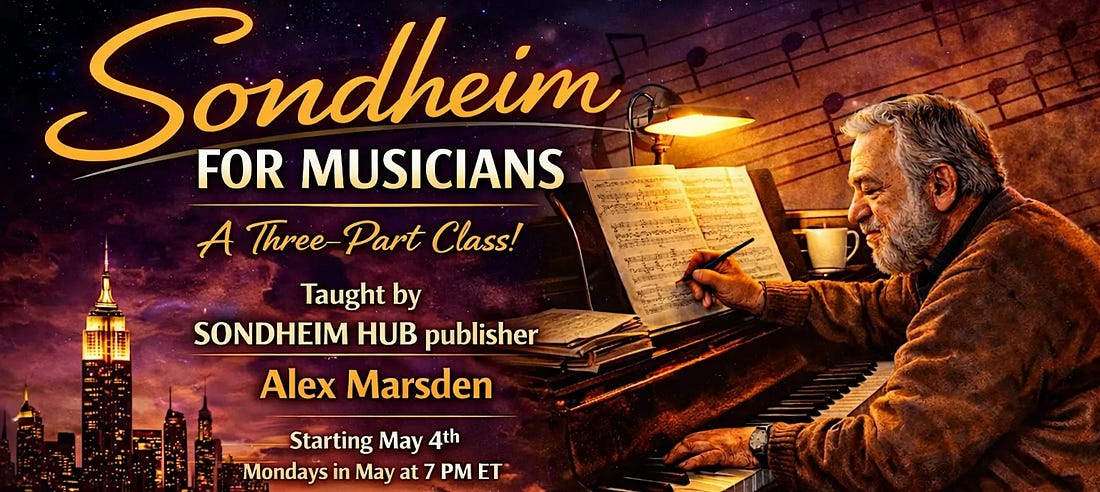
Sondheim’s music rewards close attention in ways that even well-informed listeners often miss. This course is designed to make that craft visible and audible. Join Broadway Maven guest lecturer and Sondheim Hub publisher Alex Marsden for THREE technical talks about the best within Sondheim’s scores. You don’t need an instrument to participate, but the course expects some knowledge of music theory from participants. These classes are offered Mondays at 7 pm ET on Zoom, running from May 4 to May 18. Each class is one hour long. (Current Broadway Maven Members will get sign-in info in their Friday Blasts.)
Join The Broadway Maven! Nowhere else online brims with this much Broadway content, and certainly not for so little (Membership is $25 a month for 5-15 compelling classes). Purchase a monthly or an annual plan. Cancel at any time. Sign up here: Broadway Maven Members get the Friday Blast once a week filled with Members-only goodies.
Note: A full calendar of upcoming classes is always available at TheBroadwayMaven.com.• Monday, April 27 Introduction to Broadway with David Armstrong, Noon ET (part of an 8-week course, registration closed). • Monday, May 4 Introduction to Broadway with David Armstrong, Noon ET (part of an 8-week course, registration closed). • Monday, May 4 Sondheim for Musicians with Sondheim Hub publisher Alex Marsden, 7 pm ET (Register here.) • Tuesday, May 5 Fiddler on the Roof, Noon and 7 pm ET (different classes, REGISTER HERE) • Sunday, May 10 Hair, Noon and 7 pm ET (MEMBERS ONLY) • Monday, May 11 Introduction to Broadway with David Armstrong, Noon ET (part of an 8-week course, registration closed). • Monday, May 11 Sondheim for Musicians with Sondheim Hub publisher Alex Marsden, 7 pm ET (Register here.) • Sonday, May 17 WATCH PARTY: Rodgers & Hammerstein’s Cinderella, 7 pm ET (MEMBERS ONLY) • Monday, May 18 Introduction to Broadway with David Armstrong, Noon ET (part of an 8-week course, registration closed). • Monday, May 18 Sondheim for Musicians with Sondheim Hub publisher Alex Marsden, 7 pm ET (Register here.) • Tuesday, May 19 Rodgers & Hammerstein’s Cinderella with Rodgers & Hammerstein expert Ted Chapin, 7 pm ET (MEMBERS ONLY) The Broadway Maven is a vibrant educational community that helps its members think more deeply about musical theater. We offer 5-15 classes a month for just $25. We also foster enthusiasm for Broadway through the FREE weekly Substack newsletter MARQUEE and host an expansive YouTube channel. It’s your home for Broadway appreciation. Contact The Broadway Maven at DavidBenkof@gmail.com. You're currently a free subscriber to MARQUEE: The Broadway Maven's Weekly Blast. For the full experience, upgrade your subscription.
|