Hello, Thanks for signing up for MarketBeat Daily Ratings—we’re excited to have you on board. Every weekday, you’ll get a curated summary of new “Buy” and “Sell” ratings from Wall Street’s top-rated analysts, the latest stock news, and bonus investing content—all delivered straight to your inbox. You’re just two quick steps away from completing your sign-up: 1. Make sure our emails go to your inboxGmail users:
Mobile: Tap the three dots (…) in the top right and select Move to Inbox or Move to Primary
Desktop: Click the folder icon at the top and select Move to Inbox or Primary Apple Mail users:
Tap our email address at the top (next to From: on mobile), then select Add to VIP Other providers:
Reply to this message and add newsletters@analystratings.net to your contacts 2. Confirm your subscriptionClick this link to confirm your subscription. This verifies your account and ensures you receive your newsletters without interruption instead of getting stuck in your spam filter. Confirm your subscription here. After you confirm, feel free to download our popular free report, "7 Stocks to Buy and Hold Forever" with this link. Thanks again for subscribing—we look forward to being part of your investing journey. 
Matthew Paulson
Founder and CEO, MarketBeat. P.S. If you didn’t mean to subscribe, no problem—you can unsubscribe here.
Additional Reading from MarketBeat.com
Why PriceSmart’s Discount May Not Last Much LongerSubmitted by Thomas Hughes. Date Posted: 4/10/2026. 
Key Points
- PriceSmart is positioned to grow, drive cash flow, and pay dividends in 2026, outperforming estimates for fiscal Q2.
- Marketshare gains, new stores, and comp-store growth underpin an outlook for double-digit earnings growth over the coming years.
- PriceSmart’s valuation remains below that of its larger membership-club peers, though emerging-market exposure and currency volatility remain key risks.
- Special Report: Elon’s “Hidden” Company
PriceSmart (NASDAQ: PSMT) carries elevated risk as an emerging-market stock, but it is well positioned and currently trades at a discount relative to peers Walmart’s (NASDAQ: WMT) Sam’s Club and Costco (NASDAQ: COST). Those two leading membership-club retailers trade at much higher valuations, implying PriceSmart's stock may have significant upside. PriceSmart trades at roughly 29x earnings versus Costco’s about 50x, suggesting meaningful upside underpinned by the company’s ability to grow. PriceSmart self-funds its growth and leads in percentage gains. Fiscal Q2 2026 results show a 9.7% growth rate, compared with Costco's 9.1% and Walmart's 5.6% for the comparable period.
Twenty-one banks - including JPMorgan, Goldman Sachs, and Morgan Stanley - are competing to underwrite the SpaceX IPO, internally codenamed 'Project Apex.' At a $1.75 trillion valuation, it would be the largest IPO in Wall Street history.
Studies show 95% of total profits are made before a company goes public. Dr. Mark Skousen has identified a little-known fund run by a Wall Street legend who already turned Tesla into a 30-bagger - and is now betting big on SpaceX ahead of an expected June IPO. Discover how to claim your stake in SpaceX before the IPO hits
Looking ahead, PriceSmart expects to sustain its double-digit pace, driven by market-share gains, comp-store growth and new store openings. As of fiscal Q2 2026, the company’s store count was up 3.7% year-over-year and is expected to rise nearly 9% by the end of FY2027. PriceSmart Outperformance Triggers Continuation Signal PriceSmart reported a solid fiscal Q2, with revenue up 9.7% to $1.5 billion, outperforming the consensus by 135 basis points. The gain was driven by a 9.9% increase in merchandise sales, which included a 7.8% rise in net sales and a 2.1% benefit from currency translation. Comp-store sales increased 7.6% (5.5% adjusted for currency translation), and membership fees grew 17%, suggesting comp-store momentum may continue in coming quarters. Margins also improved. Better revenue leverage, stronger-than-expected traffic and operational execution accelerated earnings growth. EBITDA, a measure of core profitability, grew 14.5%, leaving GAAP EPS at $1.62—more than a nickel ahead of consensus. Margins are expected to remain healthy in the next quarter, which helped trigger the market’s positive response. PriceSmart’s stock surged more than 2% after the release, pushing the share price to a new all-time high. The move confirms an uptrend and a bullish Flag Pattern, signaling trend continuation. Targets are based on the Flag’s pole—roughly $22—implying a target near $175 by midyear. Higher highs are likely over the longer term given the company’s growth, cash flow and capital-return potential. 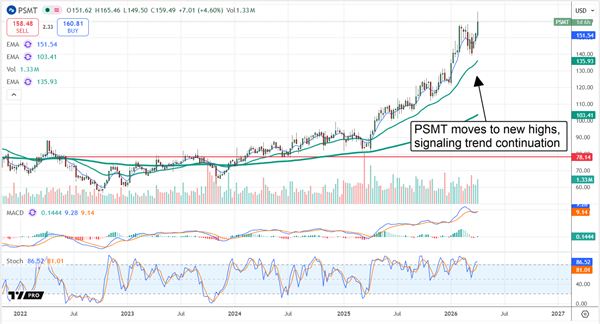 PriceSmart’s Dividend and Distribution Growth Make It a Buy-and-Hold InvestmentPriceSmart isn’t a high-yielding stock, but it is a reliable dividend payer with a track record of aggressive increases. In early 2026 the yield was below 1%, but that low yield is offset by a low payout ratio and a solid distribution compound annual growth rate (CAGR). With a payout ratio near 20%, the company has ample room to raise distributions without requiring double-digit earnings growth. The distribution CAGR is in the low teens and is likely sustainable given the payout ratio and expected earnings growth. Institutional ownership—more than 80% of shares—underscores confidence in the dividend and growth outlook, but it can also constrain price action. Institutions were net buyers over the trailing 12 months (sometimes aggressively) but were net sellers in Q1 2026. That pattern could make it harder for the stock to sustain rallies. The flip side: the fiscal Q2 results may draw institutions back into accumulation, as similar results have for other retail companies. No obvious red flags appeared on the quarter’s balance sheet. Aside from a modest decline in cash at the end of fiscal Q2, PriceSmart remains well-capitalized, with gains in current and total assets helping to offset the decrease. Liability increases were manageable, equity rose, and leverage stayed at persistently low levels. Long-term debt is less than 0.25x equity, leaving the company flexible to raise capital if needed. Key risks include rising costs, margin pressure and FX volatility. So far the company has mitigated cost and margin pressures, but foreign-exchange volatility is largely uncontrollable and likely to remain elevated for the foreseeable future. |