For years, backing the dollar with Bitcoin sounded like a conspiracy.
Now? It's moving through Congress.
A year ago, Trump signed an Executive Order creating a Strategic Bitcoin Reserve - recognizing crypto as a national asset.
Now the newly introduced "Mined in America Act" would codify that reserve into permanent law - and open a direct pipeline for the Treasury to accumulate even more BTC.
Translation?
Crypto isn't just mainstream - it's becoming the new "Gold Standard."
And here's the smart move:
You can secure Bitcoin inside a Crypto-Backed IRA - completely tax-free - just like a Gold IRA.
👉 See how to lock in your Bitcoin before this becomes law.
This isn't hype.
It's happening.
3 eVTOL Stocks, 3 Flight Plans: Which One Will Stick the Landing?
Submitted by Jeffrey Neal Johnson. Originally Published: 4/22/2026.

Key Points
- Joby Aviation is building a fully integrated air taxi service, leveraging its key automotive partnership to enhance its manufacturing capabilities.
- Archer Aviation is accelerating its path to market by collaborating with established aviation and automotive leaders to scale its operations efficiently.
- Vertical Aerospace's manufacturer-focused model is supported by a substantial pre-order book from global airlines and a newly secured financing package.
- Special Report: Elon Musk’s $1 Quadrillion AI IPO
The electric vertical takeoff and landing (eVTOL) sector is moving rapidly from science fiction toward commercial reality. Driven by the need to ease urban congestion and cut carbon emissions, electric air taxis are no longer a question of if but of when — and, for investors, how.
The industry has reached an inflection point: the conversation is shifting from dazzling prototypes to the hard business of execution. Companies now face the final, capital-intensive hurdles of achieving regulatory certification, scaling complex manufacturing, and securing enough funding to launch commercial service. For investors, the emphasis must move from the allure of the technology to a sober assessment of each competitor’s business-model viability and financial sustainability.
All Systems Go: A Trifecta of Industry-Defining Progress
The REAL Reason Trump is Invading Iran (Ad)
For a moment…
Forget about Trump’s ties to Israel.
Forget about reports of Iran’s nuclear program.
Because my research has led me to believe we’re risking World War 3 with Iran for a completely different reason.
Click here to find out what it is.The abstract promise of eVTOLs became substantially more concrete as all three industry leaders recently announced major advances. Vertical Aerospace (NYSE: EVTL) completed a piloted, two-way transition flight under the UK's Civil Aviation Authority (CAA), a critical validation of its aircraft's core mechanics. The company then secured up to $850 million in financing, addressing two major investor concerns: technical viability and cash runway.
At the same time, U.S. front-runner Joby Aviation (NYSE: JOBY) is steadily progressing through the Federal Aviation Administration’s (FAA) certification process and has deepened its partnership with the Department of Defense — a de‑risking development that can provide early revenues and demonstrates its aircraft’s capability for demanding missions.
Archer Aviation (NYSE: ACHR) also reached a key regulatory milestone when the FAA accepted its certification basis, and the company is coordinating with partner United Airlines (NASDAQ: UAL) to plan infrastructure and logistics for initial commercial routes. These simultaneous breakthroughs show the sector maturing and highlight the differing strategies each company is pursuing to win the market.
Which Blueprint Leads to Profit?
With the core technology proving itself through successful transitions and regulatory milestones, the ultimate winners will likely be those with the most efficient, scalable business models. The industry is moving beyond the spectacle of flight to the practicalities of profitable operations, and each of the three leaders has chosen a distinct path to capture the urban air mobility market.
The All-in-One Powerhouse: Joby Aviation
Joby is pursuing a tightly controlled, vertically integrated strategy. It aims to own the value chain — from aircraft design and manufacturing to the consumer-facing ride-hailing app — creating a strong competitive moat similar to Apple’s hardware-software ecosystem. This approach offers the highest potential for long-term margins by capturing multiple revenue pools.
But it is also the most capital-intensive model, with a high cash burn rate that investors should monitor closely. That risk is partially offset by Joby’s partnership with Toyota (NYSE: TM), which brings valuable mass-manufacturing expertise.
The Alliance-Based Accelerator: Archer Aviation
Archer has chosen a hybrid model that outsources major manufacturing and operational risks to established partners. By teaming with automotive giant Stellantis (NYSE: STLA) for production and with United Airlines for market access and customer acquisition, Archer reduces upfront capital needs and operational complexity.
This de‑risked approach allows Archer to concentrate on aircraft design and certification. The tradeoff is sharing future revenue and relying heavily on partners’ execution — making the strength of those alliances a key indicator of Archer’s long-term prospects.
The Capital-Efficient Manufacturer: Vertical Aerospace
Vertical Aerospace is pursuing an asset-light model as a pure-play aircraft manufacturer. Its strategy is to design, certify, and sell aircraft to airlines and leasing companies, leveraging customers’ existing infrastructure and brands rather than building a consumer airline.
This approach is the most capital efficient of the three, avoiding the enormous costs of operating a passenger service. With a pre-order book of roughly 1,500 aircraft, Vertical’s model may offer a streamlined and lower‑risk route to positive cash flow — an attractive feature in a market increasingly skeptical of high cash-burn business plans.
The Great Valuation Divide
The market has already priced these strategies differently. Joby Aviation, with its goal of total market control, carries a market capitalization of about $8.3 billion. Archer Aviation’s partnership-backed model is valued near $4.5 billion.
By contrast, Vertical Aerospace’s asset-light manufacturer model is valued much more modestly, around $282 million. That valuation gap raises an important question for investors. While analysts see upside for all three, Vertical's price target near $11.30 suggests a potential re‑rating could be warranted now that its technology and financing risks have been meaningfully reduced.
Your Final Approach: 3 Profiles for Your Portfolio
As the eVTOL sector transitions from promise to execution, the investment decision shifts from betting on a concept to analyzing business fundamentals. With recent milestones validating the technology broadly, investors can choose among three distinct strategies, each with a different risk-reward profile.
For higher-risk investors, Joby Aviation is a venture-capital‑style bet on building a dominant, vertically integrated transportation network. Archer Aviation offers a more balanced approach, leveraging blue-chip partners to reduce execution risk. Vertical Aerospace presents a value-oriented case built on capital efficiency and a substantial pre-sold order book.
Cautious investors may prefer to monitor each company as they complete certification and scale operations; those ready to establish positions should consider which strategic blueprint best fits their long-term view of urban air mobility.
Sonoco Stock Drops as Inflation Hits Q1 Results
Written by Chris Markoch. Posted: 4/24/2026.

Key Points
- Sonoco reported flat adjusted EPS of $1.20, missing expectations and putting its 2026 growth outlook at risk.
- Rising energy costs, softer volumes, and higher debt levels are creating near-term pressure on margins and cash flow.
- Growth in industrial reels tied to AI and data center demand offers a potential long-term catalyst for the stock.
- Special Report: Elon Musk’s $1 Quadrillion AI IPO
Shares of Sonoco Products (NYSE: SON) are under pressure after the company delivered its Q1 2026 earnings. The company missed on both the top and bottom lines, with the business under strain largely due to inflationary pressure from rising energy costs.
Sonoco’s earnings report is a good example of what happens during earnings season when results don’t meet expectations. Management had previously been bullish about growing adjusted earnings by roughly 20% in fiscal 2026. That projection looks challenged after Q1 results that were essentially flat year-over-year (YOY), but the headline needs context.
An Earnings Number That Gets Complicated
The REAL Reason Trump is Invading Iran (Ad)
For a moment…
Forget about Trump’s ties to Israel.
Forget about reports of Iran’s nuclear program.
Because my research has led me to believe we’re risking World War 3 with Iran for a completely different reason.
Click here to find out what it is.Sonoco reported Q1 2026 adjusted earnings per share (EPS) of $1.20, which management characterized as flat YOY. The adjusted EPS for Q1 2025 was $1.38, but that included contributions from ThermoSafe, the temperature-assurance logistics business Sonoco subsequently divested. Stripping ThermoSafe from the prior-year comparison, continuing operations generated $1.20 in Q1 2025 as well, making the flat characterization technically accurate on a like-for-like basis.
That distinction matters for shareholders. Investors who owned Sonoco a year ago received the economic benefit of $1.38 in EPS; the portfolio is now smaller, and the 18-cent difference represents earnings that left with ThermoSafe.
Whether the divestiture was worthwhile depends on two factors. First, how Sonoco deploys the proceeds: the company has primarily used the money to reduce debt and support the ongoing integration of Eviosys. Second, whether the remaining two-segment business can grow earnings from the $1.20 baseline. Management’s decision to guide toward the low end of full-year adjusted EPS guidance of $5.80–$6.20 suggests the path forward faces real near-term headwinds from volume softness and input-cost inflation.
Cash Flow: Ugly Number, Understandable Reason
Sonoco's Q1 operating cash flow was approximately $208 million, compared with about $368 million in Q1 2025. That's a sharp decline, but context matters. Approximately $103 million of the difference reflects taxes paid on gains from the divested ThermoSafe business, which is a non-recurring item. Management left full-year operating cash flow guidance unchanged at $700 million to $800 million, indicating they view Q1 as an anomaly rather than a structural trend.
Still, total debt increased by $363 million during the quarter. Net debt to total capital rose to 55.5% from 52.1% at year-end. That’s not alarming yet, but it’s a metric worth watching. If free cash flow remains pressured into Q2, leverage could become part of the conversation.
A Growth Catalyst Hidden in the Industrial Segment
Amid the headline noise, one positive stands out: Sonoco's reels volume — the industrial spools used to transport fiber-optic cables — grew about 7% in Q1. That strength is directly tied to data-center and AI infrastructure buildouts. Demand for fiber connectivity is accelerating as hyperscalers expand capacity.
Sonoco is acting on that demand. The company is investing $20 million to expand nailed-wood reel capacity in Hartselle, Alabama, adding roughly 15% incremental capacity. For investors able to look past near-term inflation headwinds, this positions Sonoco as a quiet infrastructure play.
Priced for Perfection, What’s Next for SON
SON gapped down after the earnings miss, which shouldn’t have been a total surprise. The stock had been trading near its 52-week high in the weeks before earnings, leaving little room for disappointment.
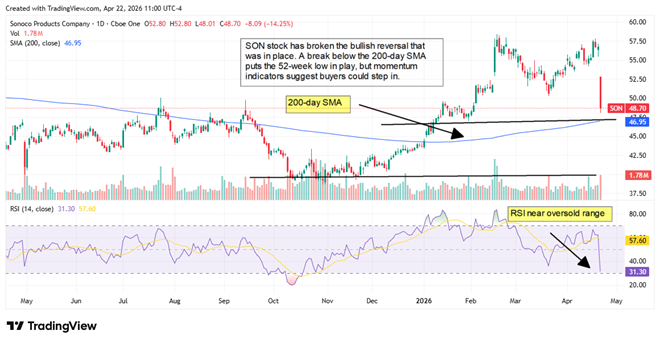
The stock fell below its 50-day simple moving average and is now trading near its 200-day SMA, which may be a key line in the sand. If SON slips below that level, the 52-week low could come into play. That said, the stock is showing signs of being oversold, which could present a buying opportunity for patient, risk-tolerant investors.
Is the Dividend Enough?
At the high end of the company’s full-year EPS guidance, Sonoco would deliver about 8% YOY growth. Management is guiding to the lower end of the range, however, which would imply essentially flat earnings YOY.
There are reasons to believe Sonoco’s prospects could improve if inflationary pressure eases, but “if” is not always a reliable investable thesis.
Even if revenue remains pressured, SON looks inexpensive at roughly 8.4X forward earnings, a discount to its historic average. On top of that, investors receive a safe dividend that the company increased for the 43rd consecutive year on April 15.
It’s also worth noting that analysts have a consensus price target of $61.78 on SON, which is more than 20% above the current price. Investors should watch for any significant re-ratings or changes to price targets in the coming weeks.
This email communication is a sponsored message from Genesis Gold Group, a third-party advertiser of MarketBeat. Why was I sent this email content?.
If you have questions or concerns about your newsletter, feel free to email MarketBeat's U.S. based support team at contact@marketbeat.com.
If you would no longer like to receive promotional emails from MarketBeat advertisers, you can unsubscribe or manage your mailing preferences here.
© 2006-2026 MarketBeat Media, LLC. All rights protected.
345 N Reid Pl., Suite 620, Sioux Falls, S.D. 57103-7078. USA..


