
I wish this wasn’t the case…
But it’s happening, exactly as I predicted.
I first warned my readers of this threat months ago. Many disregarded it.
Now it’s accelerating and unless you prepare now you could be blindsided by an event two Nobel Prize winners have warned of… an event that you cannot ignore.
The clock is ticking. Just take a look:
In a single month, March of this year, U.S. employers announced 60,620 job cuts. That's a 25% jump from February. And one force was named as the reason why.
Then the floodgates really opened.
Meta announced it's laying off roughly 8,000 employees – 10% of its workforce – and quietly killing another 6,000 unfilled roles.
The same week, Microsoft offered "voluntary separation" to 7% of its U.S. workers — more than 8,500 people.
Translation: quit on your terms, or we'll fire you on ours.
And they're not alone. Not by a long shot.
Amazon cut 16,000 corporate jobs… Block cut 40% of its workforce…. Salesforce eliminated 44% of its support team... Oracle is reportedly axing up to 30,000 roles.
IBM, Snap, Pinterest, Klarna… the list grows by the week.
Almost 80,000 tech jobs evaporated in the first three months of 2026 alone.
Although most people think this is about AI… it’s not. The story goes far deeper and is far more consequential. It’s something that I’ve been warning off for months now.
And I’m not the only one.
Two Nobel Prize winners have warned of this Final Displacement.
Because they know, as I do, this event could trigger a once-in-a-generation wealth shift.
A transfer of wealth that’s already begun with Goldman Sachs estimating 12,400 Americans are being financially destroyed every day… while others grow richer than ever before.
Which side you’re on could depend on what you do next.
Because for those who understand what’s unfolding, this could be one of the greatest wealth-building phenomena of their lives.
But for those who bury their head in the sand… this force threatens to wipe out years of investment returns and could even destroy their financial future.
Here’s the full story for you.

26 years ago, I started telling friends, family, and anyone who would listen about an unprecedented societal shift that was barreling down on us.
I’d discovered that a new technology was about to unleash massive, almost unimaginable, changes. I likened the impact to the railroad boom, the Industrial Revolution, and the rise of personal computing.
At the time, I was working as an investment analyst for an elite research group, but my colleagues and bosses refused to listen to me.
No matter what I said, they simply would not acknowledge the sands shifting beneath their feet.
The legendary Dr. Kurt Richebächer – one of the world’s leading Austrian economists – even called me and my ideas “radical.”
But I was certain this new technology would trigger a transformation that was simply unfathomable to most people… and those on the frontier could reap financial returns unlike any the world had ever seen before.
So, I decided to put my entire career – not to mention every cent I had – on the line to spread the story myself.
I left my job as a research analyst… went home to my third-floor apartment in one of Baltimore’s worst neighborhoods… and with a borrowed laptop, I wrote my first financial prophecy.
And in an investment paper that’s now been read by more than one hundred thousand people…
I explained how the endless miles of new fiber optic cables being laid was creating a new railroad across America.
And that this new “railroad” was going to upend the telecommunications industry and pave the way for a new internet economy.
I also warned it would decimate some of America's most dominant companies like AT&T.
At the time, this was an outlandish idea, with analysts calling AT&T “dominant”, “unstoppable”, and “the giant that no other company can topple.”
But those who were willing to open their minds to my so-called “radical” ideas were not only able to sell these companies before they collapsed…
They also had the chance to get in early on the firms that would go on to command this new internet economy:
Amazon, Adobe, Qualcomm, SunMicrosystems, Uniphase, Texas Instruments… These are household names now, but when I first recommended them in the late 90s, they were complete unknowns.
Since then, I’ve issued a number of other financial prophecies, many of which have come to pass precisely as I predicted.
But today, I’m stepping forward with a new exposé that I believe could surpass anything I’ve ever done…
It’s an investigation into what I call The Final Displacement… and I don’t think we will ever again see a story that rivals the magnitude of this during my lifetime.
I’m not talking about AI… quantum computing… augmented reality… the blockchain… or anything else you might be thinking of.
No. This is far bigger than them all. In fact…
It’s the cornerstone that all our recent technological innovations have been built upon and the future will be built upon too.
Yet you’ve likely never heard of it before.
Outside of the labs in the world’s most prestigious universities and tech companies, almost nobody has.
But those who have… those who can see the writing on the wall… they’re investing billions of dollars, as they know this will transform everything.
Marc Andreessen… Ben Horowitz… Elon Musk… Jeff Bezos… Mark Zuckerberg…Jensen Huang… Bill Gates… the list goes on and on.
They know, as I do, that in a few years from now, we will not recognize the world we live in.
How we work, live, communicate, transact… it will all be completely upended by what’s coming next.
Today, I’m going to share it all with you… and I promise you’ve never heard anything like this before.
You see, despite the magnitude of this story, nobody is openly and freely discussing this turning point. And that deeply concerns me, because I believe its emergence will draw an indelible demarcation line in society.
On one side, you’ll have those who understand it, invest in it, and who are greatly enriched by it.
On the other side… you’ll have those who underestimate it, turn a blind eye and are unfortunately impoverished by the sweeping changes it ushers in.
I know what side I’ll be on.
And I know what side I want you to be on.
So go here to watch my full investigation into this story.
Including the names of the companies to buy and sell if you want to capitalize on the impending multi-trillion-dollar displacement.
Good investing,
Porter Stansberry
Palantir Is Down 30%: Noise? Or a Signal to Accumulate?
By Chris Markoch. First Published: 4/28/2026.

Key Points
- Palantir stock is down sharply, but analysts still project 20%–37% upside based on current price targets.
- The company’s Ontology platform creates high switching costs and differentiates it from AI competitors like Microsoft and Alphabet.
- Technical signals suggest short-term weakness, but long-term investors may see the pullback as a strategic buying opportunity.
- Special Report: Have $500? Invest in Elon’s AI Masterplan
For some Palantir Technologies Inc. (NASDAQ: PLTR) investors, the thrill has faded. The stock is down about 20% in 2026 and roughly 30% from its 52-week high in November 2025.
Additionally, PLTR has been trading in a defined range since early February. Even a strong February earnings report wasn't enough to sustain a bullish move.
The #1 stock to buy BEFORE the June S-1 filing (Ad)
When the SpaceX IPO launches, most retail investors will be locked out. The banks, funds, and insiders get in early - while everyone else waits on the sidelines.
But one small infrastructure supplier - a critical piece Musk can't scale the Colossus network without - is still trading well under institutional radar. A new briefing reveals the name and ticker at no cost.
Get the SpaceX infrastructure stock name and ticker hereFor traders, that stagnation may signal risk or present an opportunity to bet on further downside. For long-term investors, however, this pullback looks healthy and may be an opportunity to accumulate strategically.
What's Getting Lost in the Existential Threat Debate
Palantir's valuation remains a concern, and proponents of efficient markets have plenty of ammunition. But markets aren't always rational, and analysts have been raising price targets on PLTR for more than a year.
Part of the reason is that more analysts are becoming familiar with Palantir's Ontology and how it differentiates the company. To understand the Ontology, it's important to acknowledge the perceived threat from agentic AI.
The bearish argument assumes Palantir's primary role is simply stitching data together. In that view, a company like Microsoft (NASDAQ: MSFT) with Copilot or Alphabet (NASDAQ: GOOGL) with Google Vertex could automate the task and make Palantir redundant. This line of thinking is central to the Anthropic debate.
To be fair, companies like Microsoft or Alphabet could erode part of Palantir's addressable market. But that's not what Palantir's Ontology does. The Ontology is built to represent the complex, interconnected decisions of an enterprise—not just its data. It models data, logic, action, and security as a unified system.
Practically, Palantir functions as an active semantic and operational layer developed over years in close collaboration with the organizations it serves. That increases switching costs and creates durability critics often overlook.
Signals Versus Noise
Owning PLTR means accepting volatility. The company is polarizing, its CEO is polarizing, and by many measures the stock appears overvalued.
That combination makes the stock reactive; it doesn't take much to move the price. But as many investors have discovered, shorting PLTR is not an easy bet.
Volatility can be frustrating for long-term holders, but much of it is noise. The signal for investors lies in the company's earnings, analyst forecasts, and institutional buying.
That's why May 4 is a key date—Palantir will report Q1 2026 earnings then. The bar is set high, and any signs of margin softening could push the stock lower.
For now, analysts don't appear alarmed. MarketBeat's Palantir forecasts show a few lowered price targets, but even the lowest—around $175—still implies more than 20% upside from the stock's April 27 price. The consensus target of $196.35 implies over 37% upside.
Institutional ownership did decline in the first quarter on significantly lower volume, which supports the view of a healthy, overdue pullback. Some selling likely reflects "AI will eat software" fears, but as a member of both the S&P 500 and Nasdaq 100, Palantir remains on institutional radars and will continue to attract attention.
Reading the Chart
PLTR is trading near $143, below its 50-day moving average of $144.63 and its 200-day moving average of $164.44. That's a classically bearish moving-average structure, and with the 200-day still sloping downward, the intermediate trend hasn't turned—traders should be cautious.
The short-term technical case for a descending triangle has merit. Since the February gap down, PLTR has printed lower highs while finding support in the $128–$135 zone—a flat floor with compression from above. That pattern typically resolves to the downside, and with earnings on May 4 acting as a catalyst, a disappointing report could confirm a break.
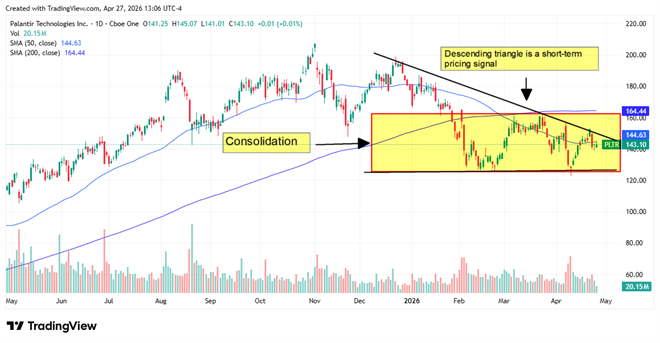
But a descending triangle is a price signal, not a business signal. The longer-term picture shows a stock digesting a near-doubling in under a year. Volume on down days hasn't been capitulatory, and institutional accumulation near the lows suggests the base is being tested—not abandoned. For patient investors, this looks less like distribution and more like a coil preparing to unwind.
Is PLTR Stock a Buy?
PLTR is not a safety play. You buy it because the business is real, contracts are expanding, and the Ontology provides durability that bears keep underestimating. The upcoming earnings report will reveal information that could move the stock in the short term, but the long-term story doesn't hinge on a single quarter.
AMD’s Breakout Isn’t the Story—This Catalyst Is
By Thomas Hughes. First Published: 4/24/2026.
Key Points
- Advanced Micro Devices' stock price action indicates potential for a significant movement driven by the upcoming Q1 earnings release.
- Analysts are boosting price targets, pointing to a 35% upside potential.
- Valuation and long-term trends suggest this stock can advance by 800% or more over the next few quarters to a year.
- Special Report: Have $500? Invest in Elon’s AI Masterplan
Advanced Micro Devices' (NASDAQ: AMD) stock is in rally mode after quarters of consolidation, and it is now sending a clearer signal to investors: a visible catalyst is ahead that the market appears to have underestimated. The catalyst is the launch of MI450 products and Helios rack-scale solutions. At first glance you might think AMD will struggle to gain share versus NVIDIA (NASDAQ: NVDA), but that concern may be moot.
Consider that NVIDIA's production capacity is effectively maxed out. Its AI-capable GPUs are sold out, and Taiwan Semiconductor (NYSE: TSM) is having difficulty ramping production.
The #1 stock to buy BEFORE the June S-1 filing (Ad)
When the SpaceX IPO launches, most retail investors will be locked out. The banks, funds, and insiders get in early - while everyone else waits on the sidelines.
But one small infrastructure supplier - a critical piece Musk can't scale the Colossus network without - is still trading well under institutional radar. A new briefing reveals the name and ticker at no cost.
Get the SpaceX infrastructure stock name and ticker hereIn that environment, TSMC and NVIDIA are unable to meet demand — estimated to be roughly 10-to-1 compared with available supply — but total GPU availability is poised to improve. While TSMC can’t significantly increase NVIDIA chip output, it is positioned to ramp AMD production, which could meaningfully boost AMD’s revenue.
The MI450 and Helios launches are slated for the back half of the year, beginning in Q3, and could drive acceleration to triple-digit revenue growth in the first two quarters after availability. To see why current estimates may be conservative, consider the scale of the opportunity: NVIDIA’s datacenter business generated over $50 billion in revenue in its fiscal Q4, which exceeds 100% of AMD’s entire fiscal year 2026 (FY2026) revenue forecast.
Against a market this large, the low-30% annual growth rate analysts are currently modeling for AMD looks tepid. Not only do current consensus forecasts imply the stock could rise substantially from its recent breakout point, but those estimates are likely too low and may be poised for meaningful upgrades.
Bullish Analyst Trends Underpin AMD Stock Price Increase
Bullish analyst trends are strengthening ahead of AMD’s upcoming fiscal Q1 2026 earnings report. MarketBeat tracks 40 analysts covering the stock, a level of coverage that supports a Moderate Buy rating, and there is a 76% Buy-side bias.
On a trailing 12-month (TTM) basis, coverage shows an increase: the number of Buys and Strong Buys has risen, Holds have declined, and Sells have largely exited. The average price target has also moved higher, increasing more than 100% on a TTM basis.
The one downside is that the consensus price target as of late April sits around $290. However, the stronger trend is pushing the potential range higher, with a top-end target near $380. A move to $380 would be roughly 35% above the critical breakout point and could prove conservative in hindsight. If AMD confirms its growth trajectory in the upcoming report — possibly revealing new orders for the MI450 — analyst sentiment should strengthen, triggering upgrades and target increases.
Institutional activity is a potential risk in Q2. Institutions accumulated aggressively for nearly two years leading into the quarter, then began taking profits once the quarter started. Continued profit-taking could limit near-term upside, but recent price action suggests a shift in market dynamics: with shares moving to new highs, both the support floor and upside potential appear to have increased.
Advanced Micro Devices: Price Advance Macro Accelerates
AMD’s price action is exhibiting a familiar technical signal in today’s market. The broader rebound in technology and AI stocks has produced multiple Three White Soldiers patterns — three consecutive periods of steady gains — and AMD’s pattern is a clear example of this strength.
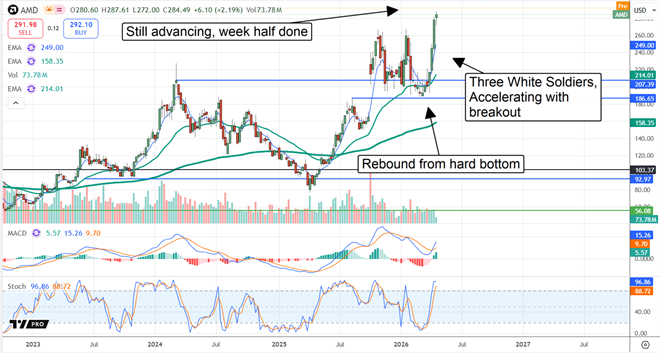
AMD’s pattern shows steady accumulation and accelerating momentum: the three candles increase in size and set a new high. The technical projection from this pattern suggests a minimum move of about $70, which would put the stock near $310, with a bull case approaching roughly 35% upside consistent with analysts' high-end range. That projection reflects a near- to mid-term view based on recent price action.
Longer-term action implies a much larger potential move. In a scenario where AMD’s GPU supply remains short of demand, its revenue, cash flow, and earnings growth could meaningfully accelerate — narrowing the valuation gap with NVIDIA. (Since 2021 NVIDIA is up over 1000% versus about 200% for AMD.)
The primary risk remains production bottlenecks. TSMC is operating near capacity, and HBM memory — critical for AI GPUs — is reported to be sold out through next year in many cases. These supply constraints could temper AMD’s revenue ramp and impact the stock in upcoming quarters.
This email communication is a paid sponsorship provided by Porter & Company, a third-party advertiser of MarketBeat. Why was I sent this email message?.
If you need help with your newsletter, feel free to email our South Dakota based support team at contact@marketbeat.com.
If you would no longer like to receive promotional emails from MarketBeat advertisers, you can unsubscribe or manage your mailing preferences here.
© 2006-2026 MarketBeat Media, LLC.
345 North Reid Place #620, Sioux Falls, SD 57103. United States of America..


