
| Unsubscribe |
Thanks to a new law Trump just signed…
Every day until April 2027 the entire GDP of Switzerland will migrate onto Trump's New Money Grid, that's $909 billion. Every single day.
That's every bank account, every fund, every mortgage, every stock trade in America.
Translation: our entire financial system is migrating onto a new blockchain-based Money Grid.
And every dollar that moves burns one scarce asset.
That's why BlackRock, JPMorgan, Goldman Sachs and Fidelity are hoarding shares like it's Black Friday.
Get in on the trade BlackRock, JPMorgan, and Fidelity are already making.
The Nasdaq just got SEC approval to move stocks onto blockchain rails.
BlackRock CEO Larry Fink dedicated his entire 2026 annual letter to it.
The World Economic Forum says 2026 is "a defining moment" for this new financial infrastructure.
Everyone who's actually building this thing is saying the same thing…
This is not a drill. This is the biggest overhaul of America's money system since we stopped using gold coins.
And at the center of it all?
A scarce asset that gets burned every single time a transaction happens.
Block Chain expert Andy Howard is calling it "Digital Oil."
And right now, before this goes mainstream, you can still get in at prices the institutions would love to lock in forever.
Get the name. The ticker. And exactly how to buy here.
Your future looks bright,
Andy Howard
The Edge™ Senior Blockchain Analyst
PS I'm predicting this could potentially be one of, if not THEE most explosive wealth opportunities I've come across. That's why you can't drag your feet here, because once retail investors catch wind of this, it will be too late…
Click here before it's too late to get in on the trade.
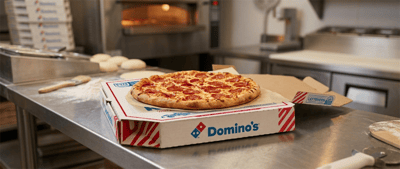
Is Domino's Stock Serving Up a Buying Opportunity?
Authored by Jeffrey Neal Johnson. Article Published: 7/20/2026.
Key Points
- Domino's Pizza reported a second-quarter revenue beat of $1.19 billion but missed earnings per share estimates, reflecting tension between strong order growth and weaker profitability.
- The pizza chain has captured the top market-share spot on Uber Eats and DoorDash, yet a disappointing Slice Sauce launch left average ticket sizes and U.S. comparable sales nearly flat.
- With shares down about 22% year-to-date and short interest elevated, incoming CEO Joe Jordan and an upcoming third-quarter product launch could determine whether margins and unit growth stabilize.
- Special Report: Everyone wanted SpaceX. Smart money wants this.
The second-quarter earnings report from Domino's Pizza (NASDAQ: DPZ) highlights an intense tug-of-war between strong market share gains and near-term margin pressure. In a quick-service restaurant environment marked by flat order counts and cautious consumers, Domino's is successfully driving record transaction volume.
Inflation is forcing a painful consolidation across the broader restaurant industry as budget-conscious diners pull back on discretionary spending. Domino's is intentionally absorbing that displaced market share through aggressive value pricing. Order counts are rising meaningfully across both carryout and delivery channels, showing that the company’s customer-acquisition model is highly effective right now.
Weighing the Cost of Customer Acquisition
Most of your net worth in one stock? (Ad)
If a large share of your net worth is tied to a single stock, concentration risk may be working against your long-term plans - and selling without a strategy can stack a serious tax bill in one year.
SmartAsset's free quiz matches you with vetted fiduciary advisors who can build a sequenced, tax-aware plan around your specific position. A few minutes to match, then you choose who to talk to.
Take the free quiz and get matched with a fiduciary advisor todayThe cost of that top-line customer acquisition is beginning to squeeze store-level economics, creating a sharp financial divergence. Domino's delivered a solid revenue beat of $1.19 billion, up 4.3% year over year. Earnings per share came in at $4.07, missing consensus estimates of $4.17.
For investors, this dynamic presents a classic transitional setup. Aggregator dominance and aggressive promotions are rapidly expanding the brand's customer base, but internal execution missteps on premium menu items have stalled average ticket growth.
With the stock trading near $328 and down roughly 22% year to date, Domino's is currently pricing in the friction of reduced unit development and margin compression. Understanding the mechanics of this volume-versus-ticket strategy is essential to evaluating the underlying cash flow model.
Topping the Charts on Uber Eats and DoorDash
Domino's historically resisted third-party delivery apps, preferring to keep customers within its proprietary digital ecosystem. That stance shifted recently, and integration into Uber's (NYSE: UBER) Eats program and DoorDash (NASDAQ: DASH) has proven highly lucrative. Domino's quickly captured the number-one pizza market share position on both platforms.
Management noted a 50% incrementality rate from these channels. Structurally, incrementality means that half of aggregator orders represent net-new business rather than existing customers migrating from the native app. These platforms act as top-of-funnel acquisition tools, feeding new consumers into the broader system.
Generating orders is only half the equation in the quick-service industry. To maintain healthy margins, operators must balance promotional volume with premium, higher-ticket items. This is where the second quarter stumbled.
Management attempted to capitalize on the highly successful 2025 launch of Stuffed Crust by introducing a premium Slice Sauce menu series. The new offering failed to resonate with consumers, creating a material drag on average ticket sizes.
Because the premium mix fell short of expectations, U.S. comparable sales essentially flatlined, posting a sluggish 0.1% growth rate. Volume was up, but consumers were spending less per order, completely offsetting the transaction gains.
Feeling the Heat in Store-Level Profits
To understand the market's reaction to the earnings miss, investors need to look at the structural mechanics of a franchise model. Corporate revenues benefit directly from higher transaction volumes through supply chain sales and top-line royalties. Indeed, supply chain gross margins expanded by 0.2 percentage points to 12% in the quarter, aided by procurement productivity that outpaced a 2.2% increase in the food basket cost.
Franchisees bear the operational brunt of lower ticket sizes. When order counts rise but average checks fall, store-level labor and delivery costs consume a larger share of revenue, compressing the franchisee's profit margin.
The immediate fallout from this margin squeeze is a deceleration in new-store growth. Facing profitability headwinds, management proactively trimmed 2026 U.S. net unit development guidance to roughly 175 stores. International growth also faced friction, with same-store sales contracting 0.1%. A significant portion of this international drag stemmed from Domino's Pizza Enterprises, the largest master franchisee for Domino's, which intentionally reduced lower-margin promotional transactions to reset its own profitability.
Wall Street is acutely aware of these margin pressures. Short interest remains elevated at 11%-12.5% of the total float, representing over 3 million shares sold short. Options markets similarly reflect near-term skepticism, with heavy put-buying indicating that institutional capital wants tangible proof of margin recovery before repricing the equity higher.
A New Chef in the Kitchen and Fresh Menu Ideas
Despite near-term execution hurdles, the underlying business is still capturing market share rapidly. Chief Operating Officer Joe Jordan assumes the chief executive role on October 1, 2026, inheriting a brand with unmatched scale and a highly effective customer acquisition engine.
Management is already pivoting to correct the ticket-size imbalance. Rather than relying on the underperforming Slice Sauce, Domino's quickly integrated Stuffed Crust into its Best Deal Ever promotional tier. This functions as paid trial marketing, enticing budget-conscious consumers to trade up for a premium product at a perceived discount, which historically drives strong repeat purchase rates.
The brand teased a highly disruptive product innovation slated for the third quarter. While details remain protected, management indicated the new offering specifically targets out-of-category consumer spending, aiming to capture occasions where diners typically choose non-pizza alternatives. If successful, this launch could provide the premium ticket boost needed to balance the current volume surge.
The most compelling leading indicator for long-term investors is the revamped Flywheel loyalty program, which just reported a 20% increase in active users. Capturing new customers through third-party aggregators and converting them into direct loyalty members could help lock in sticky, recurring revenue for years to come.
Should You Grab a Slice of Domino's Stock?
The current valuation reflects a heavily scrutinized near-term outlook. Trading at a trailing price-to-earnings ratio of 18.79 and offering a reliable 2.42% dividend yield, Domino's presents a compelling fundamental setup for those willing to look past the immediate friction in franchisee development. Consensus price targets hover around $400.57, implying over 21% upside from current levels.
The structural advantages of sheer scale, a dominant digital ordering ecosystem, and loyalty program expansion provide a floor for long-term cash generation. Investors may want to add Domino's to a watchlist, monitoring the upcoming third-quarter product launch to see if management can successfully stabilize average ticket sizes while maintaining momentum in order count growth. Those with a higher risk tolerance might view the recent multiple compression as a prime entry point into a best-in-class operator navigating a temporary execution hurdle.
Why WD-40 Is Proving Great Businesses Never Go Out of Style
Authored by Thomas Hughes. Article Published: 7/11/2026.
Key Points
- WD-40 Company reported robust fiscal Q3 results, with revenue rising 24% and net income growing 44%, driven by strength across most regions and product lines.
- Management raised guidance significantly and authorized a new $100 million share buyback, signaling confidence in continued growth and capital returns.
- Shares jumped nearly 15% in pre-market trading to a multi-year high, supported by heavy institutional buying and a bullish Buy consensus among analysts.
- Special Report: Everyone wanted SpaceX. Smart money wants this.
WD-40 Company (NASDAQ: WDFC) has long been considered a quality investment because of its global brand strength, reliable cash flow, and ability to return capital to shareholders. The company enjoys a strong moat, claims near-100% global brand recognition, and faces no meaningful competitors.
The challenge in recent years has been positioning. The company’s fragmented portfolio and loss of focus led to stagnant growth in the post-COVID era and ultimately prompted a repositioning effort.
Most of your net worth in one stock? (Ad)
If a large share of your net worth is tied to a single stock, concentration risk may be working against your long-term plans - and selling without a strategy can stack a serious tax bill in one year.
SmartAsset's free quiz matches you with vetted fiduciary advisors who can build a sequenced, tax-aware plan around your specific position. A few minutes to match, then you choose who to talk to.
Take the free quiz and get matched with a fiduciary advisor todayToday, WD-40 has emerged as a global maintenance powerhouse focused on premiumization, international markets, and disciplined cost control. There is some risk in its above-average valuation, but its premium price appears justified.
The asset-light model relies on third-party manufacturers and distributors, insulating it from operational risks and producing high-margin results.
The strength of that model is reflected in the stock’s beta, which tends to remain low at about 0.25x the S&P 500 as of mid-2026, underscoring its low-volatility profile and insulation from broader market risk.
WD-40 Company Tailwinds Strengthened in Fiscal Q3
WD-40 Company delivered a robust fiscal Q3, with revenue growing 24% to more than $195 million, nearly 1,300 basis points (bps) above MarketBeat’s reported consensus. Strength came from every region and most categories, with harvest brands the only segment to decline.
Harvest brands are the company’s smallest segment and have been in long-term decline, but they remain a high-margin business and are likely to stay in WD-40 Company's portfolio for the foreseeable future. Double-digit growth was seen across all geographic regions, led by 29% growth in the Americas and 24% in Asia, with strength across product lines. The most important driver was strength in premium products, which carry higher margins.
Margin expansion was a catalyst for higher share prices. The company faced higher input costs and increased marketing expenses, while SG&A rose as a percentage of revenue. However, these pressures were offset by scale leverage and efficiency improvements, leaving gross and operating margins higher year over year (YOY). The takeaway is that a net margin of 15.5% is solid for a business of this kind, and net income grew 44%, outpacing the 24% top-line gain.
Guidance was another catalyst, as management raised its outlook aggressively. While the revenue forecast matched the consensus estimate, earnings guidance was notably stronger. The $6.05 low end was more than a nickel above expectations and may prove conservative given current trends.
Input costs are pressuring the business today, but pricing actions are already in place and are expected to begin helping early next year. There is some risk of consumer pushback, but it appears limited. Consumers may be less sensitive to price increases than usual because each can lasts so long.
WD-40 Company Signals Confidence With Guidance Increase
WD-40 Company remains a strong capital return story, and it signaled confidence in its outlook with a new $100 million share buyback authorization. Buyback activity in 2026 resulted in a 0.6% average quarterly decline and a 0.4% reduction year to date, a pace that will likely continue in the coming quarters. The share count continues to decline, giving shareholders additional leverage and helping offset the impact of rising distributions on cash flow.
WD-40’s dividend yield is not especially high at about 1.7%, but it is a healthy payout, better than the S&P 500 average, and is on track for annual increases. The lower yield is due in part to the company’s valuation, which is supported by the quality of the payout.
The payout ratio is high at first glance, but it is supported by strong margins, a fortress balance sheet, and consistent cash flow that speaks to sustainability. The likely outcome is that WDFC continues its modest pace of distribution growth well into the future, eventually reaching Dividend Champion and Dividend King status over time.
Seismic Shift in WDFC Stock Price Action
The fiscal Q3 release and guidance update triggered a seismic shift in WDFC’s market action. Up nearly 15% in pre-market trading, WDFC opened at a multi-year high the day after the release.
Buying is centered in the institutional group, which has been accumulating at an aggressive 2-to-1 pace over the trailing 12-month period. Institutions own more than 90% of the stock, reflecting a high degree of confidence in the company’s cash flow and capital return outlook.
Analyst coverage is equally bullish. MarketBeat tracks only four analysts with current ratings, but the consensus is Buy, the buy-side bias is 75%, and no Sell ratings are recorded. More importantly, the consensus price target is $305, which still leaves upside even after the premarket price spike in WDFC shares. The likely outcome is that analyst sentiment continues to improve, supporting prices at current or even higher levels. With growth, outperformance, and capital return strength in place, price targets should rise over time, reinforcing the uptrend driven by corporate growth and capital returns.
This message is a paid sponsorship provided by Awesomely, a third-party advertiser of MarketBeat. Why was I sent this message?.
If you no longer wish to receive these emails, unsubscribe here.
If you have questions or concerns about your subscription, don't hesitate to email MarketBeat's South Dakota based support team at contact@marketbeat.com.
If you would no longer like to receive promotional emails from MarketBeat advertisers, you can unsubscribe or manage your mailing preferences here.
Copyright 2006-2026 MarketBeat Media, LLC. All rights reserved.
345 N Reid Place, Suite 620, Sioux Falls, South Dakota 57103-7078. United States..


