
| Unsubscribe |
Small Colorado Company (Backed by Sam Altman) Could Save U.S. Power Grid

A small Colorado company now owns rights to a tech that could save the entire public power grid from collapse. And billionaire Sam Altman is now an investor.
Click here to learn this company's name for free.
Why "Big Short" Investor Michael Burry Sees Upside in Beaten-Down Sportbook Stocks
Written by Leo Miller. Originally Published: 7/12/2026.

Key Points
- Michael Burry recently bought shares of DraftKings and Flutter Entertainment, betting on a recovery in beaten-down sportsbook stocks.
- Burry believes prediction markets like Kalshi and Polymarket will eventually face government regulation and taxation, reducing their competitive threat to sportsbooks.
- Wall Street analysts largely agree with Burry, with consensus price targets implying 30% upside for DraftKings and 60% upside for Flutter.
- Special Report: Everyone wanted SpaceX. Smart money wants this.
Investor Michael Burry made hundreds of millions of dollars during the Great Financial Crisis by shorting subprime mortgages. That move would later lead to his portrayal in the film “The Big Short,” cementing his reputation as a famed investor.
Burry’s hedge fund, Scion Asset Management, is now defunct. However, he remains part of the investment zeitgeist and continues sharing his views on various assets.
Most of your net worth in one stock? (Ad)
If a large share of your net worth is tied to a single stock, concentration risk may be working against your long-term plans - and selling without a strategy can stack a serious tax bill in one year.
SmartAsset's free quiz matches you with vetted fiduciary advisors who can build a sequenced, tax-aware plan around your specific position. A few minutes to match, then you choose who to talk to.
Take the free quiz and get matched with a fiduciary advisor todayNotably, Burry recently made his opinion known on one of the most beaten-down corners of the stock market in 2026: online sportsbook stocks.
The two most notable names in this space are DraftKings (NASDAQ: DKNG) and Flutter Entertainment (NYSE: FLUT). DraftKings operates a sportsbook app by the same name, while Flutter operates FanDuel.
Overall, DraftKings is down more than 20% on the year, while Flutter has lost almost half of its value. Evidently, Burry thinks the market is wrong about these entertainment names, recently picking up shares of both.
The rise of prediction markets like Kalshi and Polymarket has been a major driver of the decline in DraftKings and Flutter shares.
However, Burry believes Uncle Sam will have something to say about prediction markets, significantly weakening their competitive threat.
Burry Reveals Sportsbook Purchase Prices and Weighting
Burry says he recently purchased shares of DraftKings at around $26 per share and Flutter at around $107 per share. Shares remain very close to those levels. Burry says his allocation between the two names is 40% DraftKings and 60% Flutter. It is notable that Burry is allocating to both stocks rather than just one. This helps limit company-specific risk, such as the possibility that either management team makes poor decisions that hurt only its own firm.
By doing this, Burry can bet on a general recovery in online sportsbook stocks without putting all of his eggs in one basket. However, the slight overweight to Flutter may simply reflect the fact that the stock has fallen much harder. Additionally, Flutter has shown an ability to better convert wagers placed on FanDuel into actual revenue compared with DraftKings.
Burry’s Rationale: Governments Will Come for Prediction Markets
Prediction markets provide many of the same functions as online sportsbooks, allowing users to wager on the outcomes of events, including sports. Because prediction markets offer “event contracts,” they are federally regulated by the U.S. Commodity Futures Trading Commission rather than by states, as sportsbooks are.
In turn, they are technically legal in all 50 states, although CBS Sports notes that prediction markets are not currently live in Michigan, Minnesota, or Nevada. Meanwhile, only 30 states offer online sports betting, as many states have not legalized these platforms. Additionally, prediction markets often face significantly lower taxes than sportsbooks.
Burry ultimately believes prediction markets will not be able to operate under this lower level of legal scrutiny and taxation forever. He says, “Prediction markets exist in a loophole adjacent to a heavily regulated and taxed industry. In time, prediction markets will be subsumed into regulation and taxation.”
Notably, in Q3 2021, states collected $190 million in tax revenue from sports betting nationwide. By Q2 2025, that figure had risen 382% to $917 million. With this, it is not unreasonable to think that Burry’s argument holds weight. If prediction markets take betting share from sportsbooks, states can lose out on this large and rapidly growing revenue source.
Wall Street Data Backs Burry’s Optimistic Outlook
Only time will tell whether Burry’s thesis that prediction markets will eventually succumb to government intervention plays out. Smartly, DraftKings and Flutter are hedging for a reality where it does not. Both firms have rolled out their own prediction market offerings, potentially allowing them to benefit from growth in this space. However, Burry’s thesis becoming a reality would be ideal. Kalshi and Polymarket do not have sportsbook platforms to fall back on if regulation crushes the prediction markets industry, while DraftKings and Flutter do.
Notably, Wall Street analysts tend to agree with Burry that the market is undervaluing DraftKings and Flutter. The MarketBeat consensus price target on DraftKings is $34.30, implying upside in the range of 30%. Meanwhile, the overwhelming majority of analysts have a Buy rating on the stock. Out of 40 ratings, DraftKings has 30 Buys, eight Holds, and two Sells.
From a price target perspective, analyst bullishness is even more pronounced when it comes to Flutter. The MarketBeat consensus price target on this name is $178.83, implying upside in the range of 60%. However, the ratings breakdown is somewhat less favorable compared with DraftKings. Out of 29 ratings, Flutter has 18 Buys, nine Holds, and two Sells.
Why ASML’s AI Monopoly Is Still Getting Stronger
Written by Thomas Hughes. Originally Published: 7/15/2026.

Key Points
- ASML's monopoly on EUV lithography machines and its growing Installed Base give it a durable competitive moat against emerging rivals like Canon.
- ASML's Q2 results beat expectations with 21% revenue growth, expanding gross margins, and guidance suggesting continued strong demand into 2027.
- Analysts raised price targets after the report, though geopolitical risks tied to China, Taiwan, and customer concentration remain significant threats.
- Special Report: Everyone wanted SpaceX. Smart money wants this.
ASML (NASDAQ: ASML) holds a monopoly on foundational AI technology, making it the most structurally sound tech investment you can own. Its Extreme Ultraviolet (EUV) lithography machines are the only ones capable of printing AI-capable circuitry, and demand remains strong.
Evidence of that strength appeared in the company's Q2 results and guidance update, released July 15. The report highlighted not only demand but also a business model built for the long term. While new EUV machines are the story today, those sales will cool over time. The bigger opportunity lies in the persistent upgrade cycle built into the technology, which includes software and hardware upgrades as well as the services needed to implement them.
Most of your net worth in one stock? (Ad)
If a large share of your net worth is tied to a single stock, concentration risk may be working against your long-term plans - and selling without a strategy can stack a serious tax bill in one year.
SmartAsset's free quiz matches you with vetted fiduciary advisors who can build a sequenced, tax-aware plan around your specific position. A few minutes to match, then you choose who to talk to.
Take the free quiz and get matched with a fiduciary advisor todayASML’s machine bases are bolted to the floors of semiconductor foundries around the world, and as foundry capacity expands, each installed machine contributes to Installed Base revenue. As it stands, the Installed Base accounted for 30% of net revenue, growing 11% sequentially and 5% year over year, creating a wide moat around the business.
There is an up-and-coming competing technology developed by Canon (OTCMKTS: CAJPY), but it is not slated for anything close to commercial-scale availability until 2028 and, even then, is unlikely to be a true competitor. Canon’s Nanoimprint technology, which stamps circuits onto silicon, can produce similarly fine circuitry but also carries a much higher error rate, making it unsuitable for advanced computing.
ASML Signals Momentum Shift in Lithography Markets
ASML had a robust quarter, with revenue growing 21% in Q2. Topline results outpaced consensus by approximately 450 basis points (bps), driven by strength in new equipment and upgrades. The company sold 86 new machines, up 28%, while used equipment sales declined. Gross margin, another critical factor, expanded by 1,000 bps due to leverage, including that provided by Installed Base management.
Margin is another important factor for this investment, as the company has maintained a healthy gross margin in the mid-50% range and is improving due to sales strength and Installed Base growth. The only negative is that net margin contracted, leaving earnings up just 5.8%, but there is a silver lining. The company is investing in technology and capacity to meet new demand, signaling the durability of the cycle.
Guidance is another sign of this company’s strength, position and momentum within the industry. The company issued a Q3 revenue target more than 1,000 bps above expectations, lifted its full-year outlook and signaled a change to its long-term outlook. The caveat is that the updated long-term view won’t be revealed until next year at the company’s subsequent investor day. Until then, ASML forecasts Q3 revenue to grow more than 23% sequentially and 31% year over year (YOY), which may underestimate demand for its products.
Analysts Pound Table for Top-Pick ASML
Analysts responded vigorously to ASML’s release, issuing numerous commentaries that reinforced their bullish view. The group noted the company’s considerable top- and bottom-line strength, Installed Base growth, Installed Base management gains and the direct translation into capacity expansion.
Activity included several price target increases, aligning with trends pushing the high end of the range higher. The consensus price target of $1,891 reported by MarketBeat in mid-July offered only modest upside, but the high end added nearly 40% to that figure. The likely outcome is that analyst sentiment remains robust through year-end and into 2027, underpinning the stock’s rally.
Capital returns are also a factor in this stock’s ownership, including dividends and share buybacks. The dividend is little more than a token, yielding approximately 0.6% as of mid-July, but it is reliable, increases annually and is supplemented by share count reductions. Q2 activity contributed to a nearly 1% trailing 12-month decline, a pace that is likely to continue in upcoming quarters.
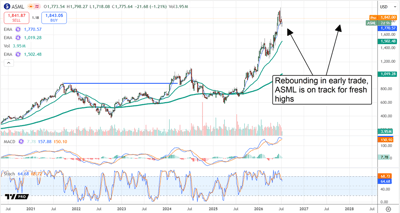
Stock price action following the earnings release told a mixed story. ASML jumped more than 3% in premarket trading before giving back those gains, though it held support near $1,775, coinciding with the 30-day exponential moving average.
This suggests short-term buyers are active and defending support, but they have not yet taken decisive control. A move through the existing high near $2,000 is the level to watch; clearing it would likely trigger fresh capital inflows. If new highs are set, the next resistance target is in the $2,250 region.
ASML’s biggest risks are geopolitical. Restrictions, bans and actions by China against Taiwan pose an existential threat, potentially disrupting the business. U.S. legislation currently under review could keep the company from even servicing equipment already installed in China. Customer concentration is centered on Taiwanese manufacturers, including Taiwan Semiconductor (NASDAQ: TSM), as well as Intel (NASDAQ: INTC) and Samsung (OTCMKTS: SSNLF). Valuation is also a risk, as the stock is priced for perfection and flawless execution.
This email is a sponsored message from Altimetry, a third-party advertiser of MarketBeat. Why did I receive this email content?.
This ad is sent on behalf of Altimetry, 110 Cambridge Street, Cambridge, MA 02141. If you would like to optout from receiving offers from Altimetry please click here.
If you have questions or concerns about your newsletter, please don't hesitate to email our U.S. based support team at contact@marketbeat.com.
If you would no longer like to receive promotional emails from MarketBeat advertisers, you can unsubscribe or manage your mailing preferences here.
© 2006-2026 MarketBeat Media, LLC.
345 N Reid Place #620, Sioux Falls, SD 57103. United States..