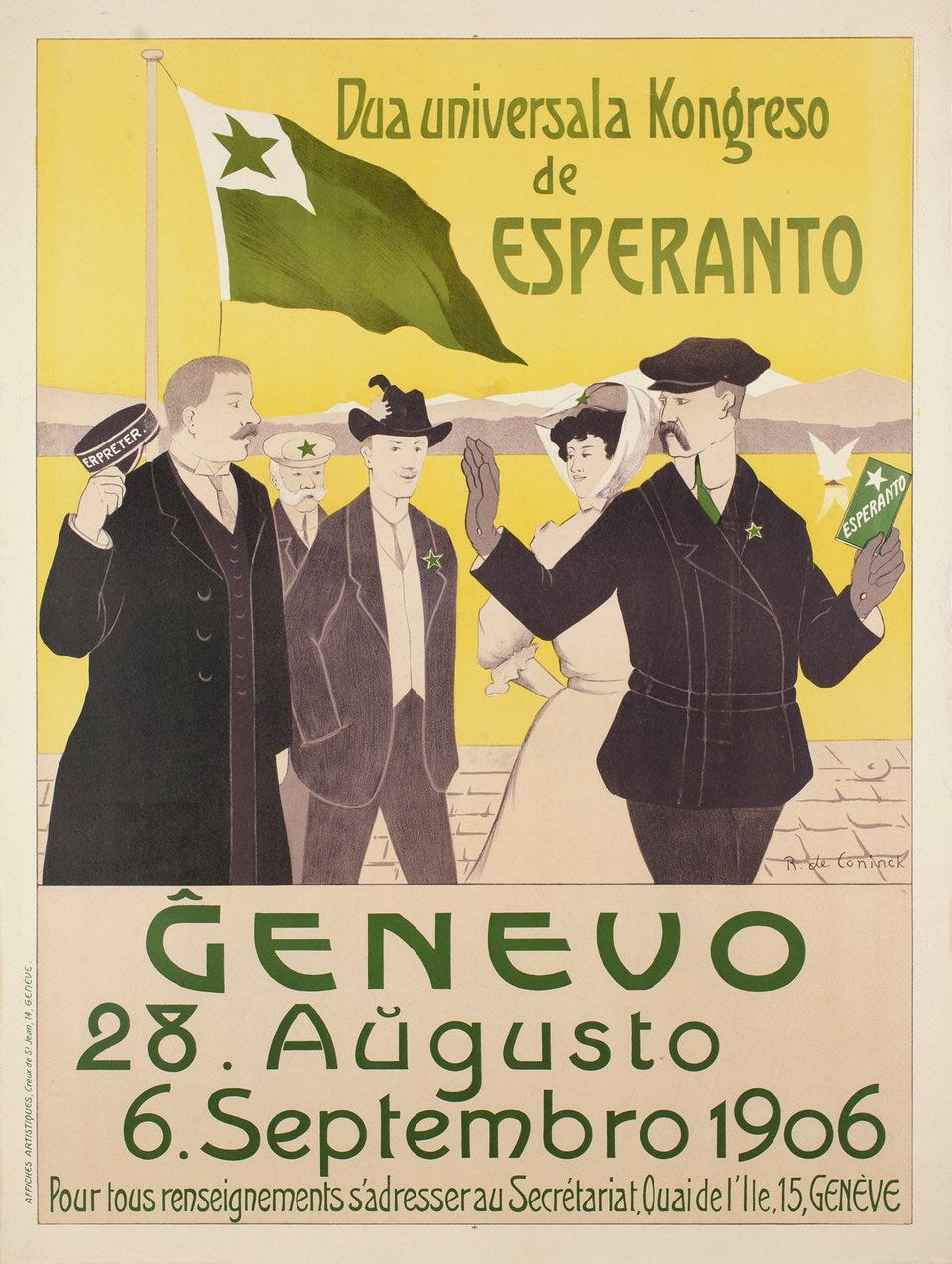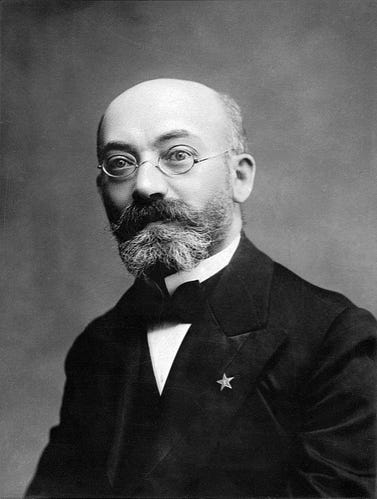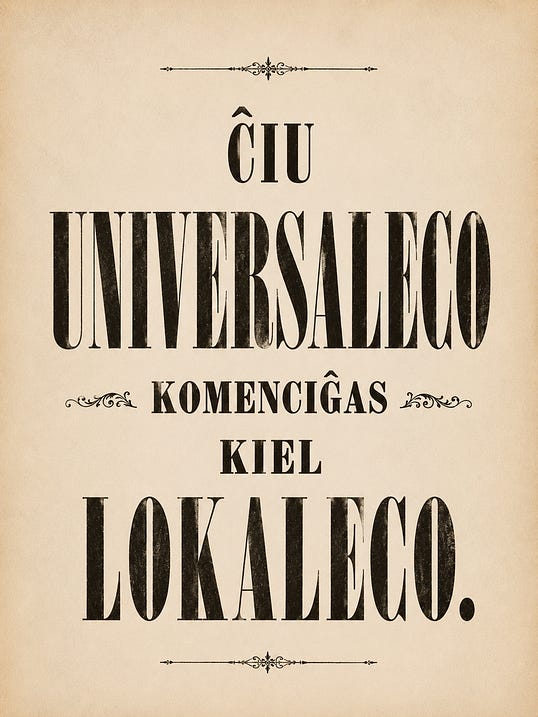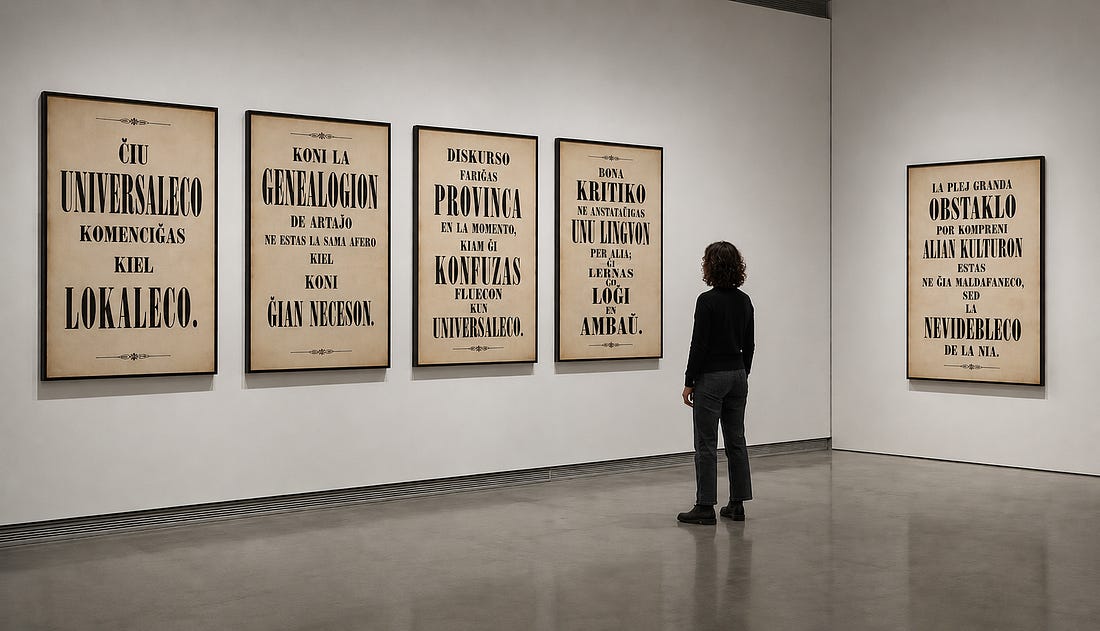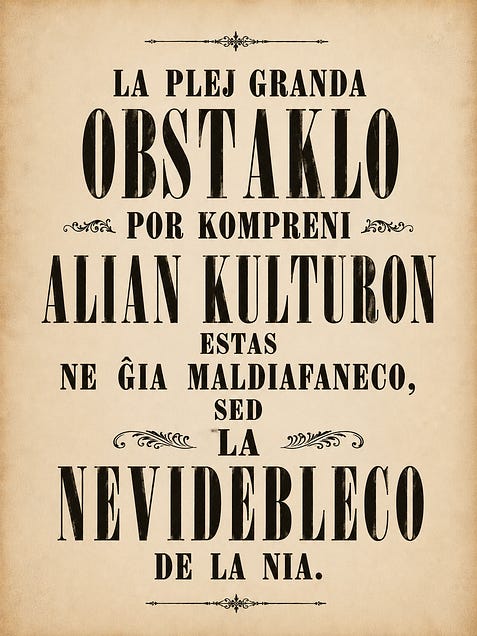

This essay is part of The Esperanto Project, a distributed international exhibition that launches this week. The project consists of a series of typographic posters featuring aphorisms I have written and translated into Esperanto, exploring questions of translation, locality, universality, and cultural interpretation. Rather than existing in a single venue, the exhibition unfolds through the participation of museums, galleries, universities, and artist-run spaces around the world, each presenting one or more posters within its own local context. Initial participating organizations include The Print Center (Philadelphia), Grand Central Art Center (Santa Ana, California), Espacio Arista 1701 (Mexicali), Longtermhandstand (Budapest), and the Center of Art, Design and Visual Culture (Baltimore), with additional venues continuing to join the project. — Ludwik Zamenhof was only nineteen years old when, in 1878, he unveiled an extraordinary idea: the creation of a universal language that anyone in the world could learn. He believed that if people shared a neutral means of communication, they might come to understand one another more easily and perhaps even diminish the conflicts that arose from ethnic, national, and religious divisions. What began as the youthful ambition of a single idealist would become the defining project of his life. Zamenhof had been born in 1859 in Białystok, then part of the Russian Empire (today in Poland), a city inhabited by Russians, Poles, Jews, Belarusians, Germans, and other communities whose coexistence was often marked by tension. Raised in an Ashkenazi Jewish family, he grew up speaking Yiddish and Russian, while also learning Polish, Hebrew, German, French, and Belarusian. Perhaps unsurprisingly, from an early age he was fascinated by language—at the age of ten he even wrote a play inspired by the Tower of Babel. Witnessing the divisions around him, he became convinced that many of these conflicts were sustained by mutual incomprehension. If language could separate people, perhaps language could also bring them together.
While studying medicine over the following decade, Zamenhof refined his linguistic project, simplifying grammar and drawing vocabulary from Romance, Germanic, and Slavic languages in the hope of making it broadly accessible. In 1887 he published Unua Libro (”The First Book”), the formal introduction of what he called Esperanto. Zamenhof lived long enough to witness Esperanto spread across the world and to see an international community embrace it. Yet he also came to recognize that a common language alone could not abolish war or prejudice. By the time of his death in 1917, that hope had faded. Totalitarian regimes viewed Esperanto with intense suspicion and often violently repressed its speakers. Because the language was designed to be politically neutral and international, dictatorships saw its decentralized, borderless networks as a threat to strict state control, nationalism, and state-sanctioned propaganda. Esperanto, however, did not fade. Today it continues to be spoken by millions of people around the world, including an estimated two thousand native speakers and 100,000 regular users. It has generated its own literature, poetry, music, and even, delightfully, a swear-word coloring book. At the same time, Esperanto has often been ridiculed as an impractical ideal. In practice, English has emerged as the world’s de facto lingua franca, propelled less by linguistic merit than by the geopolitical, economic, and cultural influence of the countries that speak it. Ironically, the very quality that gives Esperanto its raison d’être—its aspiration to be a neutral, universal auxiliary language—may also have limited its adoption. Languages rarely spread because they are neutral; they spread because they become indispensable to commerce, diplomacy, migration, education, or popular culture.
However, Esperanto’s greatest irony is that, in attempting to become everyone’s language, it became someone else’s. Rather than abolishing local culture, it gave birth to a new one. Esperantists today share histories, references, literature, jokes, and rituals largely unintelligible to outsiders. The universal language acquired a native tongue. This is very similar to our very own contemporary art discourse. We often imagine ourselves to inhabit an international discourse that has transcended provincialism. Because our references circulate globally—through biennials, journals, graduate programs, and museums—we mistake them for universal ones. Yet contemporary art constitutes its own highly specialized interpretive community, complete with its own vocabulary, historical canon, rituals, and assumptions. Its language is no less situated than that of the small town, the regional museum, or the local artist. The difference is simply that our dialect enjoys greater institutional authority. Yet, it is often ridiculed by the outside just as Esperanto is. Perhaps to better understand this dynamic one needs to consider what aesthetic provincialism actually means. Whenever I visit smaller cities or regions that lie outside the centers of contemporary art discourse, I make a point of visiting their local museums. Their collections often present artists who, from the standpoint of the international canon, appear derivative or belated, revisiting aesthetic languages that elsewhere had already been exhausted. Judged solely by the standards of originality, technical innovation, or historical influence that dominate contemporary criticism, these works can seem unremarkable. Yet what has always fascinated me is the profound significance these same artists hold within their own communities. They are remembered not because they revolutionized art history at large, but because they transformed the history of art in that particular place. They introduced new possibilities, challenged local conventions, or marked cultural turning points that remain invisible to an outsider. Standing before such works, I have often found myself resisting the impulse to evaluate them according to the criteria I habitually employ. Increasingly, I have come to suspect that my inability to fully appreciate them says as much about the limits of my own interpretive framework as it does about the works themselves. For years I believed that because I could situate a work within the history of contemporary art, I understood it. Only gradually did I realize that I often understood its references better than its reasons for existing. The interpretive parameters we habitually apply—particularly those inherited from Euro-American art history—are not always equipped to recognize the local symbolic codes, cultural conversations, political circumstances, or historical urgencies that gave these works their meaning. We are, in effect, attempting to read one language through the grammar of another. The point, then, is not to confuse significance with quality. Rather, it is to recognize that they are distinct categories. We already possess a highly developed critical language for discussing artistic innovation, conceptual rigor, and historical influence. What we often lack is an equally nuanced language for recognizing the cultural specificity that makes a work indispensable to the community from which it emerged. A useful way of understanding this problem comes from the anthropologist Clifford Geertz, who adopted the philosopher Gilbert Ryle’s notion of “thick description.” Geertz argued that no gesture, object, or action possesses meaning in isolation. Every act unfolds within a dense web of shared customs, symbols, histories, and assumptions that are largely invisible to those outside the culture in which they occur. An outsider may correctly identify what is happening while entirely missing what it means. The same is true of art. A painting that appears merely derivative to an international audience may, within its own cultural setting, represent a decisive break with local traditions, a response to a particular political moment, or the visual articulation of a shared historical experience. Without access to that web of meaning, we risk mistaking our inability to read the work for a lack of significance in the work itself.
What is striking, however, is that the contemporary art world operates according to precisely the same logic. We often imagine it as a universal language, yet it too depends upon a dense network of shared references, theoretical debates, institutional histories, aesthetic conventions, and conceptual lineages that remain largely opaque to those outside its discourse. Much of what gives a contemporary artwork its significance is legible only to those already fluent in that vocabulary. In this sense, the highly localized painting in a provincial museum and the conceptually sophisticated installation in an international biennial are not opposites but parallel cases. Each belongs to a community of interpretation; each derives its meaning from a particular cultural grammar. The difference is that one community has become accustomed to imagining its own language as universal. One could say that these thick descriptions only thicken the plot. The more closely we examine them, the harder it becomes to separate the local from the universal, since each depends upon its own community of shared meanings. Said in another way, thick descriptions, one discovers, have an unfortunate tendency to thicken the plot. Contemporary art has become extraordinarily good at producing ever thicker descriptions of increasingly local worlds while continuing to imagine itself as speaking a universal language. Or, put in Esperanto, La densaj priskriboj nur plidensigas la intrigon (”The thick descriptions only make the plot denser.”) None of what I am describing is entirely new. Variations of this insight have long appeared in anthropology, postcolonial theory, and cultural studies. I am simply Esperanto as a metaphor for what I would call a multilingual criticism: a way of approaching works of art that acknowledges the multiple languages in which they acquire meaning. Whenever we encounter a work rooted in a particular place—whether as artists, curators, critics, or viewers—we should ask how it is being read across different interpretive communities. How does it function within the local culture that produced it? How does it circulate within the international art world? These are not competing interpretations so much as distinct registers of meaning, each illuminating aspects that the other may overlook. The tensions between these registers can be revealing. A work may resonate deeply within its own community yet appear derivative or inconsequential from the perspective of international art discourse. Conversely, a work may become highly celebrated within the global art world while remaining largely unintelligible—or even irrelevant—to the community from which it claims to emerge. Neither condition is inherently problematic. Problems arise when we mistake one register for the whole story, or when success in one language is assumed to guarantee significance in another.
The task of criticism, then, is less to choose between the local and the universal than to become fluent in both. Every work of art is destined to be translated as it moves between places, institutions, and audiences. The question is whether we undertake that translation with enough humility to recognize that every language, including the one spoken by the international art world, reveals certain meanings while inevitably obscuring others. Perhaps this is where the Esperanto analogy ultimately becomes useful. Zamenhof never imagined Esperanto as a replacement for existing languages. Quite the opposite: he envisioned it as an auxiliary language, one that would allow communication across cultures while leaving every mother tongue intact. The aspiration was not uniformity but mutual intelligibility. Something similar may be worth aspiring to in art. The language of contemporary art need not displace the symbolic languages of the communities in which artworks are made, just as local cultural meanings need not reject the broader conversations of international art history. The challenge is to cultivate a criticism capable of moving between them. For artists, curators, historians, and critics alike, this means approaching every context with the awareness that no work speaks in a single language. Every artwork is embedded within multiple, overlapping systems of meaning: local histories, shared cultural references, institutional discourses, and international conversations. Some of these languages we may already speak fluently. Others require patient listening, careful translation, and the humility to recognize that we remain outsiders. We may never become fully fluent in every local code or every thick description that gives a work its meaning. But perhaps that is not the point. The first responsibility is simply to acknowledge that those languages exist. The second is to learn enough of them to understand not only what a work says, but why it needed to be said there, in that place, to those people. Our objective is not to replace one language with another, nor to imagine that a universal language could ever suffice. Or to put it in another way: Nia tasko ne estas paroli Esperanton. Ĝi estas scii, kiam Esperanto ne sufiĉas: The task is not to speak Esperanto: it is to know when Esperanto is insufficient. You're currently a free subscriber to Beautiful Eccentrics. For the full experience, upgrade your subscription.
|