
| Unsubscribe |
Worst News for Stocks in 50 Years
Wall Street’s declared what could be the worst news for the U.S. stock market in 50 years.
If Goldman Sachs and Morgan Stanley are right... this won't be like the crashes we're used to. What's about to hit America next could keep your portfolio in the red for 10 years or longer - unless you make a big change now.
To hear about this decade-long crisis now being predicted by multiple Wall Street banks...
And to see what you can do to prepare your wealth before this hits...
Click here to learn how to defend your portfolio.
Regards,
Keith Kaplan
CEO, TradeSmith
P.S. You may have noticed we see "surprise" crashes every year now. Think about it: rate spikes in 2022... the bank crisis in 2023... $8 trillion wiped out in 2024... $11 trillion wiped out during the tariff crash in 2025... and, this year, $12 trillion was wiped out in 30 days during the Iran War. Something is off and Wall Street suggests this could continue (and worsen) well into the 2030s. Click here to learn the truth about this market and see what you must do now to prepare.
Why ASML’s AI Monopoly Is Still Getting Stronger
Submitted by Thomas Hughes. Publication Date: 7/15/2026.
Key Points
- ASML's monopoly on EUV lithography machines and its growing Installed Base give it a durable competitive moat against emerging rivals like Canon.
- ASML's Q2 results beat expectations with 21% revenue growth, expanding gross margins, and guidance suggesting continued strong demand into 2027.
- Analysts raised price targets after the report, though geopolitical risks tied to China, Taiwan, and customer concentration remain significant threats.
- Special Report: Forget SpaceX. Buy the company Musk can't replace.
ASML (NASDAQ: ASML) holds a monopoly on foundational AI technology, making it one of the most structurally sound tech investments you can own. Its Extreme Ultraviolet (EUV) lithography machines are the only ones capable of printing AI-capable circuitry, and demand for them remains strong.
Evidence of that strength came in the company's Q2 results and guidance update, released July 15. The report highlighted not only demand, but also a business model built for the long term. While new EUV machines are the story today, those sales will eventually cool. The longer-term opportunity lies in the persistent upgrade cycle built into the technology, which includes software and hardware upgrades as well as the services needed to implement them.
A 17-year investing experiment investigated in Dublin (Ad)
Porter Stansberry flew the Porter and Co. team 3,300 miles to Dublin to investigate a 17-year investing experiment called Project Prophet - and documented everything on film.
Rooted in the laws of physics, this quantitative approach challenges conventional wealth-building wisdom. With 17 years of verified data behind it, Porter calls it unlike anything he has seen in nearly 30 years in the business.
Watch the full investigation and decide for yourselfASML’s machines are bolted to the floors of semiconductor foundries around the world, foundry capacity is expanding rapidly, and each machine adds to Installed Base volume. As it stands, the Installed Base accounted for 30% of net revenue, growing 11% sequentially and 5% year over year, with a wide moat around the business.
There is an up-and-coming competitor technology developed by Canon (OTCMKTS: CAJPY), but it is not slated for commercial-scale availability until 2028 and, even then, does not appear to be a true competitor. Canon’s Nanoimprint technology, which stamps circuits onto silicon, can produce similarly fine circuitry, but it also carries a much higher error rate, making it unsuitable for advanced computing.
ASML Signals Momentum Shift in Lithography Markets
ASML had a robust quarter, with revenue growing 21% in Q2. The top line outpaced consensus by approximately 450 basis points (bps), driven by strength in new equipment and upgrades. The company sold 86 new machines, up 28%, while used equipment sales declined. Gross margin, another critical factor, expanded by 1,000 bps due to leverage, including that provided by Installed Base management.
Margins are another critical factor for this investment, as the company has maintained a healthy gross margin in the mid-50% range and is improving due to sales strength and Installed Base growth. The only bad news is that net margin contracted, leaving earnings up just 5.8%, but there is a silver lining. The company is investing in technology and capacity to meet new demand, signaling the durability of the cycle.
Guidance is yet another signal of this company’s strength, position, and momentum within the industry. The company issued a Q3 revenue target more than 1,000 bps above expectations, lifted its full-year outlook, and signaled a change to its long-term outlook. The caveat is that the change will not be revealed until next year’s investor day event. Until then, ASML forecasts Q3 revenue to grow more than 23% sequentially and 31% year over year (YOY), which may underestimate demand for its products.
Analysts Pound Table for Top-Pick ASML
Analysts responded vigorously to ASML’s release, issuing numerous commentaries that reinforced the bullish narrative. The group noted the company’s considerable top- and bottom-line strength, Installed Base growth, Installed Base management strength, and the direct translation into capacity expansion.
Activity included several price target increases, pushing the high end of the range higher. The consensus price target of $1,891 reported by MarketBeat in mid-July offered only modest upside, but the high end added nearly 40% to that figure. The likely outcome is that analyst sentiment remains robust through year-end and into 2027, supporting the stock’s rally.
Capital returns are part of this stock’s appeal, including dividends and share buybacks. The dividend is little more than a token, yielding approximately 0.6% as of mid-July, but it is reliable, the distribution increases annually, and it is supplemented by share count reductions. Q2 activity contributed to a nearly 1% trailing 12-month decline, a pace that is likely to continue in upcoming quarters.
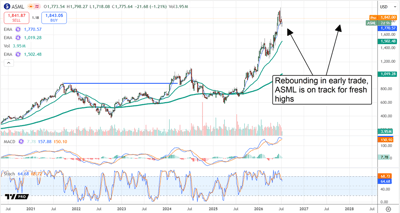
Stock price action following the earnings release told a mixed story. ASML jumped more than 3% in premarket trading before giving back those gains, though it held support near $1,775, coincident with the 30-day exponential moving average.
This suggests short-term buyers are active and defending support, but they have not yet taken decisive control. A move through the existing high near $2,000 is the key level to watch—clearing it would likely trigger fresh capital inflows. If new highs are set, the next resistance target is in the $2,250 region.
ASML’s biggest risks are geopolitical. Restrictions, bans, and actions by China against Taiwan pose an existential threat and could disrupt the business. U.S. legislation currently under review could keep the company from even servicing equipment already placed in China. Customer concentration is focused on Taiwanese manufacturers, including Taiwan Semiconductor (NASDAQ: TSM), as well as Intel (NASDAQ: INTC) and Samsung (OTCMKTS: SSNLF). Valuation is also a risk, as the stock is priced for perfection and flawless execution.
Blueprint for a Billion: Nebius Group Secures the AI Floor
Submitted by Jeffrey Neal Johnson. Publication Date: 7/15/2026.

Key Points
- Nebius Group's stock dropped roughly 6% on 15 million shares traded as macroeconomic concerns triggered a broad sell-off across high-beta technology names.
- A $1 billion, NVIDIA-backed Reflection AI contract running through 2029 expanded Nebius Group's contracted backlog to an estimated $50 billion, bolstering revenue visibility.
- Insider share sales by Nebius Group's CEO and CTO appear to reflect routine liquidity events rather than diminished confidence, given the company's operational progress.
- Special Report: Forget SpaceX. Buy the company Musk can't replace.
The broader technology sector is currently navigating a sharp, liquidity-driven rotation. Recent macroeconomic shifts and tepid June payroll data have prompted institutional capital to lock in profits, triggering a broad sell-off across high-beta momentum equities.
Nebius Group (NASDAQ: NBIS) has been caught in the crossfire, falling roughly 6% on heavy trading volume of 15 million shares.
A 17-year investing experiment investigated in Dublin (Ad)
Porter Stansberry flew the Porter and Co. team 3,300 miles to Dublin to investigate a 17-year investing experiment called Project Prophet - and documented everything on film.
Rooted in the laws of physics, this quantitative approach challenges conventional wealth-building wisdom. With 17 years of verified data behind it, Porter calls it unlike anything he has seen in nearly 30 years in the business.
Watch the full investigation and decide for yourselfBut when you step back from the noise, Nebius's underlying fundamentals point to a structural advantage the market may be mispricing.
Initial reactions to macroeconomic data often prompt broad selling across an entire sector, regardless of individual company execution.
For disciplined investors, these sector-wide rotations can create opportunities to evaluate infrastructure providers that are expanding their operational moats while their share prices consolidate.
Reflection AI Deal Cements the Neocloud Foundation
Nebius Group recently executed a monumental $1 billion forward compute contract with Reflection AI. The agreement secures raw infrastructure supply for the startup through 2029, cementing Nebius Group as an indispensable provider in the generative AI ecosystem and helping de-risk its long-term revenue pipeline.
By locking in a billion-dollar forward contract, Nebius Group achieves something incredibly rare in the volatile tech sector: financial clarity. The market frequently worries about software churn and the risk that a trending AI application could lose its user base overnight to a faster competitor.
Nebius Group bypasses that software risk. It operates strictly as the digital landlord, leasing the physical compute required to run complex models regardless of which application ultimately wins the consumer race.
Beyond the sheer size of the deal, the strength of the counterparty helps support the agreement. Reflection AI is backed by NVIDIA Corporation (NASDAQ: NVDA) and is currently finalizing a funding round at a $25 billion valuation. Reflection AI also recently executed a similar multi-billion-dollar compute contract with SpaceX (NASDAQ: SPCX), illustrating an inelastic enterprise demand cycle. This immense capitalization gives the $1 billion contract for Nebius Group the feel of a revenue floor rather than a speculative projection.
Trading CPUs for Next-Gen GPUs
To understand the magnitude of this catalyst, it helps to break down the mechanics of the neocloud business model. Traditional cloud providers operate legacy data centers built heavily around CPUs. Neoclouds like Nebius Group are engineered from the ground up to host high-density GPU clusters, which are essential for training frontier artificial intelligence models.
Legacy data centers face severe thermal and structural limitations when retrofitting facilities to meet the power-dense requirements of modern AI training. Nebius Group purpose-builds its facilities to accommodate the extreme liquid-cooling and power loads required by the latest hardware. This architectural foresight gives the company a distinct technical advantage, allowing it to lease capacity at a premium to startups and enterprises that cannot afford deployment delays.
Unpacking a $50 Billion Backlog Buffer
The Reflection AI deal pushes the total reported contracted backlog for Nebius Group to an estimated $50 billion. For investors modeling future cash flows, a backlog of this magnitude acts as a shock absorber against cyclical uncertainty. Recent quarterly filings highlight a staggering 684% year-over-year revenue surge.
When reviewing the headline financials, a stated net margin of over 95% immediately stands out. Investors need to strip away accounting anomalies to evaluate the true operating reality. Recent filings indicate a $781 million non-cash gain skewed that quarterly net income heavily. Adjusted operating metrics actually reveal a 20% widening in net losses.
Far from being a red flag, that widening loss is a direct result of the heavy infrastructure capital expenditures required for hardware procurement. Nebius Group is deploying significant capital to scale its data centers today, which should translate into leasing capacity tomorrow. It is a classic infrastructure build-out phase before deep free cash flow generation.
Securing the NVIDIA GB300 Hardware Pipeline
A prevailing bear thesis surrounding Nebius Group centers on the imminent threat of traditional hyperscalers entering the third-party hardware leasing market. The fear is that if tech giants begin leasing out excess compute, the sudden surge in supply will compress margins across the specialized neocloud sector.
This perspective mischaracterizes Nebius Group's strategic positioning. Market data confirms that Nebius Group holds active partnership agreements with both Meta Platforms (NASDAQ: META) and Microsoft Corporation (NASDAQ: MSFT).
Rather than acting solely as competitors, these hyperscalers often use specialized neocloud infrastructure to handle overflow compute demand and run distinct, segregated workloads. Nebius Group is effectively hedging against hyperscaler encroachment by embedding itself directly into broader operational supply chains.
More importantly, Nebius Group maintains a highly privileged strategic alliance with NVIDIA. In an environment defined by global semiconductor bottlenecks, capital alone is not enough to build a data center; guaranteed access to hardware is essential. Nebius Group holds prioritized allocations for next-generation GB300 clusters. This hardware pipeline serves as an operational moat.
Finding Asymmetry in the Infrastructure Cycle
It is entirely natural for a stock with a $49.5 billion market capitalization on $529.80 million in trailing 12-month sales to experience sharp volatility. Trading at a trailing price-to-sales multiple of 93, Nebius is undeniably priced for flawless execution. When the market rotates away from technology, high-multiple stocks inevitably face the heaviest selling pressure. The recent pullback aligns logically with this sector consolidation.
Some market participants have pointed to recent insider distributions as a reason for caution. Regulatory filings show a 16,937-share sale by the chief technology officer and a more than $10 million block sold by the company's CEO. Contextualizing these sales against the total outstanding share count of more than 250 million reveals them as standard liquidity events, largely tied to compensation structures.
Systematic selling can be a warning sign, but these specific distributions do not indicate a fundamental lack of executive conviction, given the scale of recent operational victories.
The artificial intelligence gold rush requires immense physical infrastructure, and the market is rapidly separating speculative software developers from foundational hardware providers.
Nebius has successfully secured its position as a premier pick-and-shovel operation, insulated by a robust backlog and anchored by multi-year tier-one counterparty contracts. Patient capital may view the selloff as a compelling entry point into a business that has locked in its revenue pipeline for the rest of the decade.
This email message is a paid advertisement from TradeSmith, a third-party advertiser of MarketBeat. Why was I sent this email message?.
This ad is sent on behalf of TradeSmith at 1125 N. Charles Street, Baltimore, Maryland 21201. If you’re not interested in this opportunity, please click here.
If you need assistance with your newsletter, feel free to contact our South Dakota based support team at contact@marketbeat.com.
If you would no longer like to receive promotional emails from MarketBeat advertisers, you can unsubscribe or manage your mailing preferences here.
Copyright 2006-2026 MarketBeat Media, LLC.
345 N Reid Pl. #620, Sioux Falls, S.D. 57103. United States..


