
| Unsubscribe |
Editor's Note: Famed $1 billion fund manager Louis Navellier has informed us that his system recently assigned an A rating to a tech company that's popular with both Elon Musk and President Trump. In his new presentation, Louis gives away the name and ticker symbol of this firm for free. Click here to watch it now, or read below for more details.
Dear Reader,
When this struggling PC maker went private in 2013, many were skeptical.
Forbes wrote that the CEO's track record "does not inspire confidence in the company's future."
And according to the New York Times, private equity giant BlackStone withdrew a bid after "discovering that [its] business was deteriorating faster than previously understood."
But its business didn't deteriorate. It transformed.
And when it returned to the public markets, it was no longer just another computer company.
It had acquired all the software and hardware to become – as the Wall Street Journal put it – "a globe-straddling AI-supercomputer builder."
That's why, when Elon Musk set out to win the AI race, this firm was the first company he called.
That said, no one is a bigger fan of this company than President Trump.
He's repeatedly told crowds to buy this firm's flagship product...
Awarded it a five-year, $9.7 billion Pentagon contract...
And personally invested up to $5 million in its shares.
This company is the comeback story of the century – and it's only just beginning.
My system recently assigned it an A rating...
The same rating Comfort Systems, Supermicro, and Applovin received before they soared by as much as 1,117%, 2,007%, and 1,863%, respectively.
Over the years, I've poured over $9 million into building and maintaining this system, and it's rarely failed me.
Nevertheless, timing is everything.
Trump, Elon, and this company are rapidly building out an AI infrastructure that will secure our country's dominant position in the global economy for decades to come.
And on August 6, I believe a major event will occur that could bring the magnitude of this plan to light.
If you don't get on the winning side of this shift before that date, you run the risk of missing out entirely.
Regards,
Louis Navellier
Senior Analyst, InvestorPlace
P.S. No e-mail, credit card, or subscription is required to access this pick. Click here to view (must act before August 6)...
CleanSpark Inks a $6.6B AI Lease to Become a Digital Landlord
Written by Jeffrey Neal Johnson. Date Posted: 7/15/2026.

Key Points
- CleanSpark signed a $6.6 billion, 20-year triple-net lease in Sandersville, Georgia, providing 175 megawatts to an undisclosed technology tenant for AI data center use.
- The deal, plus an exclusivity agreement covering an 885-megawatt Texas portfolio, could generate over $1 billion in predictable annual revenue and shift CleanSpark's valuation away from crypto mining cycles.
- CleanSpark faces roughly $1.75 billion to $2.1 billion in Sandersville construction costs and plans to use its 13,941 Bitcoin treasury as collateral to avoid shareholder dilution.
- Special Report: Forget SpaceX. Buy the company Musk can't replace.
The digital gold rush is rapidly giving way to the artificial intelligence land grab. For years, Bitcoin miners amassed vast power portfolios to run energy-intensive operations. Today, that same electrical capacity sits at the exact bottleneck starving the world's largest technology firms. Power is the new premium real estate, and the organizations controlling grid connections hold the ultimate leverage.
CleanSpark (NASDAQ: CLSK) just weaponized that leverage, securing a $6.6 billion, 20-year AI data center lease that decouples its valuation from cryptocurrency volatility. By locking in $330 million in expected annual net operating income, CleanSpark is forcing Wall Street to aggressively reprice the stock. Once a cyclical miner, the company is rapidly transforming into a premier digital infrastructure landlord.
Cashing in on the High-Performance Compute Boom
A 17-year investing experiment investigated in Dublin (Ad)
Porter Stansberry flew the Porter and Co. team 3,300 miles to Dublin to investigate a 17-year investing experiment called Project Prophet - and documented everything on film.
Rooted in the laws of physics, this quantitative approach challenges conventional wealth-building wisdom. With 17 years of verified data behind it, Porter calls it unlike anything he has seen in nearly 30 years in the business.
Watch the full investigation and decide for yourselfWhen evaluating infrastructure companies, predictability is everything. CleanSpark recently executed a 20-year triple-net lease at its Sandersville, Georgia, campus. The agreement designates 175 megawatts of critical IT load for high-performance computing and AI workloads.
For investors unfamiliar with commercial real estate terminology, a triple-net lease requires the tenant to pay property expenses, including real estate taxes, building insurance, and maintenance. This structure shields CleanSpark from operational cost creep. Management projects a near-100% net operating income contribution margin from the arrangement, generating an average of $330 million in annual cash flow once deliveries begin in late 2027.
The identity of the tenant remains officially undisclosed, but CleanSpark notes that the partner is a high-investment-grade global technology entity.
Recent market whispers suggest Meta Platforms (NASDAQ: META) was in advanced discussions for capacity in Sandersville, adding serious weight to the lease's underlying credit quality.
This catalyst created a sharp divergence in the sector. While CleanSpark shares rose nearly 9% on July 14, direct competitors lacking similar infrastructure pivots, such as Marathon Digital Holdings (NASDAQ: MARA) and Riot Platforms (NASDAQ: RIOT), saw muted trading. The market is clearly beginning to value gigawatt-scale power capacity as prime AI real estate.
The Texas Land Grab: An 885 MW Exclusivity Agreement
The Sandersville facility represents only the pilot program for a much broader strategic overhaul. Embedded within the $6.6 billion agreement is a letter of intent granting the tenant exclusivity over CleanSpark's entire Texas portfolio. This pipeline includes 718 acres of land with up to 885 megawatts of secured and planned power capacity across the Sealy and Brazoria campuses.
The financial implications of a full deployment are substantial. If 175 megawatts in Georgia translates to $330 million in annual net operating income, successfully contracting the 885-megawatt Texas pipeline under a similar pricing framework could generate well over $1 billion in highly predictable recurring revenue.
By locking up its Texas land under an exclusivity agreement, CleanSpark establishes a clear, multi-year runway to operate at institutional scale.
Funding the Build: Bridging the Capital Expenditure Gap
Transforming raw land and energy into production-grade AI infrastructure requires tremendous upfront capital. This is where investors should look past the headline revenue numbers and assess the balance sheet. Management estimates landlord project costs will range from $10 million to $12 million per megawatt of critical IT load. For the 175-megawatt Sandersville buildout, CleanSpark faces capital expenditures of roughly $1.75 billion to $2.1 billion before recognizing revenue in 2027. With trailing net margins at -67%, the immediate question is how CleanSpark will fund this transition without destroying shareholder value through equity dilution.
The answer lies in CleanSpark's treasury. The company holds 13,941 Bitcoin (BTC), valued at approximately $878 million at current market prices. Rather than liquidating those holdings or issuing millions of new shares, CleanSpark can leverage the treasury as collateral.
Financial institutions are increasingly willing to offer debt financing against digital assets. Securing project-level debt would allow CleanSpark to bridge the development gap and sharply weaken the bearish thesis that heavy dilution is the only path forward.
Breaking the Cycle: The Shift Forcing Shorts Out
Whenever a business undergoes a structural transformation, technical friction often follows. CleanSpark currently carries a high short interest, with roughly 33% of the free float sold short. Institutional bears built those positions around the traditional crypto mining narrative, which includes unpredictable revenue, margin compression during Bitcoin drawdowns, and the constant threat of dilution to fund operations.
The Sandersville lease directly attacks the foundation of that short thesis. When a business secures $6.6 billion in contracted revenue from an investment-grade tenant, the valuation model shifts. Analysts no longer apply cyclical crypto multiples; they instead apply premium digital real estate valuation frameworks.
While some analysts look for chart breakouts to trigger a short squeeze, others understand that a sudden change in the underlying business model can also fuel violent upside moves. With a heavily skewed bullish options chain and over 78 million shares sold short, the risk of forced covering is elevated. Short sellers are stepping in front of a business that just secured decades of guaranteed cash flow.
Closing Costs: Assessing the Digital Real Estate Horizon
The transition from mining to hosting is not without risk. The regulatory filings detailing the triple-net lease outline strict, milestone-based delivery covenants. CleanSpark must execute its construction and power integration flawlessly over the next 18 months, as failure to meet these deadlines could result in significant rent abatements or termination of the lease. The multi-quarter delay before revenue recognition in 2027 means the income statement will not reflect this $6.6 billion victory for quite some time.
Despite the execution risks, securing a multi-decade commitment from a tier-one technology titan validates the broader land-and-power strategy. Investors looking to capitalize on the AI compute bottleneck might consider adding CleanSpark to their watchlist to monitor how management secures project financing and executes early construction milestones in Georgia.
Why ASML’s AI Monopoly Is Still Getting Stronger
Written by Thomas Hughes. Date Posted: 7/15/2026.

Key Points
- ASML's monopoly on EUV lithography machines and its growing Installed Base give it a durable competitive moat against emerging rivals like Canon.
- ASML's Q2 results beat expectations with 21% revenue growth, expanding gross margins, and guidance suggesting continued strong demand into 2027.
- Analysts raised price targets after the report, though geopolitical risks tied to China, Taiwan, and customer concentration remain significant threats.
- Special Report: Forget SpaceX. Buy the company Musk can't replace.
ASML (NASDAQ: ASML) holds a monopoly on foundational AI technology, making it one of the most structurally sound tech investments you can own. Its Extreme Ultraviolet (EUV) lithography machines are the only ones capable of printing AI-capable circuitry, and demand remains strong.
Evidence of that strength came through in the company’s Q2 results and guidance update, released July 15. The report highlighted not only demand but also a business model built for the long term. While new EUV machines are the story today, those sales will eventually cool. The real long-term opportunity lies in the persistent upgrade cycle built into the technology, which includes software and hardware upgrades as well as the services needed to implement them.
A 17-year investing experiment investigated in Dublin (Ad)
Porter Stansberry flew the Porter and Co. team 3,300 miles to Dublin to investigate a 17-year investing experiment called Project Prophet - and documented everything on film.
Rooted in the laws of physics, this quantitative approach challenges conventional wealth-building wisdom. With 17 years of verified data behind it, Porter calls it unlike anything he has seen in nearly 30 years in the business.
Watch the full investigation and decide for yourselfASML’s machine bodies are bolted to the floors of semiconductor foundries around the world, and foundry capacity is expanding rapidly. Each machine body adds to Installed Base volume. As it stands, the Installed Base accounted for 30% of net revenue, growing 11% sequentially and 5% year over year, with a wide moat surrounding the business.
There is an up-and-coming competitor technology developed by Canon (OTCMKTS: CAJPY), but it is not expected to reach anything close to commercial-scale availability until 2028 and, even then, does not appear to be a true competitor. Canon’s Nanoimprint technology, which stamps circuits onto silicon, can produce similarly fine circuitry but also carries a much higher error rate, making it unsuitable for advanced computing.
ASML Signals Momentum Shift in Lithography Markets
ASML had a robust quarter, with revenue growing 21% in Q2. The topline outpaced consensus by approximately 450 basis points (bps), driven by strength in new equipment and upgrades. The company sold 86 new machines, up 28%, while used equipment sales declined. Gross margin, another critical factor, expanded by 1,000 bps due to leverage, including that provided by Installed Base management.
Margin is another critical factor for this investment, as the company has maintained a healthy gross margin in the mid-50% range and is improving due to sales strength and Installed Base growth. The only bad news is that net margin contracted, leaving earnings up only 5.8%. Still, there is a silver lining: the company is investing in technology and capacity to meet new demand, signaling the cycle’s durability.
Guidance is yet another sign of the company’s strength, position, and momentum within the industry. The company issued a Q3 revenue target more than 1,000 bps above expectations, lifted its full-year outlook, and signaled a change to its long-term outlook. The caveat is that the change will not be revealed until next year’s investor day event. Until then, ASML forecasts Q3 revenue growth of more than 23% sequentially and 31% year over year (YOY), which may underestimate demand for its products.
Analysts Pound the Table for Top-Pick ASML
Analysts responded vigorously to ASML’s release, issuing numerous commentaries to reinforce their bullish case. The group highlighted the company’s considerable top- and bottom-line strength, Installed Base growth, Installed Base management strength, and the direct translation into capacity expansion.
Activity also included several price target increases, pushing the high end of the range higher. The consensus price target of $1,891 reported by MarketBeat in mid-July offered only modest upside, but the high-end target added nearly 40% to it. The likely outcome is that analyst sentiment remains robust through year-end and into 2027, supporting the stock’s rally.
Capital returns are another factor in this stock’s appeal, including dividends and share buybacks. The dividend is little more than a token, yielding approximately 0.6% as of mid-July, but it is reliable, increases annually, and is complemented by share count reductions. Q2 activity helped drive a nearly 1% trailing 12-month decline, and that pace is likely to continue in upcoming quarters.
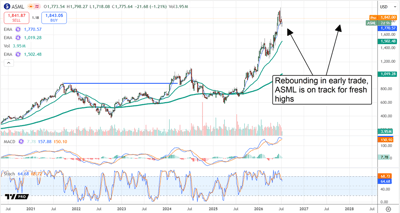
Stock price action following the earnings release told a mixed story. ASML jumped more than 3% in premarket trading before giving back the gains, though it held support near $1,775, coincident with the 30-day exponential moving average.
This suggests short-term buyers are active and defending support, but they have not yet taken decisive control. A move through the existing high near $2,000 is the key level to watch—clearing it would likely trigger fresh capital inflows. Assuming new highs are set, the next resistance target is in the $2,250 region.
ASML’s biggest risks are geopolitical. Restrictions, bans, and actions by China against Taiwan pose an existential threat and could disrupt the business. U.S. legislation currently under review could prevent the company from even servicing equipment already placed in China. Customer concentration is centered on Taiwanese manufacturers, including Taiwan Semiconductor (NASDAQ: TSM), as well as Intel (NASDAQ: INTC) and Samsung (OTCMKTS: SSNLF). Valuation is also a risk, as the stock is priced for perfection and flawless execution.
This email content is a paid advertisement provided by InvestorPlace, a third-party advertiser of MarketBeat. Why did I get this email?.
This ad is sent on behalf of InvestorPlace Media at 1125 N. Charles Street, Baltimore, Maryland 21201. If you're not interested in this opportunity, please click here.
If you need help with your newsletter, please contact our South Dakota based support team at contact@marketbeat.com.
If you would no longer like to receive promotional emails from MarketBeat advertisers, you can unsubscribe or manage your mailing preferences here.
© 2006-2026 MarketBeat Media, LLC. All rights reserved.
345 N Reid Place #620, Sioux Falls, SD 57103. USA..


